Solids, Liquids, and Gases Worksheet
A first-grade science worksheet to introduce and reinforce understanding of solids, liquids, and gases.
Includes
Standards
Topics
Solids, Liquids, and Gases
Name:
Date:
Score:
Read each question carefully and answer to the best of your ability.
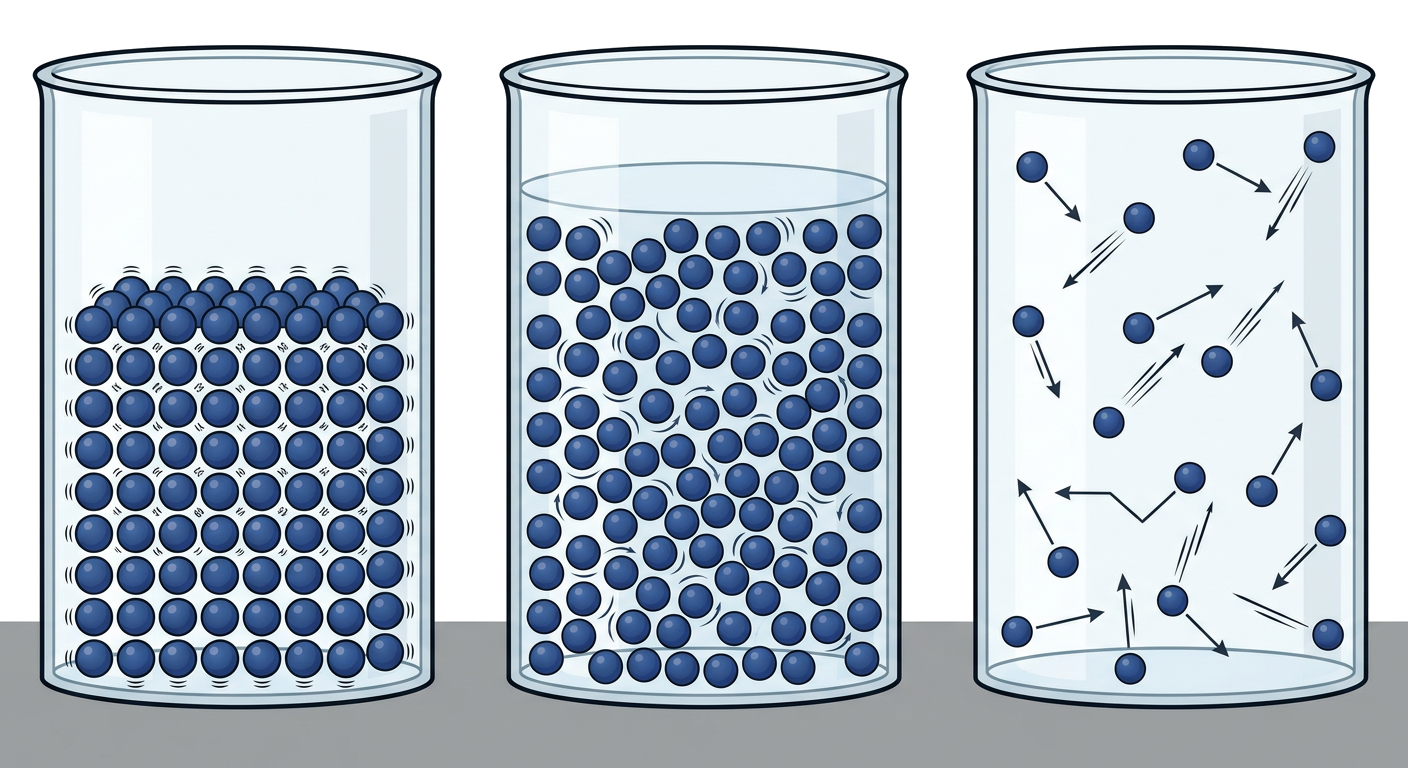
Everything around us is made of matter! Matter can be a solid, a liquid, or a gas.
Look at the picture below to see how particles are arranged in each state of matter.
1. Which of these is a solid?
Water
Air
Ice
Juice
2. Which of these takes the shape of its container?
Solid
Liquid
Gas
Both liquid and gas
3. A solid has its own and size.
4. We cannot always see a , but it is all around us.
5. When ice melts, it turns into a .
6. A balloon filled with air is an example of a solid.
True
False
7. You can pour a liquid, but you cannot pour a solid.
True
False
8. Give two examples of a solid.
9. Give two examples of a liquid.
Match the state of matter to its property.
10. Solid
a. Spreads out to fill its container
11. Liquid
b. Keeps its own shape
12. Gas
c. Has no fixed shape or size
Related Worksheets
My Science Lab Tools
A Grade 1 science worksheet introducing common laboratory equipment and their uses.
Physical and Chemical Properties
Explore the physical and chemical properties of matter with this engaging worksheet for first graders.
States of Matter Fun!
Explore the three main states of matter: solids, liquids, and gases, with this engaging worksheet for first graders.
Understanding Diffusion
A Grade 1 science worksheet to introduce the concept of diffusion through simple observations.
Atoms and Molecules Worksheet
An introductory science worksheet for Grade 1 on atoms and molecules, covering basic concepts and identification.
Physical Changes Fun!
Explore physical changes with this engaging worksheet for Grade 1. Learn about how things can change shape, size, or state without becoming a new kind of matter.
Solutions and Mixtures
Explore the basic concepts of solutions and mixtures with this engaging worksheet for first graders, featuring activities like identifying examples and understanding simple separations.
Introduction to Lab Equipment
Learn about common lab equipment used in science experiments at a first-grade level.