Cell Energy: Photosynthesis and Cellular Respiration
Explore the fundamental processes of photosynthesis and cellular respiration, how cells obtain and use energy, and the organelles involved.
Includes
Standards
Topics
Cell Energy: Photosynthesis and Cellular Respiration
Name:
Date:
Score:
Read each question carefully and provide your best answer. Some questions may require you to refer to diagrams or your knowledge of cell biology.
1. Which organelle is primarily responsible for photosynthesis in plant cells?
Mitochondrion
Chloroplast
Nucleus
Ribosome
2. The process of cellular respiration occurs in which two main stages (and associated locations) within eukaryotic cells?
Glycolysis (cytoplasm) and Krebs cycle (nucleus)
Light-dependent reactions (thylakoid) and Calvin cycle (stroma)
Glycolysis (cytoplasm) and oxidative phosphorylation (mitochondria)
Fermentation (mitochondria) and electron transport chain (cytoplasm)
3. The primary energy currency of the cell is .
4. Photosynthesis converts light energy into energy stored in glucose.
5. In the absence of oxygen, cells can undergo to produce a small amount of ATP.
Match the term on the left with its correct description on the right.
6. Chlorophyll
a. Site of cellular respiration
7. Mitochondrion
b. Green pigment that absorbs light energy
8. Stomata
c. Pores on plant leaves for gas exchange
9. Briefly explain the relationship between photosynthesis and cellular respiration in terms of energy flow and reactants/products.
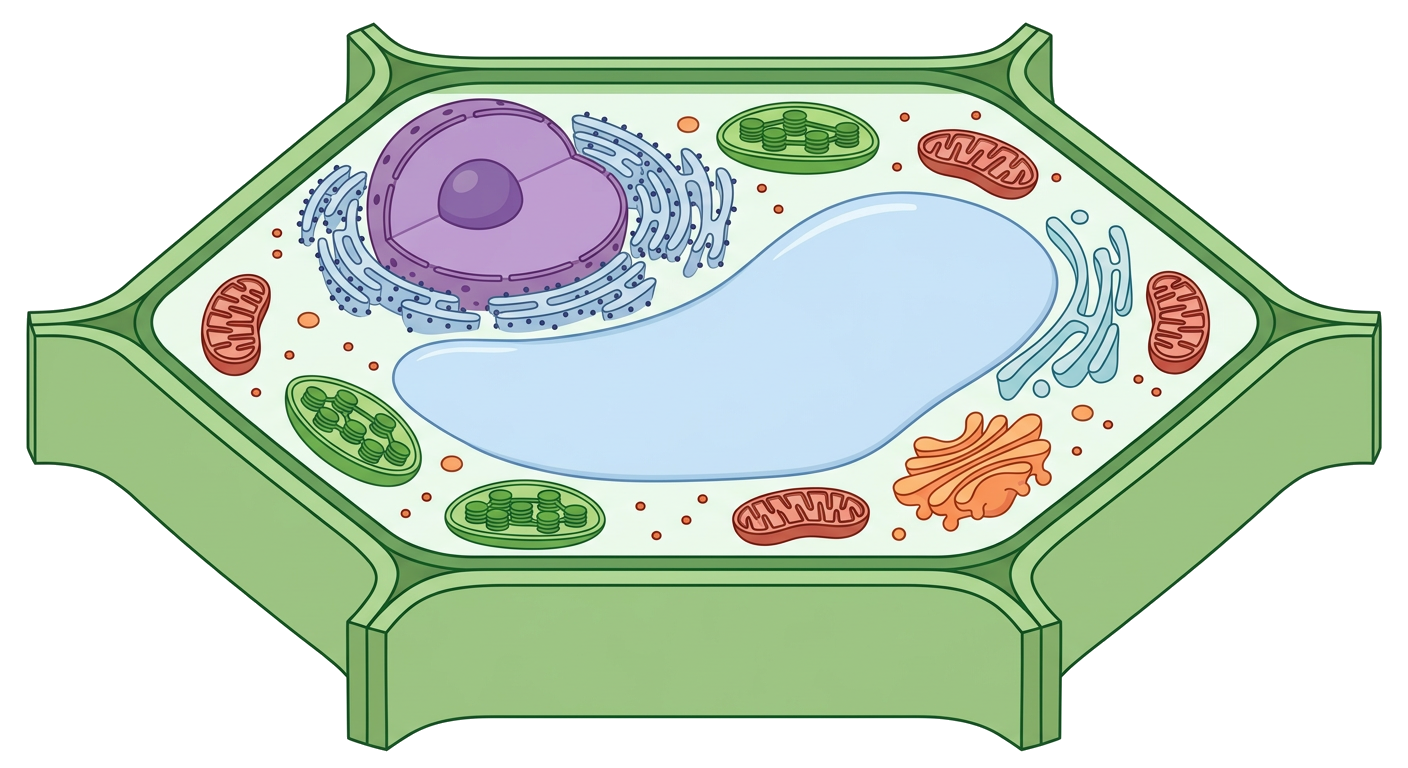
10. Observe the diagram of a plant cell below. Identify the organelle responsible for capturing light energy and converting it into chemical energy, and label it.
Related Worksheets
Phylogenetic Tree Worksheet
Explore the principles of phylogenetic trees, common ancestry, and evolutionary relationships among organisms.
Blood Sugar Regulation Worksheet
A Grade 10 science worksheet covering the regulation of blood sugar, including the roles of insulin, glucagon, and the pancreas.
Bacterial Transformation Worksheet
This worksheet covers key concepts in bacterial transformation, including the process, mechanisms, and applications.
Cell Environments Worksheet
Explore the principles of cell environments, including osmosis, diffusion, active transport, and their effects on plant and animal cells.
Bone Markings Worksheet
A Grade 10 Science worksheet focusing on the identification and function of various bone markings.
Properties of Carbon Worksheet
Explore the unique properties of carbon, its atomic structure, bonding capabilities, and its importance in organic chemistry and living organisms.
Human Skull Anatomy Worksheet
A Grade 10 science worksheet focusing on the anatomy and functions of the human skull, including its various bones and protective role.
Grade 10 Biology: Heart Structure Worksheet
A comprehensive worksheet for Grade 10 Biology students covering the structure and function of the human heart.