Energy Flow in Ecosystems
Explore the concepts of energy flow, food chains, food webs, and ecological pyramids in this Grade 10 Science worksheet.
Includes
Standards
Topics
Energy Flow in Ecosystems
Name:
Date:
Score:
Read each question carefully and answer to the best of your ability. Show all your work for calculations.
Match each organism to its correct trophic level in an ecosystem.
1. Grass
a. Primary Consumer
2. Rabbit
b. Producer
3. Snake
c. Secondary Consumer
4. Hawk
d. Tertiary Consumer
1. The ultimate source of energy for almost all ecosystems on Earth is the .
2. Organisms that produce their own food are called .
3. Only about percent of energy is transferred from one trophic level to the next.
4. Decomposers, such as bacteria and fungi, play a crucial role in recycling back into the ecosystem.
1. Which of the following best describes a food chain?
A network of interconnected food chains.
A single pathway of energy transfer.
The feeding relationships between all organisms in an ecosystem.
The process of photosynthesis.
2. If a producer has 10,000 units of energy, how much energy would typically be available to a secondary consumer in that ecosystem?
10,000 units
1,000 units
100 units
10 units
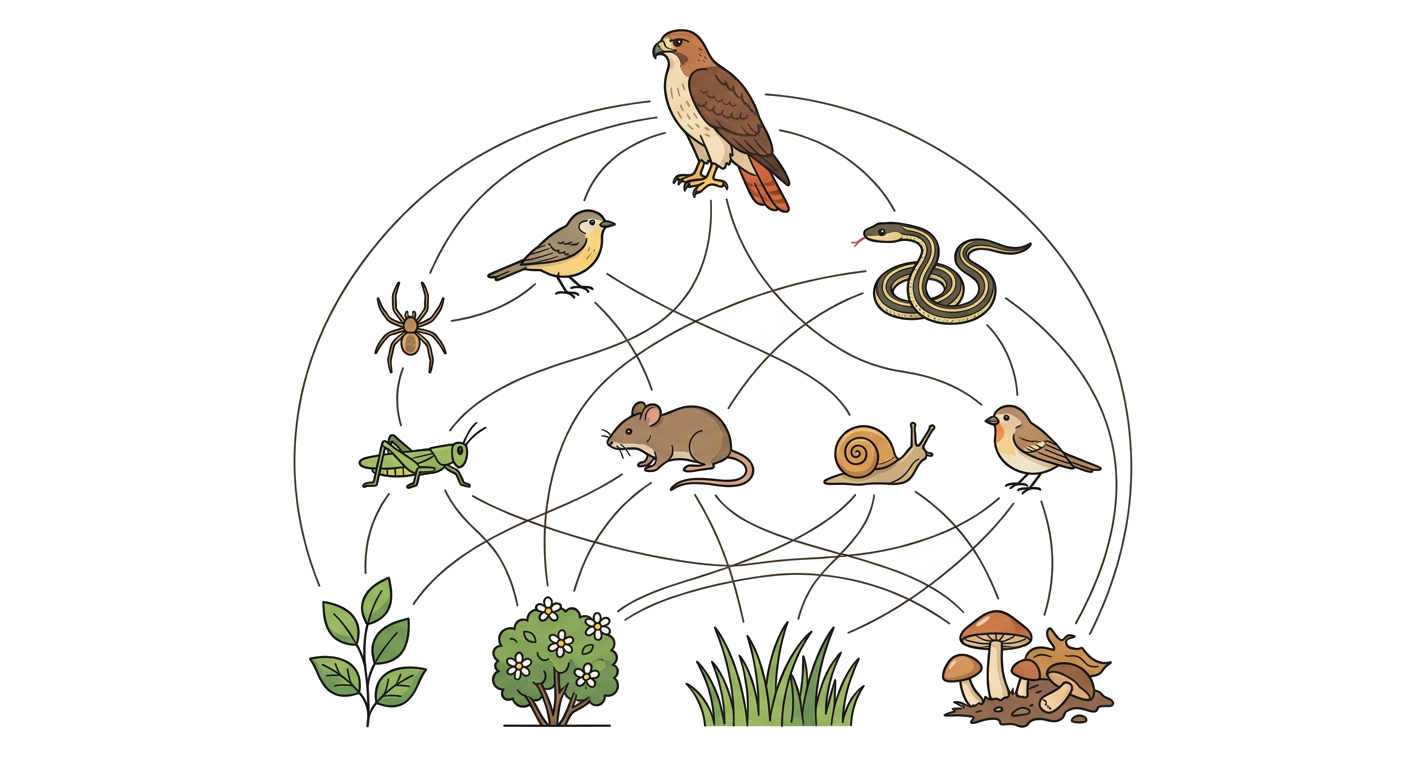
Observe the food web above and answer the following questions:
1. Identify two producers from the food web.
2. Name one organism that is both a primary and secondary consumer.
3. What would happen to the population of snakes if the hawk population decreased significantly?
1. Explain the difference between a food chain and a food web.
2. Describe the concept of an energy pyramid and why it is always upright.
1. Decomposers are at the top of every food chain.
True
False
2. Herbivores are primary consumers.
True
False
Related Worksheets
Phylogenetic Tree Worksheet
Explore the principles of phylogenetic trees, common ancestry, and evolutionary relationships among organisms.
Blood Sugar Regulation Worksheet
A Grade 10 science worksheet covering the regulation of blood sugar, including the roles of insulin, glucagon, and the pancreas.
Bacterial Transformation Worksheet
This worksheet covers key concepts in bacterial transformation, including the process, mechanisms, and applications.
Cell Environments Worksheet
Explore the principles of cell environments, including osmosis, diffusion, active transport, and their effects on plant and animal cells.
Bone Markings Worksheet
A Grade 10 Science worksheet focusing on the identification and function of various bone markings.
Properties of Carbon Worksheet
Explore the unique properties of carbon, its atomic structure, bonding capabilities, and its importance in organic chemistry and living organisms.
Human Skull Anatomy Worksheet
A Grade 10 science worksheet focusing on the anatomy and functions of the human skull, including its various bones and protective role.
Grade 10 Biology: Heart Structure Worksheet
A comprehensive worksheet for Grade 10 Biology students covering the structure and function of the human heart.