Fingerprint Analysis Worksheet
This worksheet covers the basics of fingerprint analysis, including patterns, types, and their importance in forensic science for Grade 10 students.
Includes
Standards
Topics
Fingerprint Analysis Worksheet
Name:
Date:
Score:
Read each question carefully and provide your best answer. For multiple-choice questions, circle the correct option. For fill-in-the-blanks, write your answer in the space provided. For short-answer questions, use complete sentences.
1. Which of the following fingerprint patterns is the most common?
Arch
Loop
Whorl
Accidental
2. What is the primary reason fingerprints are used in forensic science?
They are easily altered.
They are identical among siblings.
They are unique to each individual.
They change over a person's lifetime.
3. The study of fingerprints is known as .
4. Fingerprints are formed by friction ridges on the skin of the and .
5. A fingerprint that is not readily visible to the naked eye is called a print.
6. Briefly explain the difference between a latent print and a patent print.
7. Describe the three basic fingerprint patterns and provide a distinguishing characteristic for each.
Match each term with its correct definition.
8. Minutiae
a. Points on a fingerprint used for identification
9. AFIS
b. Automated Fingerprint Identification System
10. Dactyloscopy
c. The scientific study of fingerprints
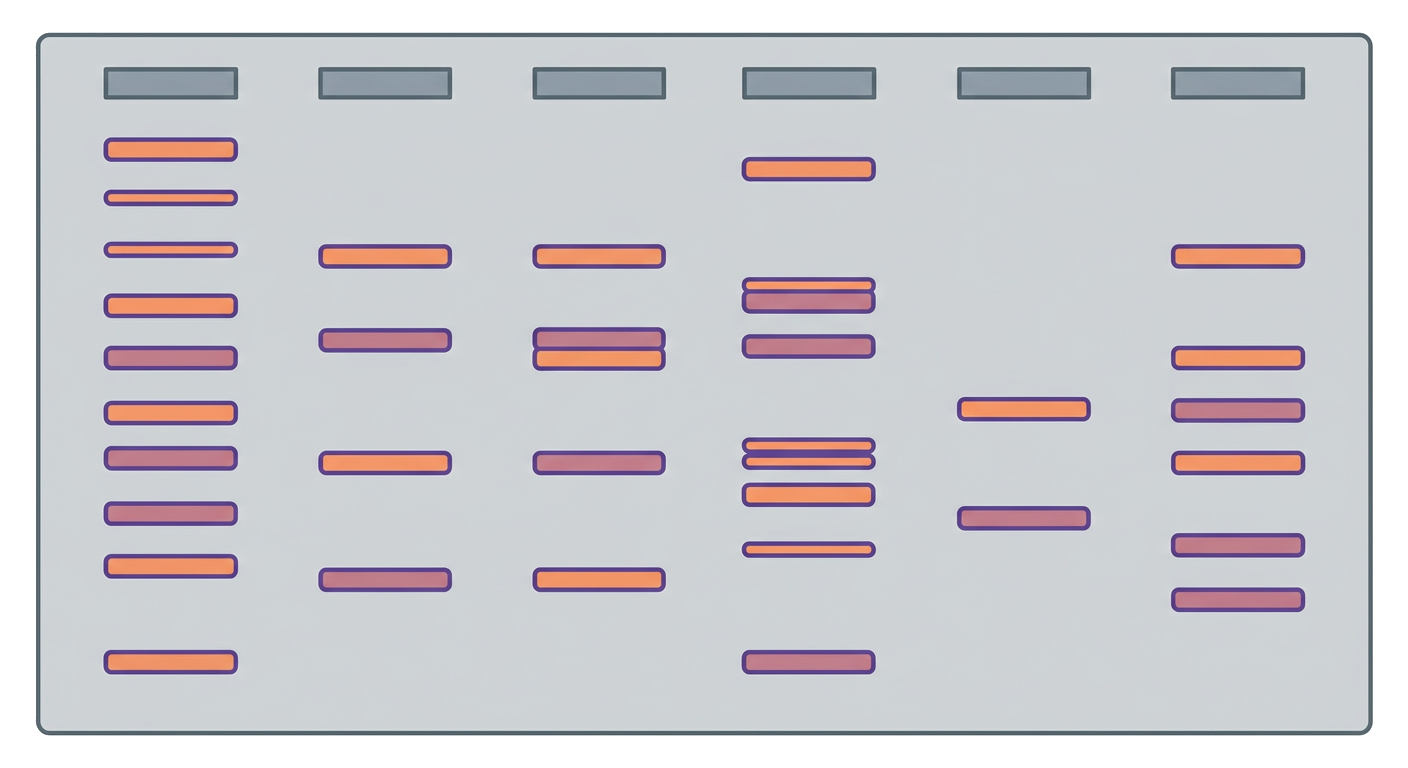
11. Observe the image below of a DNA fingerprinting gel. While this is not a traditional 'fingerprint' from a human finger, it uses a similar concept of unique patterns for identification. Explain how DNA fingerprinting is similar to and different from traditional fingerprinting in terms of identification principles.
Related Worksheets
Phylogenetic Tree Worksheet
Explore the principles of phylogenetic trees, common ancestry, and evolutionary relationships among organisms.
Blood Sugar Regulation Worksheet
A Grade 10 science worksheet covering the regulation of blood sugar, including the roles of insulin, glucagon, and the pancreas.
Bacterial Transformation Worksheet
This worksheet covers key concepts in bacterial transformation, including the process, mechanisms, and applications.
Cell Environments Worksheet
Explore the principles of cell environments, including osmosis, diffusion, active transport, and their effects on plant and animal cells.
Bone Markings Worksheet
A Grade 10 Science worksheet focusing on the identification and function of various bone markings.
Properties of Carbon Worksheet
Explore the unique properties of carbon, its atomic structure, bonding capabilities, and its importance in organic chemistry and living organisms.
Human Skull Anatomy Worksheet
A Grade 10 science worksheet focusing on the anatomy and functions of the human skull, including its various bones and protective role.
Grade 10 Biology: Heart Structure Worksheet
A comprehensive worksheet for Grade 10 Biology students covering the structure and function of the human heart.