Fossil Dating Worksheet
Explore the methods used to determine the age of fossils, including relative and absolute dating techniques, for Grade 10 Science students.
Includes
Standards
Topics
Fossil Dating: Uncovering Earth's History
Name:
Date:
Score:
Read each question carefully and answer to the best of your ability. This worksheet covers various aspects of fossil dating, including relative and absolute dating techniques.
1. Which dating method estimates the age of a fossil by comparing its position in rock layers to other fossils?
Radiometric dating
Carbon-14 dating
Relative dating
Absolute dating
2. The half-life of a radioactive isotope refers to the time it takes for:
All of the parent isotope to decay
Half of the parent isotope to decay
Half of the daughter isotope to form
The fossil to become radioactive
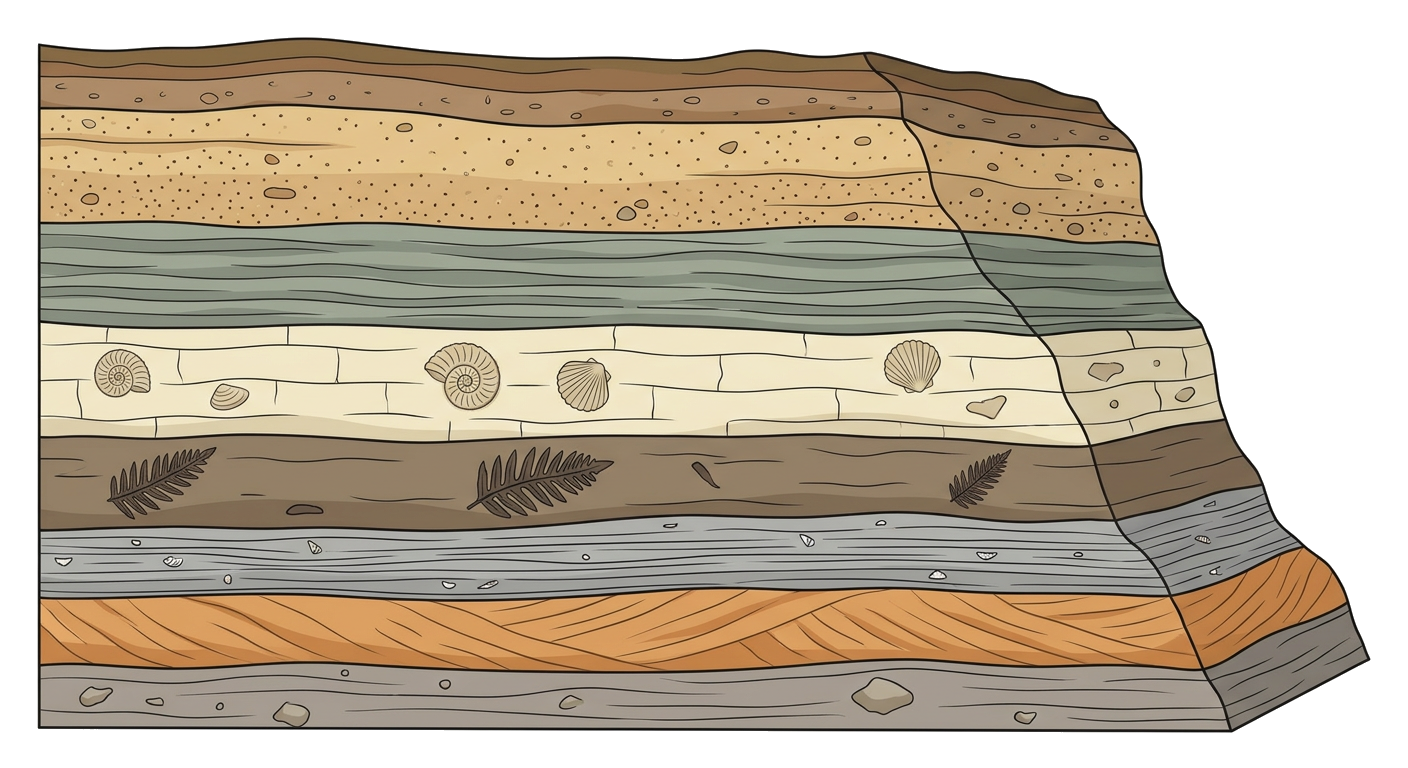
3. The principle of states that in an undisturbed rock sequence, the oldest layers are at the bottom and the youngest layers are at the top.
4. Carbon-14 dating is effective for dating fossils up to approximately years old.
5. Fossils that are geographically widespread and existed for a relatively short period are known as fossils.
6. Explain the difference between relative dating and absolute dating.
7. Describe how the principle of superposition is used in relative dating.
8. Absolute dating methods provide an exact numerical age for a fossil.
True
False
9. Index fossils are useful for relative dating because they lived for a very long time.
True
False
Match each term on the left with its definition on the right.
10. Half-life
a. The process of using radioactive decay to determine a fossil's age
11. Radiometric dating
b. The time it takes for half of a radioactive isotope to decay
12. Superposition
c. Principle stating that oldest rock layers are at the bottom
Related Worksheets
Phylogenetic Tree Worksheet
Explore the principles of phylogenetic trees, common ancestry, and evolutionary relationships among organisms.
Blood Sugar Regulation Worksheet
A Grade 10 science worksheet covering the regulation of blood sugar, including the roles of insulin, glucagon, and the pancreas.
Bacterial Transformation Worksheet
This worksheet covers key concepts in bacterial transformation, including the process, mechanisms, and applications.
Cell Environments Worksheet
Explore the principles of cell environments, including osmosis, diffusion, active transport, and their effects on plant and animal cells.
Bone Markings Worksheet
A Grade 10 Science worksheet focusing on the identification and function of various bone markings.
Properties of Carbon Worksheet
Explore the unique properties of carbon, its atomic structure, bonding capabilities, and its importance in organic chemistry and living organisms.
Human Skull Anatomy Worksheet
A Grade 10 science worksheet focusing on the anatomy and functions of the human skull, including its various bones and protective role.
Grade 10 Biology: Heart Structure Worksheet
A comprehensive worksheet for Grade 10 Biology students covering the structure and function of the human heart.