Punnett Squares Worksheet
Explore the principles of Mendelian genetics and predict offspring genotypes and phenotypes using Punnett squares.
Includes
Standards
Topics
Punnett Squares: Predicting Inheritance
Name:
Date:
Score:
Read each question carefully and answer to the best of your ability. Use Punnett squares to show your work where applicable. Remember that dominant alleles are represented by capital letters and recessive alleles by lowercase letters.
1. A is a diagram that is used to predict the genotypes of a particular cross or breeding experiment.
2. An organism with two identical alleles for a trait is said to be .
3. The observable physical properties of an organism are called its .
4. The genetic makeup of an organism, including all the alleles, is its .
5. If a homozygous dominant parent (AA) is crossed with a homozygous recessive parent (aa), what percentage of the offspring will be heterozygous (Aa)?
0%
25%
50%
100%
6. In pea plants, tall (T) is dominant over short (t). If a heterozygous tall pea plant (Tt) is crossed with another heterozygous tall pea plant (Tt), what is the expected phenotypic ratio of tall to short offspring?
1:1
2:1
3:1
4:0
7. In humans, brown eyes (B) are dominant over blue eyes (b). A brown-eyed man, whose mother had blue eyes, marries a blue-eyed woman. What are the possible genotypes and phenotypes of their children? Show your work using a Punnett square.
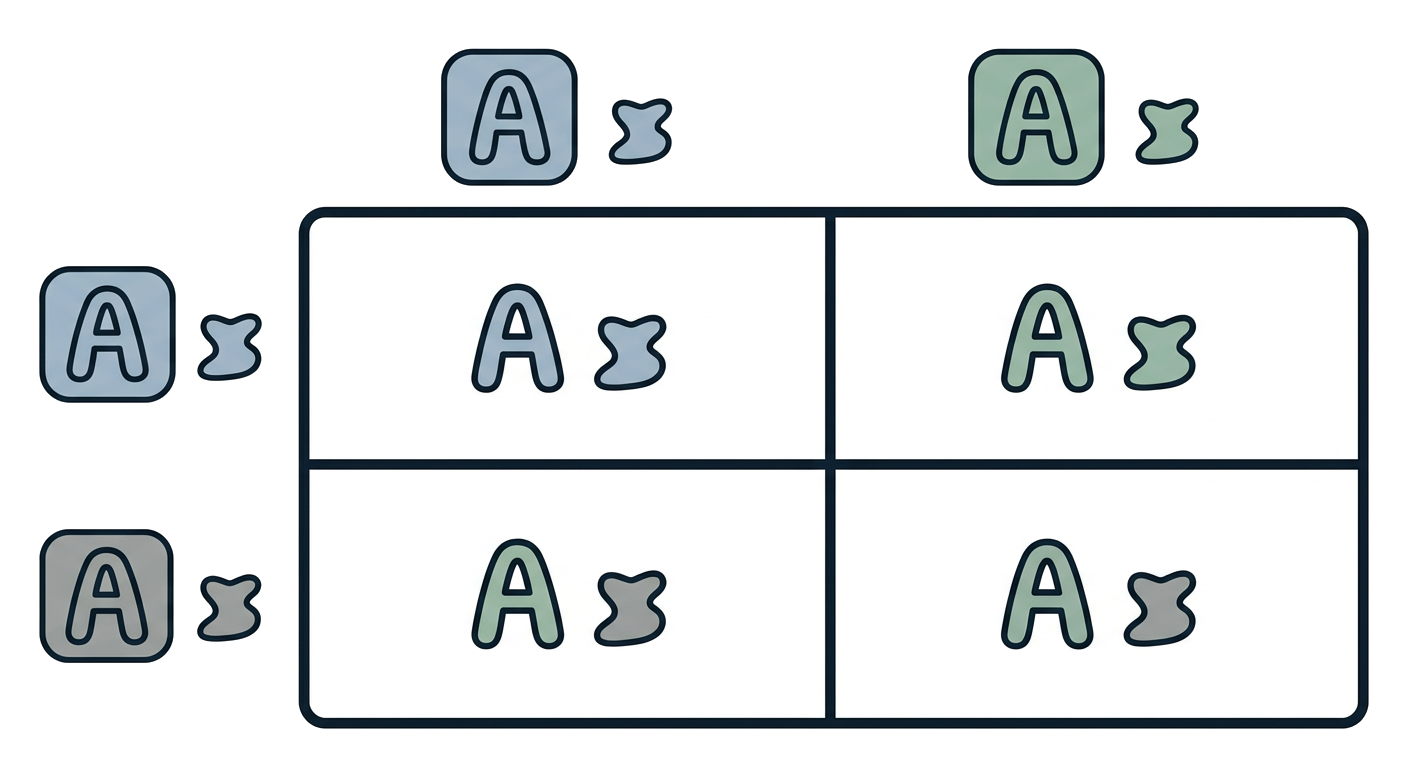
8. In guinea pigs, rough coat (R) is dominant over smooth coat (r). If a heterozygous rough-coated male is crossed with a smooth-coated female, what are the expected genotypic and phenotypic ratios of their offspring? Show your work using a Punnett square.
9. A Punnett square can predict the exact number of offspring with a certain genotype.
True
False
10. Incomplete dominance results in a blended phenotype in the heterozygous individual.
True
False
11. Explain the difference between genotype and phenotype. Provide an example for each using a genetic trait.
12. Describe a scenario where a Punnett square would be useful in real-world applications, beyond basic genetics problems. What information could it provide?
Related Worksheets
Phylogenetic Tree Worksheet
Explore the principles of phylogenetic trees, common ancestry, and evolutionary relationships among organisms.
Blood Sugar Regulation Worksheet
A Grade 10 science worksheet covering the regulation of blood sugar, including the roles of insulin, glucagon, and the pancreas.
Bacterial Transformation Worksheet
This worksheet covers key concepts in bacterial transformation, including the process, mechanisms, and applications.
Cell Environments Worksheet
Explore the principles of cell environments, including osmosis, diffusion, active transport, and their effects on plant and animal cells.
Bone Markings Worksheet
A Grade 10 Science worksheet focusing on the identification and function of various bone markings.
Properties of Carbon Worksheet
Explore the unique properties of carbon, its atomic structure, bonding capabilities, and its importance in organic chemistry and living organisms.
Human Skull Anatomy Worksheet
A Grade 10 science worksheet focusing on the anatomy and functions of the human skull, including its various bones and protective role.
Grade 10 Biology: Heart Structure Worksheet
A comprehensive worksheet for Grade 10 Biology students covering the structure and function of the human heart.