Standard Plate Count Worksheet
This worksheet assesses understanding of the Standard Plate Count method, including its principles, procedure, calculations, and applications in microbiology.
Includes
Standards
Topics
Standard Plate Count
Name:
Date:
Score:
Read each question carefully and answer to the best of your ability. Show all calculations where applicable.
1. What is the primary purpose of performing a Standard Plate Count?
To identify specific types of bacteria.
To determine the total viable bacterial population in a sample.
To measure the metabolic activity of microorganisms.
To sterilize laboratory equipment.
2. Which of the following is crucial for obtaining accurate results in a Standard Plate Count?
Using a sterile technique during dilutions and plating.
Incubating plates at very high temperatures.
Using only tap water for dilutions.
Counting colonies immediately after plating.
3. The acceptable range for colony counting on a plate is typically between and colonies.
4. Serial dilutions are performed to the concentration of microorganisms in a sample, making it easier to count individual colonies.
5. CFU stands for , which represents the number of viable bacterial cells in a sample.
6. Describe the process of performing a pour plate technique in the Standard Plate Count method.
7. A student performs a Standard Plate Count on a water sample. They dilute the sample by a factor of 10^-4. They then plate 0.1 mL of this diluted sample onto an agar plate. After incubation, they count 75 colonies. Calculate the original concentration of bacteria in the water sample (CFU/mL). Show your work.
8. All microorganisms present in a sample will grow and form colonies on the agar plate in a Standard Plate Count.
True
False
9. Aseptic technique is not necessary when handling environmental samples for Standard Plate Count.
True
False
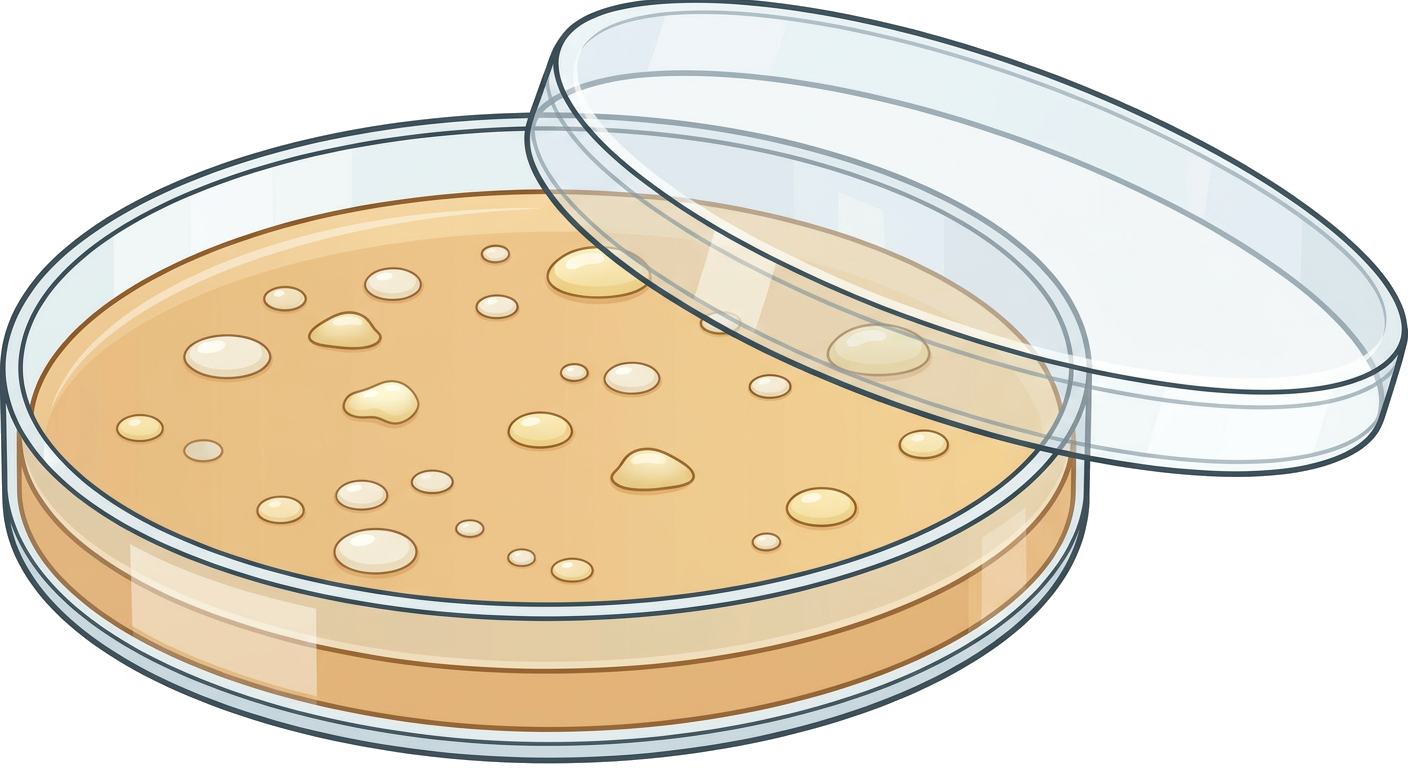
10. Observe the petri dish below. If this plate was inoculated with 1 mL of a 10^-3 dilution of a bacterial sample, what is the approximate CFU/mL of the original sample? (Assume each dot represents a colony).
Related Worksheets
Phylogenetic Tree Worksheet
Explore the principles of phylogenetic trees, common ancestry, and evolutionary relationships among organisms.
Blood Sugar Regulation Worksheet
A Grade 10 science worksheet covering the regulation of blood sugar, including the roles of insulin, glucagon, and the pancreas.
Bacterial Transformation Worksheet
This worksheet covers key concepts in bacterial transformation, including the process, mechanisms, and applications.
Cell Environments Worksheet
Explore the principles of cell environments, including osmosis, diffusion, active transport, and their effects on plant and animal cells.
Bone Markings Worksheet
A Grade 10 Science worksheet focusing on the identification and function of various bone markings.
Properties of Carbon Worksheet
Explore the unique properties of carbon, its atomic structure, bonding capabilities, and its importance in organic chemistry and living organisms.
Human Skull Anatomy Worksheet
A Grade 10 science worksheet focusing on the anatomy and functions of the human skull, including its various bones and protective role.
Grade 10 Biology: Heart Structure Worksheet
A comprehensive worksheet for Grade 10 Biology students covering the structure and function of the human heart.