Covalent Formulas Worksheet
A Grade 10 chemistry worksheet focusing on understanding and writing covalent formulas, including Lewis structures and molecular geometry.
Includes
Standards
Topics
Covalent Formulas Worksheet
Name:
Date:
Score:
Read each question carefully and provide your best answer. Show all your work for calculations and drawing structures.
1. Which of the following elements is most likely to form a covalent bond with another nonmetal?
Sodium (Na)
Calcium (Ca)
Carbon (C)
Iron (Fe)
2. What type of bond is formed when atoms share electrons?
Ionic bond
Metallic bond
Covalent bond
Hydrogen bond
1. In a covalent bond, electrons are transferred from one atom to another.
True
False
2. The molecule H₂O is an example of a covalent compound.
True
False
1. A covalent bond is formed between two atoms.
2. In a single covalent bond, pair(s) of electrons are shared.
3. The ability of an atom to attract electrons in a chemical bond is called .
1. Draw the Lewis structure for carbon dioxide (CO₂).
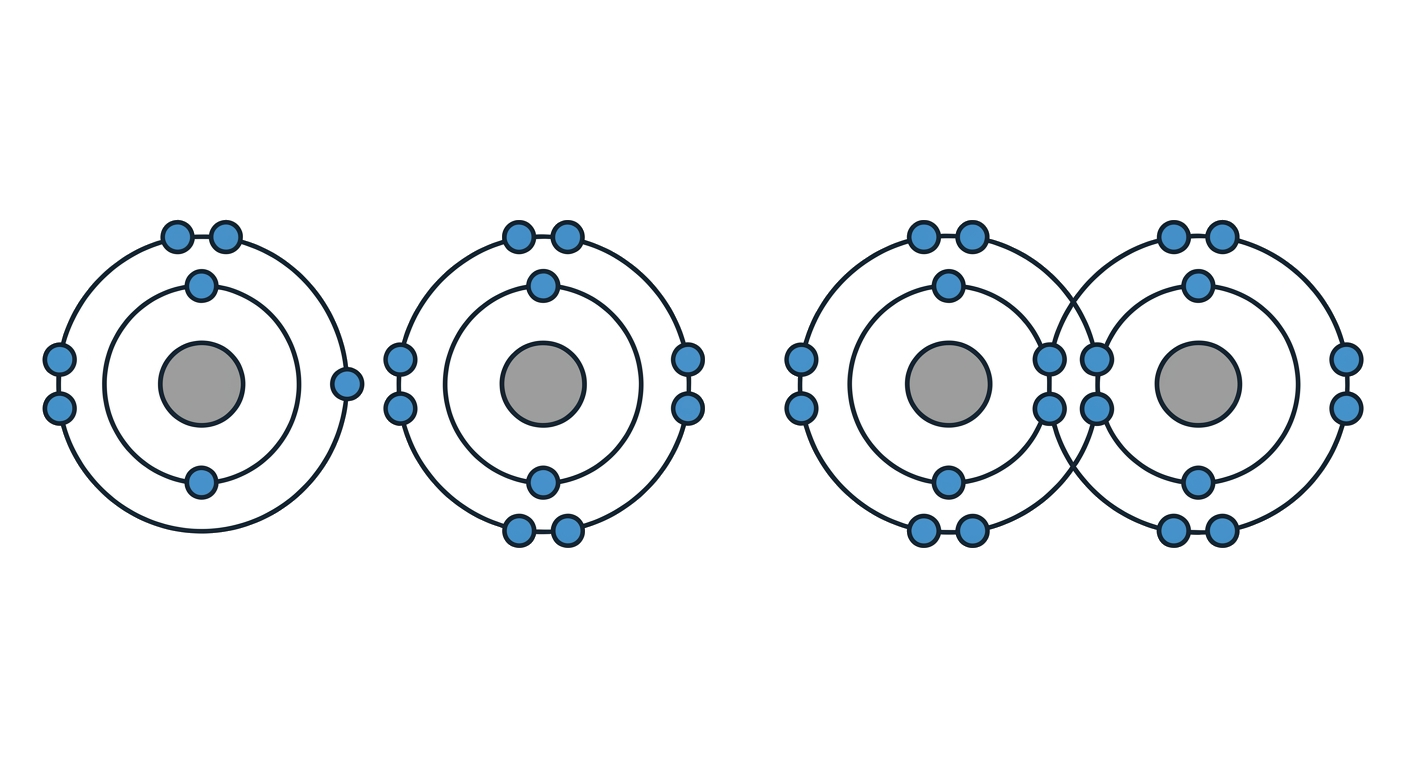
2. Explain the difference between a polar and a nonpolar covalent bond.
Match the term on the left with its definition on the right.
1. Octet Rule
a. A bond where electrons are shared unequally
2. Polar Covalent Bond
b. Atoms tend to gain, lose, or share electrons to achieve eight valence electrons
3. Nonpolar Covalent Bond
c. A bond where electrons are shared equally
Related Worksheets
Ions and Formula Units Worksheet
Explore the formation of ions, ionic bonds, and the naming and writing of chemical formulas for ionic compounds at a Grade 10 level.
Actual Yield in Chemical Reactions
Explore the concept of actual yield, theoretical yield, and percentage yield in chemical reactions with this Grade 10 chemistry worksheet.
Exploring Salts: Properties and Reactions
This worksheet covers the properties, formation, and uses of various salts, including their role in everyday life and chemical reactions.
Relative Mass Worksheet
Explore the concepts of relative atomic mass, relative molecular mass, and isotopic abundance in this Grade 10 chemistry worksheet.
Solubility Curves Worksheet
This worksheet explores solubility curves, their interpretation, and how they represent the relationship between temperature and the solubility of substances.
Predicting Products of Chemical Reactions
Grade 10 Science worksheet focusing on predicting the products of various types of chemical reactions, including synthesis, decomposition, single displacement, double displacement, and combustion.
Band of Stability Worksheet
Explore the concept of the band of stability, nuclear forces, and radioactive decay with this Grade 10 chemistry worksheet.
Electron Dot Diagrams Worksheet
A Grade 10 Science worksheet covering electron dot diagrams, valence electrons, and their importance in chemical bonding.