Ionic Bonds Worksheet
Explore the formation, characteristics, and properties of ionic bonds with this comprehensive worksheet for Grade 10 Chemistry students.
Includes
Standards
Topics
Ionic Bonds Worksheet
Name:
Date:
Score:
Read each question carefully and provide your best answer. Show all your work for calculations.
1. Which of the following best describes an ionic bond?
Sharing of electrons between two nonmetals
Transfer of electrons from a metal to a nonmetal
Attraction between two oppositely charged ions in a solution
Formation of a sea of delocalized electrons
2. Which pair of elements is most likely to form an ionic bond?
Carbon and Oxygen
Hydrogen and Chlorine
Sodium and Chlorine
Nitrogen and Nitrogen
3. In an ionic bond, electrons are from one atom to another.
4. The force of attraction between oppositely charged ions is called an force.
5. Metals tend to electrons to form positive ions called .
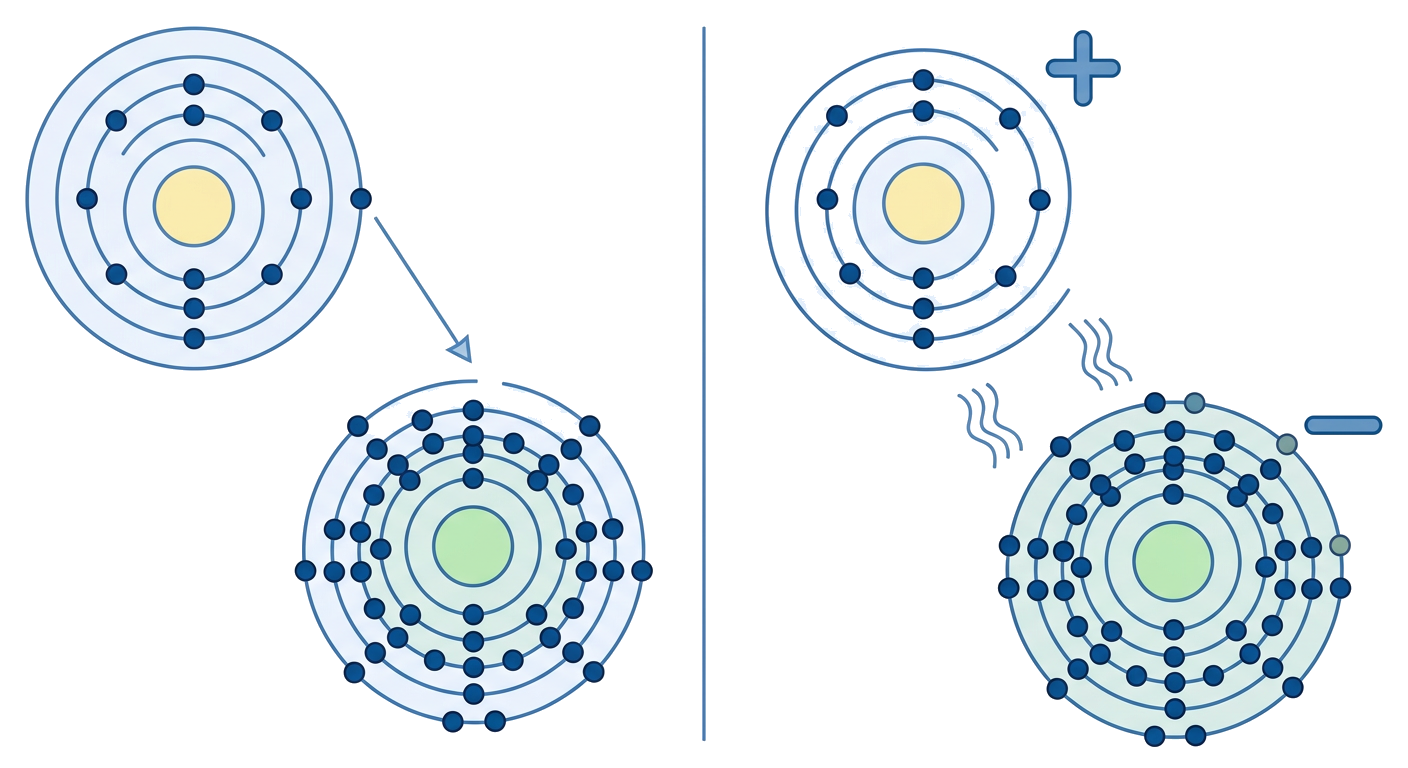
6. Describe the process of ionic bond formation between Sodium (Na) and Chlorine (Cl) atoms. Include the electron configuration changes and the resulting ions.
7. Explain why ionic compounds typically have high melting and boiling points.
8. Ionic compounds are generally good conductors of electricity in their solid state.
True
False
9. The electronegativity difference between two atoms forming an ionic bond is typically small.
True
False
Match each term on the left with its correct definition on the right.
10. Cation
a. A negatively charged ion
11. Anion
b. A positively charged ion
12. Octet Rule
c. Atoms gain, lose, or share electrons to achieve a stable electron configuration with eight valence electrons