Actual Yield in Chemical Reactions
Explore the concept of actual yield, theoretical yield, and percentage yield in chemical reactions with this Grade 10 chemistry worksheet.
Includes
Standards
Topics
Actual Yield in Chemical Reactions
Name:
Date:
Score:
Read each question carefully and provide your answers in the space provided. Show all your work for calculation problems.
1. The amount of product actually obtained from a chemical reaction is called the .
2. The maximum amount of product that can be formed from given amounts of reactants is the .
3. The ratio of actual yield to theoretical yield, multiplied by 100, is known as the .
1. Why is the actual yield almost always less than the theoretical yield?
Reactants are always consumed completely.
Some product is lost during purification or transfer.
Side reactions consume all of the limiting reactant.
The balanced chemical equation is incorrect.
2. A chemist synthesized 5.0 g of a compound, but calculations predicted a theoretical yield of 6.2 g. What is the percentage yield?
19.4%
80.6%
124%
Cannot be determined.
1. In an experiment, 2.5 moles of hydrogen gas react with excess oxygen gas to produce water. The balanced equation is 2H₂(g) + O₂(g) → 2H₂O(l). If the actual yield of water is 40.0 g, calculate the theoretical yield of water in grams. Then calculate the percentage yield for the reaction. (Molar mass of H₂O = 18.02 g/mol)
2. Explain two common reasons why the actual yield of a chemical reaction might be lower than the theoretical yield.
1. A percentage yield greater than 100% is impossible under normal experimental conditions.
True
False
2. The theoretical yield is determined by performing the experiment in a laboratory.
True
False
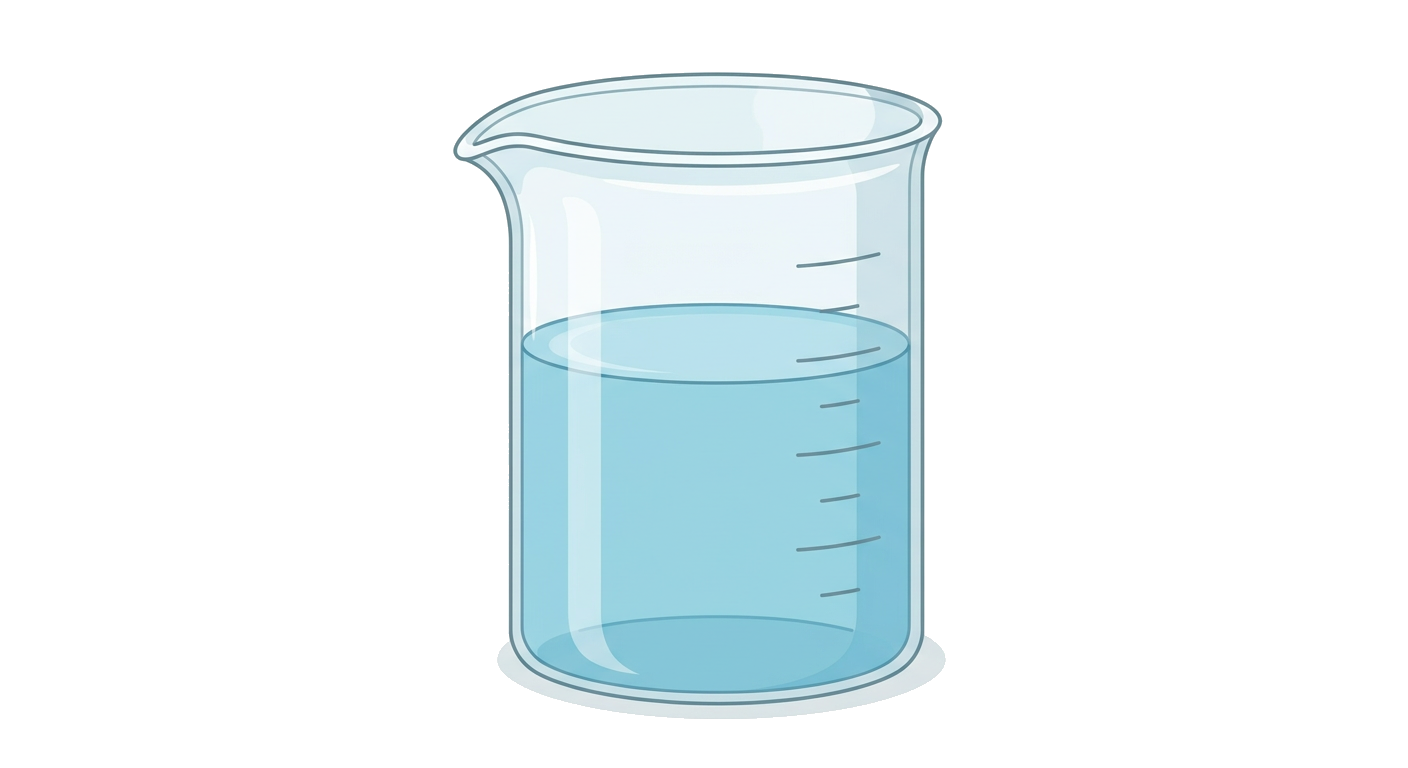
3. Consider an experiment where a precipitate is formed in a beaker. In the image below, a beaker is shown. Imagine you are trying to collect the precipitate from this beaker. What are some steps you would take to maximize your actual yield?