Avogadro's Number Worksheet
This worksheet covers Avogadro's Number, its definition, significance, and applications in calculating moles, mass, and number of particles for Grade 10 Chemistry students.
Includes
Standards
Topics
Avogadro's Number Worksheet
Name:
Date:
Score:
Read each question carefully and answer to the best of your ability. Show all your work for calculations.
1. Avogadro's number is approximately particles per mole.
2. A mole is defined as the amount of substance that contains as many elementary entities as there are atoms in exactly 12 grams of -12.
3. The molar mass of a substance is numerically equal to its atomic or molecular mass expressed in per mole.
1. Which of the following represents Avogadro's number?
6.022 x 10^22
6.022 x 10^23
1.000 x 10^23
1.000 x 10^22
2. How many atoms are present in 2 moles of Helium (He)?
6.022 x 10^23 atoms
1.2044 x 10^24 atoms
3.011 x 10^23 atoms
1.2044 x 10^23 atoms
1. Avogadro's number is used to convert between moles and the number of particles.
True
False
2. The molar mass of a compound is the sum of the atomic masses of all atoms in the compound.
True
False
1. Calculate the number of moles in 45.0 grams of water (H₂O). (Atomic masses: H=1.01 g/mol, O=16.00 g/mol)
2. How many molecules are in 0.5 moles of oxygen gas (O₂)?
Observe the image of a water molecule below and answer the following question:
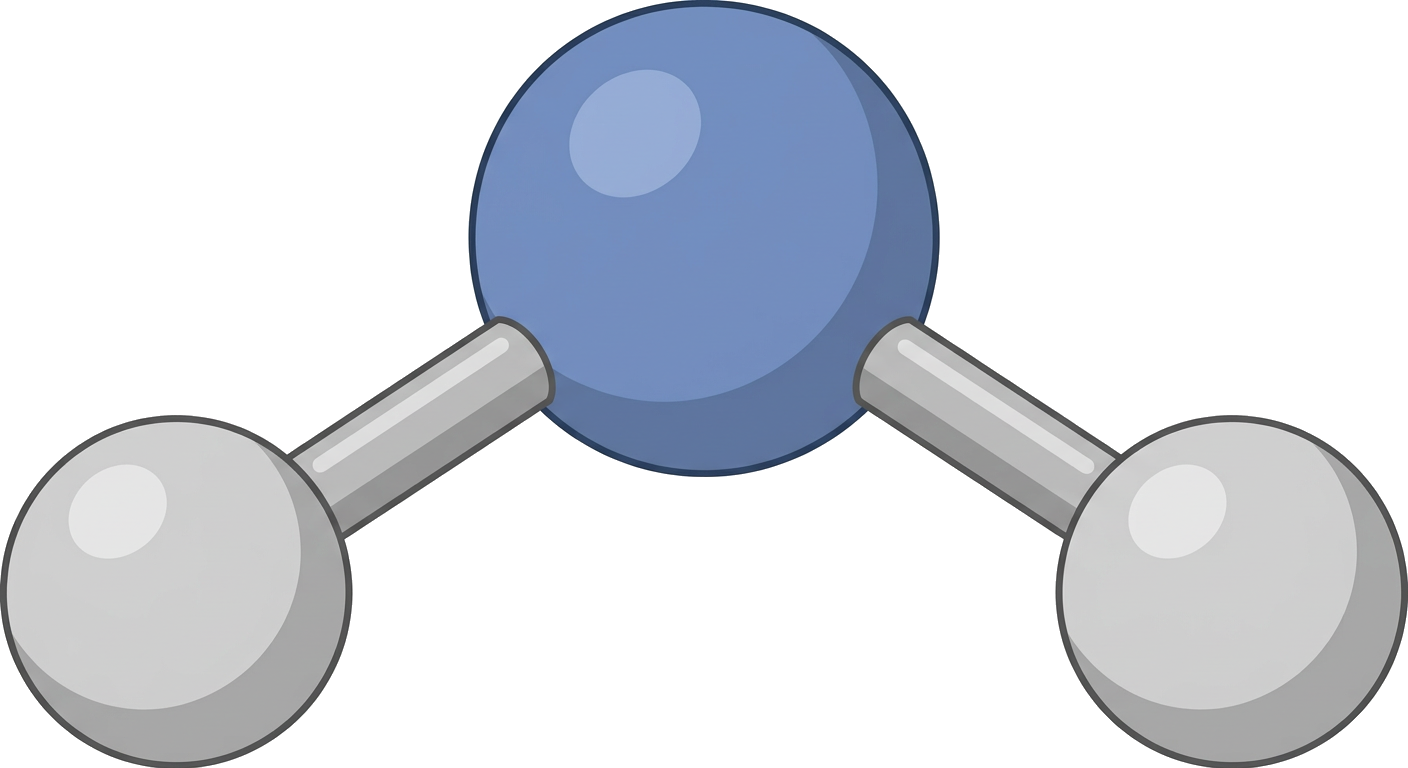
If you have 3 moles of water, how many hydrogen atoms are present?