Grade 10 Chemistry: Chemical Bonding
A worksheet covering the fundamentals of chemical bonding, including ionic, covalent, and metallic bonds, suitable for Grade 10 science students.
Includes
Standards
Topics
Grade 10 Chemistry: Chemical Bonding
Name:
Date:
Score:
Read each question carefully and provide your best answer. Show all work for calculations.
1. Which type of bond involves the transfer of electrons between atoms?
Covalent bond
Ionic bond
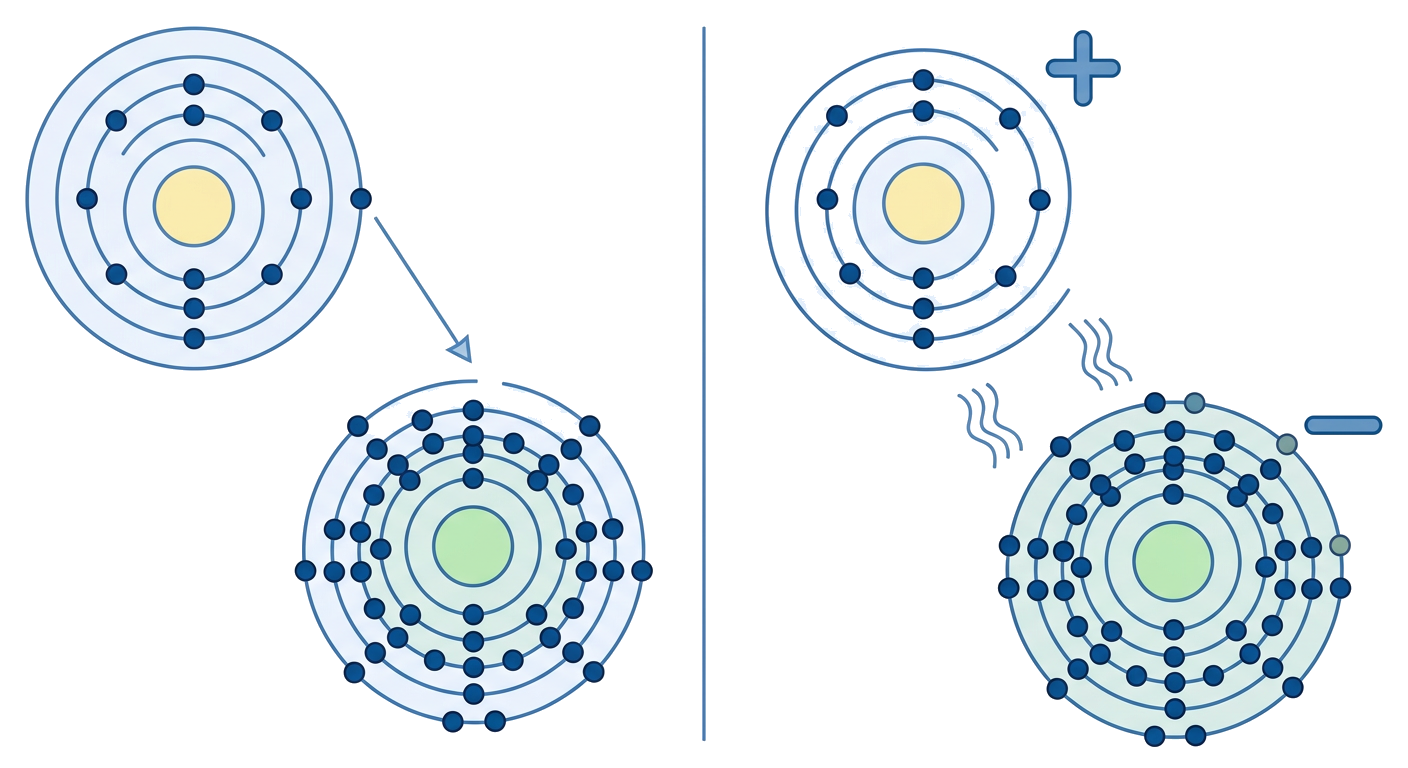
Metallic bond
Hydrogen bond
2. What is the octet rule?
Atoms share 8 electrons.
Atoms gain or lose 8 protons.
Atoms tend to achieve a stable electron configuration with 8 valence electrons.
Atoms always have 8 neutrons.
3. In an ionic bond, a metal atom typically electrons and becomes a positive ion, while a nonmetal atom electrons and becomes a negative ion.
4. Covalent bonds are formed when atoms electrons.
5. The ability of an atom to attract electrons in a chemical bond is called .
6. All compounds formed between two nonmetals are covalent.
True
False
7. Metallic bonds involve a 'sea' of delocalized electrons.
True
False
8. Describe the main difference between a polar covalent bond and a nonpolar covalent bond.
9. Explain why ionic compounds typically have high melting points.
Match each term with its correct definition.
10. Electronegativity
a. Positively charged ion
11. Cation
b. Negatively charged ion
12. Anion
c. The ability of an atom to attract electrons in a chemical bond
13. Observe the diagram below showing the formation of an ionic bond. Identify the metal and nonmetal atoms involved, and describe the electron transfer.