Calorimetry Principles and Applications
Explore the fundamental principles of calorimetry, its components, and practical applications in measuring heat changes in chemical and physical processes.
Includes
Standards
Topics
Calorimetry Principles and Applications
Name:
Date:
Score:
Read each question carefully and answer to the best of your ability. Show all work for calculations.
1. What is the primary purpose of a calorimeter?
To measure temperature changes only
To measure the rate of a chemical reaction
To measure the heat absorbed or released in a process
To determine the concentration of a solution
2. Which of the following is a key characteristic of an ideal calorimeter?
It allows significant heat exchange with the surroundings.
It has a low heat capacity.
It is perfectly insulated.
It is made of highly conductive materials.
3. A calorimeter works on the principle of conservation of .
4. The specific heat capacity of water is approximately J/g°C.
5. In a bomb calorimeter, the reaction occurs at a constant .
6. Describe the main components of a simple coffee-cup calorimeter and explain the function of each component.
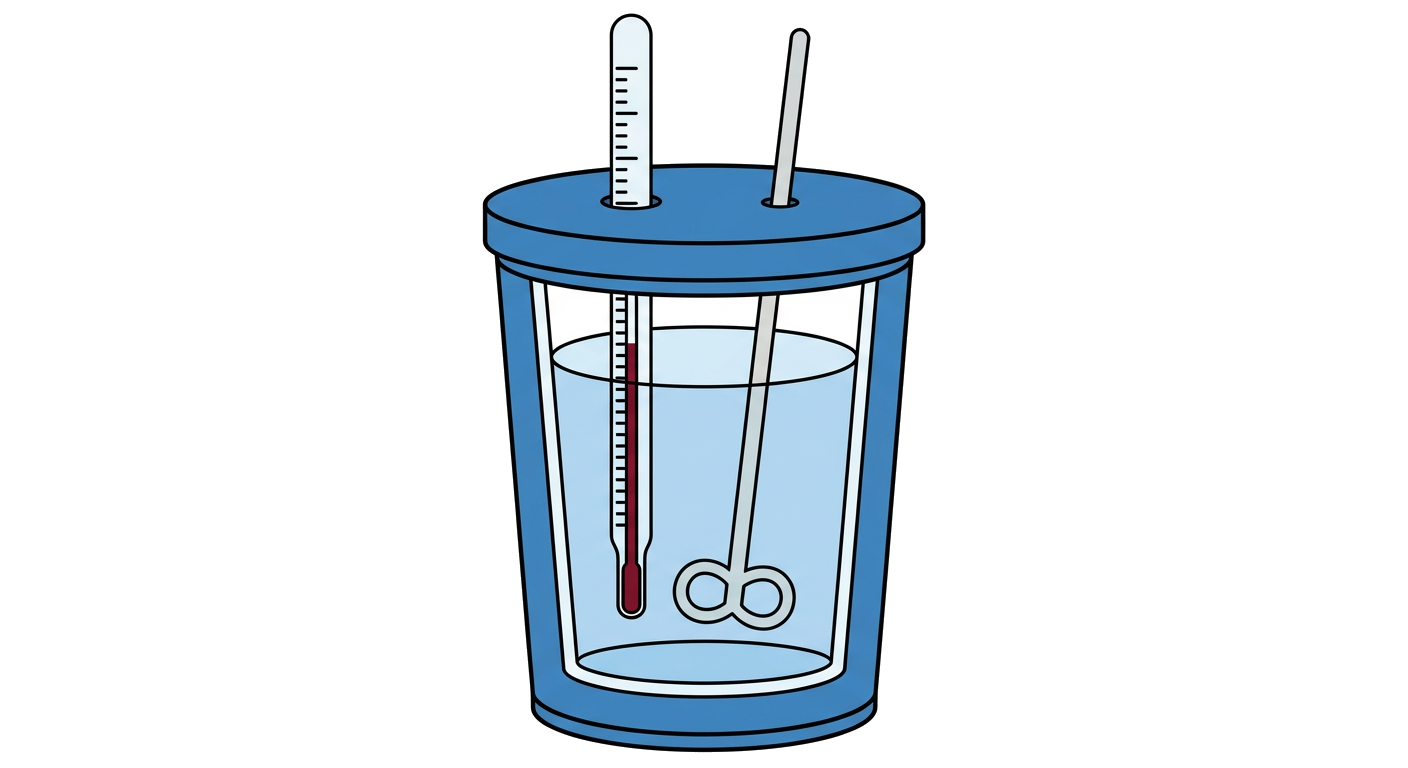
7. Explain the difference between an exothermic and an endothermic reaction in terms of heat flow and temperature change observed in a calorimeter.
8. The heat capacity of a calorimeter refers to the amount of heat required to raise its temperature by one degree Celsius.
True
False
9. In an isolated system, the total amount of energy remains constant.
True
False
10. A 10.0 g sample of an unknown metal at 100.0 °C is placed into a coffee-cup calorimeter containing 50.0 g of water at 22.0 °C. The final temperature of the water and metal is 25.3 °C. Assuming no heat loss to the surroundings and that the specific heat capacity of water is 4.18 J/g°C, calculate the specific heat capacity of the unknown metal.