Calorimetry Principles
This worksheet covers fundamental concepts of calorimetry, including specific heat capacity, heat transfer, and calculations involving temperature changes and energy.
Includes
Standards
Topics
Calorimetry Principles Worksheet
Name:
Date:
Score:
Read each question carefully and answer to the best of your ability. Show all calculations for problems requiring numerical answers.
1. Calorimetry is the science of measuring the change in of chemical reactions or physical changes.
2. The specific heat capacity (c) of a substance is the amount of required to raise the temperature of 1 gram of the substance by 1 degree Celsius.
3. In an isolated system, the total amount of energy .
1. Which of the following equations is used to calculate the heat absorbed or released by a substance?
q = m/cΔT
q = mcΔT
q = mΔT/c
q = cΔT/m
2. A substance with a high specific heat capacity will:
Heat up quickly
Cool down quickly
Resist changes in temperature
Have a low melting point
1. A 25.0 g sample of a metal is heated to 100.0 °C and then placed in a calorimeter containing 50.0 g of water at 22.0 °C. The final temperature of the water and metal is 28.5 °C. Calculate the specific heat capacity of the metal. (Specific heat capacity of water = 4.18 J/g°C)
2. Explain the principle of conservation of energy as it applies to calorimetry.
1. An exothermic reaction releases heat to its surroundings.
True
False
2. A bomb calorimeter measures reactions at constant pressure.
True
False
Observe the diagram of a simple calorimeter below and answer the question.
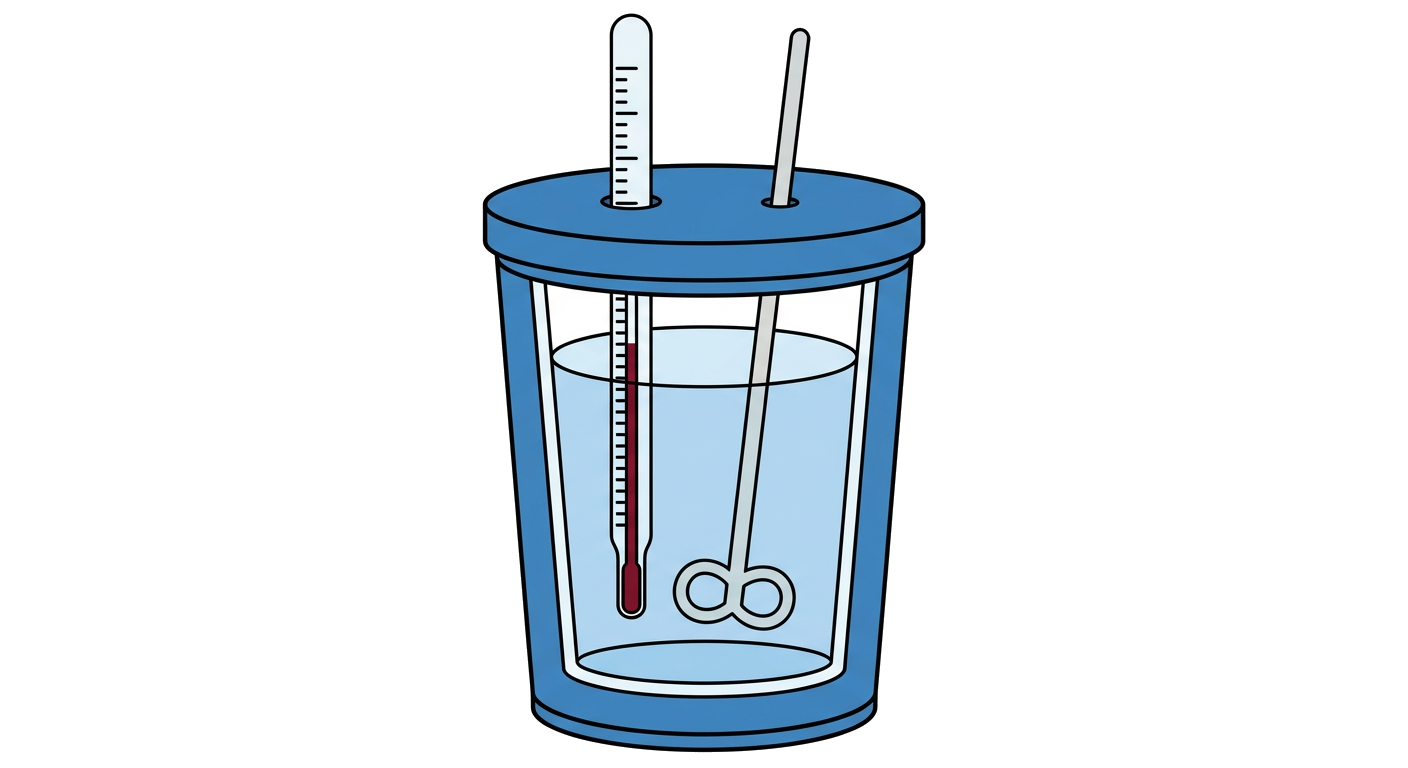
1. Briefly describe the function of the stirrer and the thermometer in the calorimeter shown above.