Covalent Compounds Worksheet
This worksheet covers the basics of covalent compounds, including their formation, properties, and naming conventions for Grade 10 Science students.
Includes
Standards
Topics
Covalent Compounds Worksheet
Name:
Date:
Score:
Read each question carefully and answer to the best of your ability. Show all your work where applicable.
1. Which of the following best describes a covalent bond?
Transfer of electrons between atoms
Sharing of electrons between atoms
Attraction between oppositely charged ions
Formation of a metallic lattice
2. Which pair of elements is most likely to form a covalent bond?
Sodium and Chlorine
Magnesium and Oxygen
Carbon and Oxygen
Potassium and Fluorine
3. Covalent bonds typically form between two atoms.
4. In a covalent bond, electrons are between atoms to achieve a stable electron configuration.
5. A molecule where electrons are shared unequally is called a covalent molecule.
6. Covalent compounds generally have high melting and boiling points.
True
False
7. Water (H2O) is an example of a polar covalent compound.
True
False
8. Describe the main difference between an ionic bond and a covalent bond. You may refer to the diagram below.
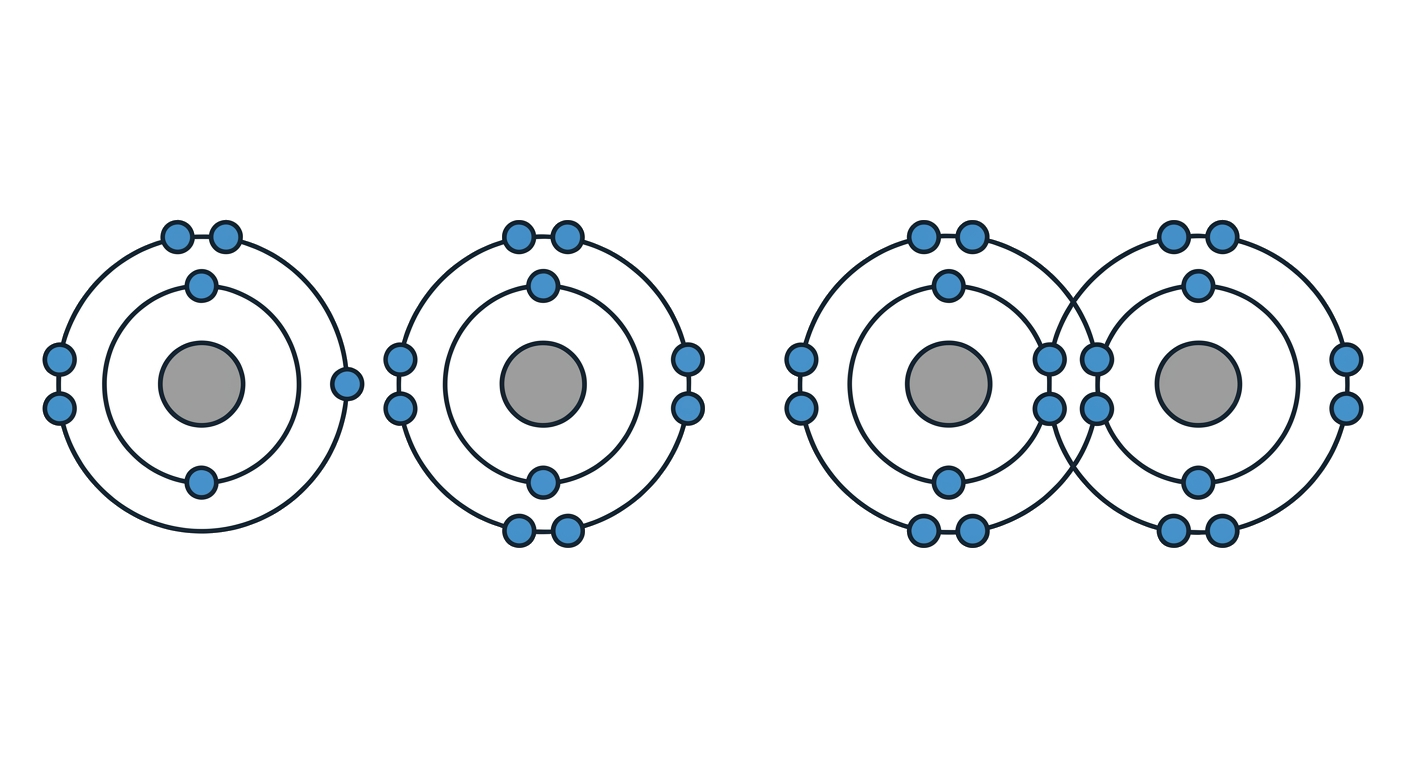
9. Explain why covalent compounds generally do not conduct electricity.
Match the term on the left with its definition on the right.
10. Molecule
a. A bond formed by the unequal sharing of electrons
11. Nonpolar covalent bond
b. A neutral group of atoms held together by covalent bonds
12. Polar covalent bond
c. A bond formed by the equal sharing of electrons