Electron Configuration Worksheet
A Grade 10 Science worksheet covering electron configuration, orbitals, and quantum numbers.
Includes
Standards
Topics
Electron Configuration Worksheet
Name:
Date:
Score:
Read each question carefully and answer to the best of your ability. Show all work where applicable.
1. Which principle states that each electron occupies the lowest energy orbital available?
Hund's Rule
Pauli Exclusion Principle
Aufbau Principle
Heisenberg Uncertainty Principle
2. How many electrons can a single atomic orbital hold?
1
2
6
8
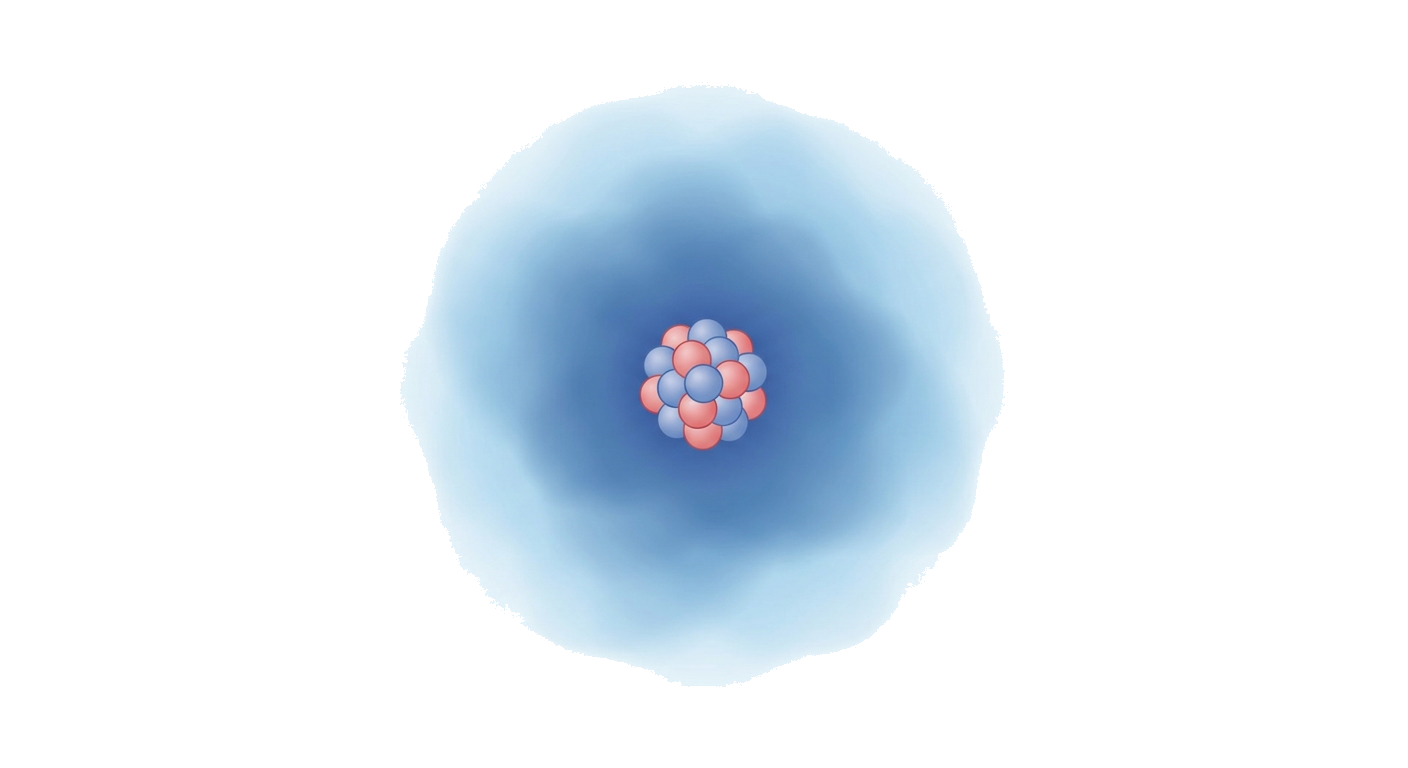
3. The image above represents the electron cloud model of an atom. Which statement best describes an electron cloud?
A fixed path where electrons orbit the nucleus.
A region around the nucleus where electrons are most likely to be found.
The nucleus of an atom.
A cloud of protons and neutrons.
4. The letter 's' in 's-orbital' stands for .
5. The maximum number of electrons in the third energy level (n=3) is .
6. Write the full electron configuration for Oxygen (atomic number 8).
7. Explain the difference between an orbital and an electron shell.
Match the term to its definition.
8. Pauli Exclusion Principle
a. States that electrons fill degenerate orbitals singularly before pairing up.
9. Hund's Rule
b. No two electrons in an atom can have the same set of four quantum numbers.
10. Valence Electrons
c. Electrons in the outermost shell of an atom.
Related Worksheets
Ions and Formula Units Worksheet
Explore the formation of ions, ionic bonds, and the naming and writing of chemical formulas for ionic compounds at a Grade 10 level.
Actual Yield in Chemical Reactions
Explore the concept of actual yield, theoretical yield, and percentage yield in chemical reactions with this Grade 10 chemistry worksheet.
Exploring Salts: Properties and Reactions
This worksheet covers the properties, formation, and uses of various salts, including their role in everyday life and chemical reactions.
Relative Mass Worksheet
Explore the concepts of relative atomic mass, relative molecular mass, and isotopic abundance in this Grade 10 chemistry worksheet.
Solubility Curves Worksheet
This worksheet explores solubility curves, their interpretation, and how they represent the relationship between temperature and the solubility of substances.
Predicting Products of Chemical Reactions
Grade 10 Science worksheet focusing on predicting the products of various types of chemical reactions, including synthesis, decomposition, single displacement, double displacement, and combustion.
Band of Stability Worksheet
Explore the concept of the band of stability, nuclear forces, and radioactive decay with this Grade 10 chemistry worksheet.
Electron Dot Diagrams Worksheet
A Grade 10 Science worksheet covering electron dot diagrams, valence electrons, and their importance in chemical bonding.