Grade 10 Flame Test Worksheet
A Grade 10 science worksheet covering the principles and applications of flame tests in chemistry.
Includes
Standards
Topics
Flame Test Exploration
Name:
Date:
Score:
Read each question carefully and provide concise answers. Use your knowledge of flame tests and atomic structure to complete the worksheet.
1. What causes the characteristic colors observed in a flame test?
Excitation of protons
Emission of light by excited electrons
Absorption of light by the flame
Combustion of the metal ions
2. Which of the following elements produces a crimson red color in a flame test?
Sodium
Potassium
Lithium
Copper
3. In a flame test, the metal ions gain energy from the heat of the flame and their electrons move to a higher energy level, becoming .
4. When these excited electrons return to their original, lower energy levels, they emit energy in the form of , which we observe as colored light.
5. Explain why different metallic elements produce different colors in a flame test.
6. Describe a potential limitation of the flame test as a method for identifying unknown substances.
7. A platinum wire loop is typically used in flame tests because it is reactive and contributes to the observed colors.
True
False
8. The colors produced in a flame test are due to the continuous spectrum of emitted light.
True
False
9. Observe the diagram below, which shows a metal rod being heated by a flame. Although this is not a flame test setup, consider the energy transfer.
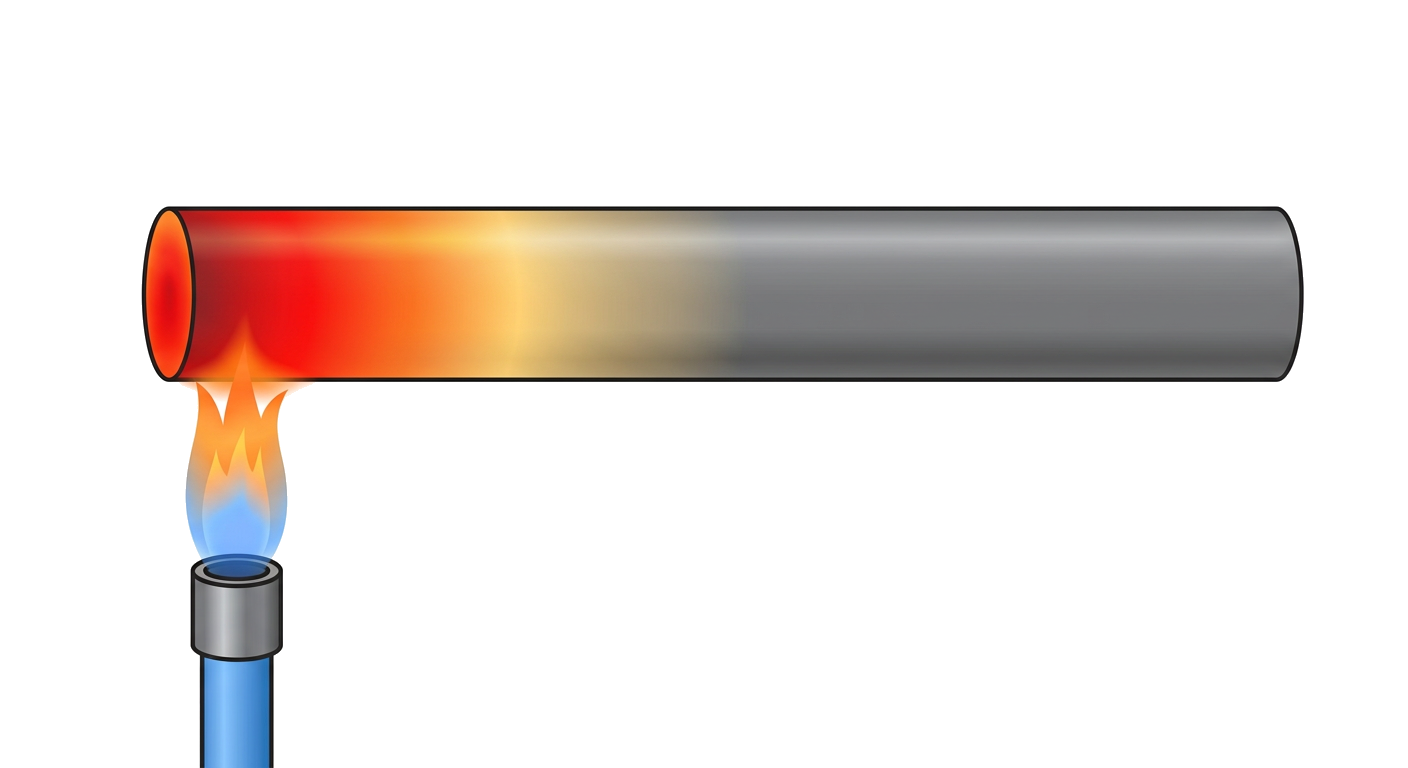
How is the energy from the flame transferred to the metal atoms in the rod, leading to their possible excitation if this were a flame test scenario?