Interpreting Spectra Worksheet
Grade 10 Science worksheet on interpreting emission and absorption spectra, including the electromagnetic spectrum and its applications.
Includes
Standards
Topics
Interpreting Spectra Worksheet
Name:
Date:
Score:
Read each question carefully and answer to the best of your ability. Use the provided space for your answers.
The electromagnetic spectrum is the range of all types of EM radiation. Radiation is energy that travels and spreads out as it goes – the visible light that comes from a lamp in your house and the radio waves that come from a radio tower are two types of electromagnetic radiation. Other examples of EM radiation are microwaves, infrared light, ultraviolet light, X-rays, and gamma-rays. All electromagnetic radiation consists of photons that travel in waves and move at the speed of light.
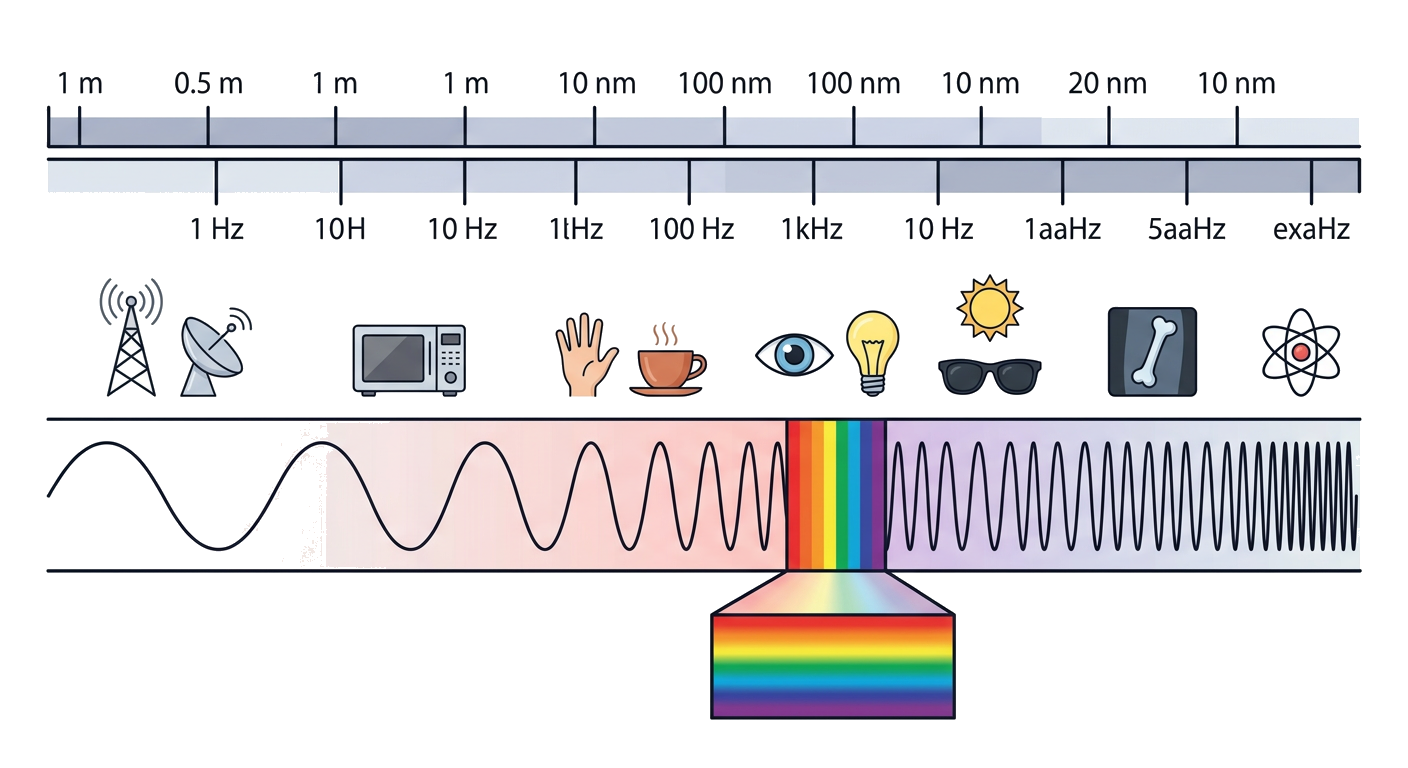
1. Which type of electromagnetic radiation has the longest wavelength?
Gamma rays
Radio waves
Visible light
X-rays
2. True or False: All types of electromagnetic radiation travel at the same speed in a vacuum.
True
False
3. When an atom absorbs energy, its electrons jump to a higher energy level. When these electrons fall back to their original energy levels, they emit light at specific wavelengths, creating an spectrum.
4. An spectrum is produced when a continuous spectrum of light passes through a cool, dilute gas, and specific wavelengths are absorbed by the atoms in the gas.
5. Each element has a unique emission and absorption spectrum, which acts like a for that element.
6. Explain how scientists use spectra to determine the composition of stars.
7. Describe one real-world application of interpreting spectra, other than astronomy.
Match each term on the left with its definition on the right.
8. Emission Spectrum
a. The range of all types of electromagnetic radiation
9. Absorption Spectrum
b. A spectrum of light that has specific wavelengths removed by a gas
10. Electromagnetic Spectrum
c. A spectrum of light emitted by an excited gas, showing bright lines at specific wavelengths