Ionic Bonding Worksheet
A Grade 10 Chemistry worksheet covering the fundamentals of ionic bonding, including formation, properties, and examples.
Includes
Standards
Topics
Ionic Bonding Worksheet
Name:
Date:
Score:
Read each question carefully and provide your best answer. Show all work where applicable.
1. Ionic bonds typically form between a and a .
2. In an ionic bond, electrons are from one atom to another.
3. The electrostatic attraction between oppositely charged ions is called an bond.
4. Atoms achieve a stable electron configuration, typically an octet, by gaining or losing .
1. Which of the following compounds is formed by ionic bonding?
H2O
NaCl
CO2
CH4
2. What happens to a metal atom when it forms an ionic bond?
It gains electrons and becomes negatively charged.
It loses electrons and becomes positively charged.
It shares electrons with another atom.
It becomes a neutral molecule.
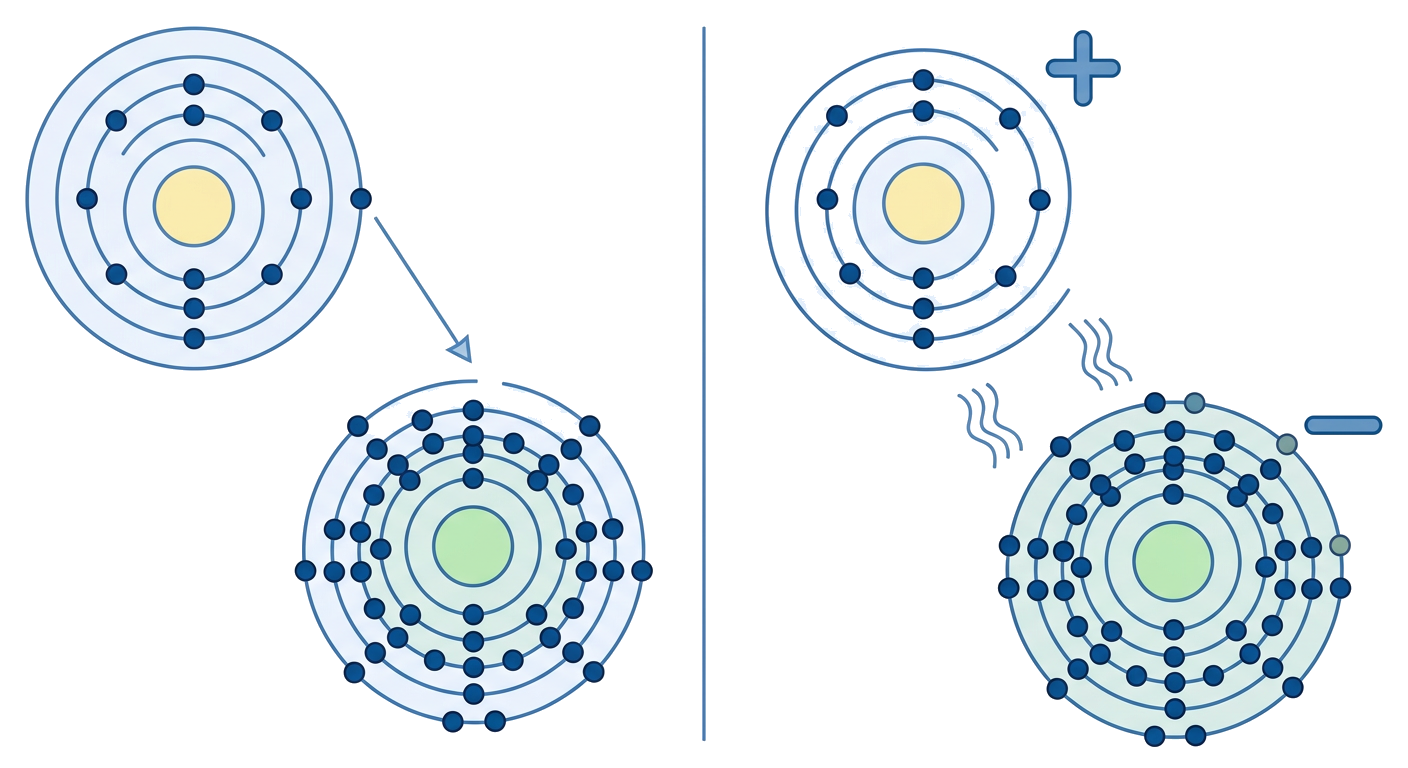
1. Explain the process of ionic bond formation between Sodium (Na) and Chlorine (Cl) atoms. You may refer to the illustration below.
1. Ionic compounds generally have low melting and boiling points.
True
False
2. Ionic compounds are excellent conductors of electricity in their solid state.
True
False
Match the term on the left with its definition on the right.
1. Cation
a. A negatively charged ion
2. Anion
b. A positively charged ion
3. Octet Rule
c. Atoms tend to gain, lose, or share electrons to achieve eight valence electrons