Ionic Charges Worksheet
A Grade 10 chemistry worksheet focusing on understanding and determining ionic charges, including the formation of ionic bonds.
Includes
Standards
Topics
Ionic Charges: Grade 10 Chemistry
Name:
Date:
Score:
Read each question carefully and answer to the best of your ability. Show all your work for calculations.
1. Which of the following elements is most likely to form a cation with a +2 charge?
Chlorine (Cl)
Oxygen (O)
Calcium (Ca)
Sodium (Na)
2. An anion is an ion with a charge.
positive
negative
neutral
variable
3. Atoms gain or lose electrons to achieve a stable electron configuration, typically resembling that of a gas.
4. When an atom loses electrons, it forms a positively charged ion called a .
5. The charge of an ion can be predicted by its group number on the table.
6. All elements in Group 17 (halogens) tend to form ions with a -1 charge.
True
False
7. Ionic bonds are formed between two nonmetals.
True
False
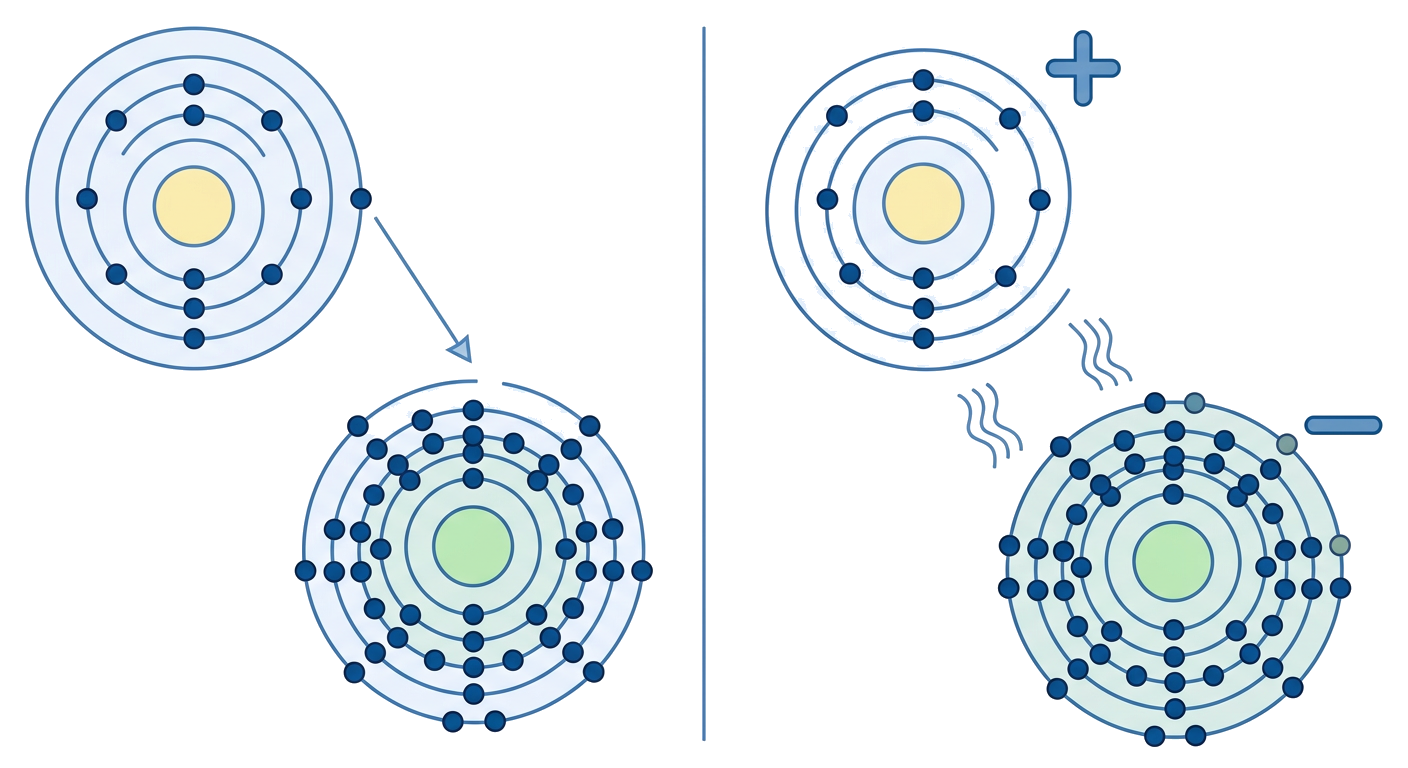
8. Explain how an ionic bond is formed between a metal and a nonmetal. You may refer to the diagram below.
Match the element with its most common ionic charge.
9. Magnesium (Mg)
a. -3
10. Sulfur (S)
b. +1
11. Potassium (K)
c. -2
12. Aluminum (Al)
d. +2
13. Nitrogen (N)
e. +3
14. Discuss the octet rule and its significance in the formation of ionic compounds. Provide examples of how different groups of elements achieve a stable octet.
Related Worksheets
Ions and Formula Units Worksheet
Explore the formation of ions, ionic bonds, and the naming and writing of chemical formulas for ionic compounds at a Grade 10 level.
Actual Yield in Chemical Reactions
Explore the concept of actual yield, theoretical yield, and percentage yield in chemical reactions with this Grade 10 chemistry worksheet.
Exploring Salts: Properties and Reactions
This worksheet covers the properties, formation, and uses of various salts, including their role in everyday life and chemical reactions.
Relative Mass Worksheet
Explore the concepts of relative atomic mass, relative molecular mass, and isotopic abundance in this Grade 10 chemistry worksheet.
Solubility Curves Worksheet
This worksheet explores solubility curves, their interpretation, and how they represent the relationship between temperature and the solubility of substances.
Predicting Products of Chemical Reactions
Grade 10 Science worksheet focusing on predicting the products of various types of chemical reactions, including synthesis, decomposition, single displacement, double displacement, and combustion.
Band of Stability Worksheet
Explore the concept of the band of stability, nuclear forces, and radioactive decay with this Grade 10 chemistry worksheet.
Electron Dot Diagrams Worksheet
A Grade 10 Science worksheet covering electron dot diagrams, valence electrons, and their importance in chemical bonding.