Ionic Compound Formula Writing
A Grade 10 chemistry worksheet focusing on writing chemical formulas for ionic compounds, including naming conventions and charge balancing.
Includes
Standards
Topics
Ionic Compound Formula Writing
Name:
Date:
Score:
Read each question carefully and follow the instructions to write the correct chemical formulas or answers. Remember to balance charges and simplify ratios.
Ionic bonds are formed between a metal and a nonmetal through the transfer of electrons, resulting in the formation of charged ions (cations and anions). These oppositely charged ions are attracted to each other, forming an ionic compound.
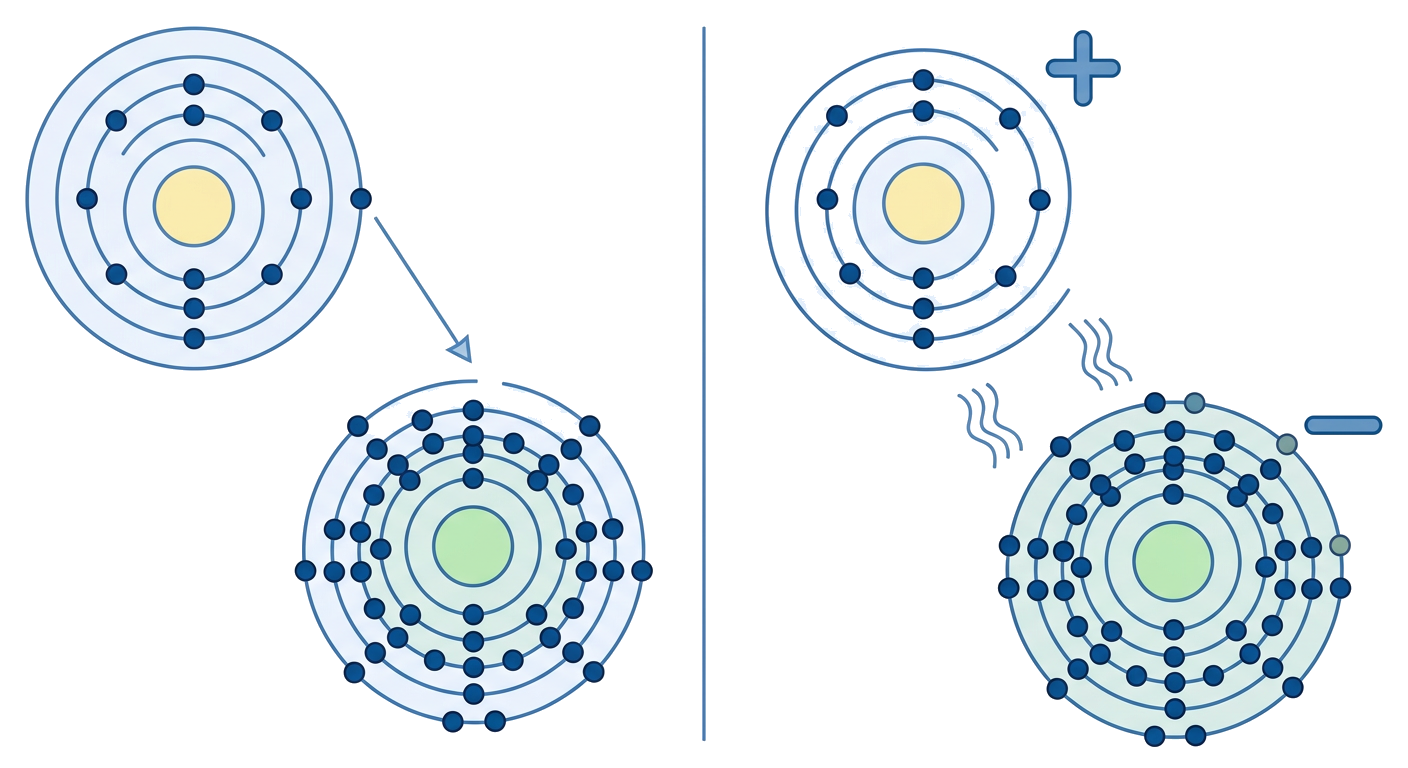
1. An ionic bond typically forms between a and a .
2. When an atom loses electrons, it forms a positively charged ion called a .
3. When an atom gains electrons, it forms a negatively charged ion called an .
4. Which of the following pairs of elements would MOST likely form an ionic bond?
Carbon and Oxygen
Sodium and Chlorine
Nitrogen and Hydrogen
Sulfur and Oxygen
5. What is the charge of a calcium ion (Ca) when it forms an ionic bond?
+1
-1
+2
-2
For each pair of ions, write the correct chemical formula for the ionic compound they form.
6. Sodium ion (Na⁺) and Bromide ion (Br⁻)
7. Magnesium ion (Mg²⁺) and Oxide ion (O²⁻)
8. Aluminum ion (Al³⁺) and Chloride ion (Cl⁻)
9. Potassium ion (K⁺) and Sulfate ion (SO₄²⁻)
10. Iron(III) ion (Fe³⁺) and Hydroxide ion (OH⁻)
11. The sum of the charges in an ionic compound must always be zero.
True
False
12. In the formula MgCl₂, the subscript '2' indicates there are two magnesium atoms.
True
False
13. Explain the criss-cross method for writing ionic formulas and provide an example using Calcium and Phosphorus.