Ionic Compound Formulas Worksheet
Grade 10 Chemistry worksheet focusing on writing and naming ionic compound formulas, including polyatomic ions and transition metals.
Includes
Standards
Topics
Ionic Compound Formulas
Name:
Date:
Score:
Read each question carefully and provide the correct ionic compound formula or name as requested. Pay attention to charges, polyatomic ions, and transition metals.
Write the correct chemical formula for the following ionic compounds:
1. Sodium chloride:
2. Magnesium oxide:
3. Aluminum fluoride:
4. Calcium bromide:
5. Potassium iodide:
Name the following ionic compounds:
6. K₂S
7. Al₂O₃
8. FeCl₃
9. Cu(NO₃)₂
10. What is the primary driving force for the formation of an ionic bond?
Sharing of electrons
Transfer of electrons
Attraction between similar charges
Formation of a sea of electrons
11. Which of the following pairs of elements would most likely form an ionic bond?
Carbon and Oxygen
Hydrogen and Chlorine
Sodium and Chlorine
Nitrogen and Nitrogen
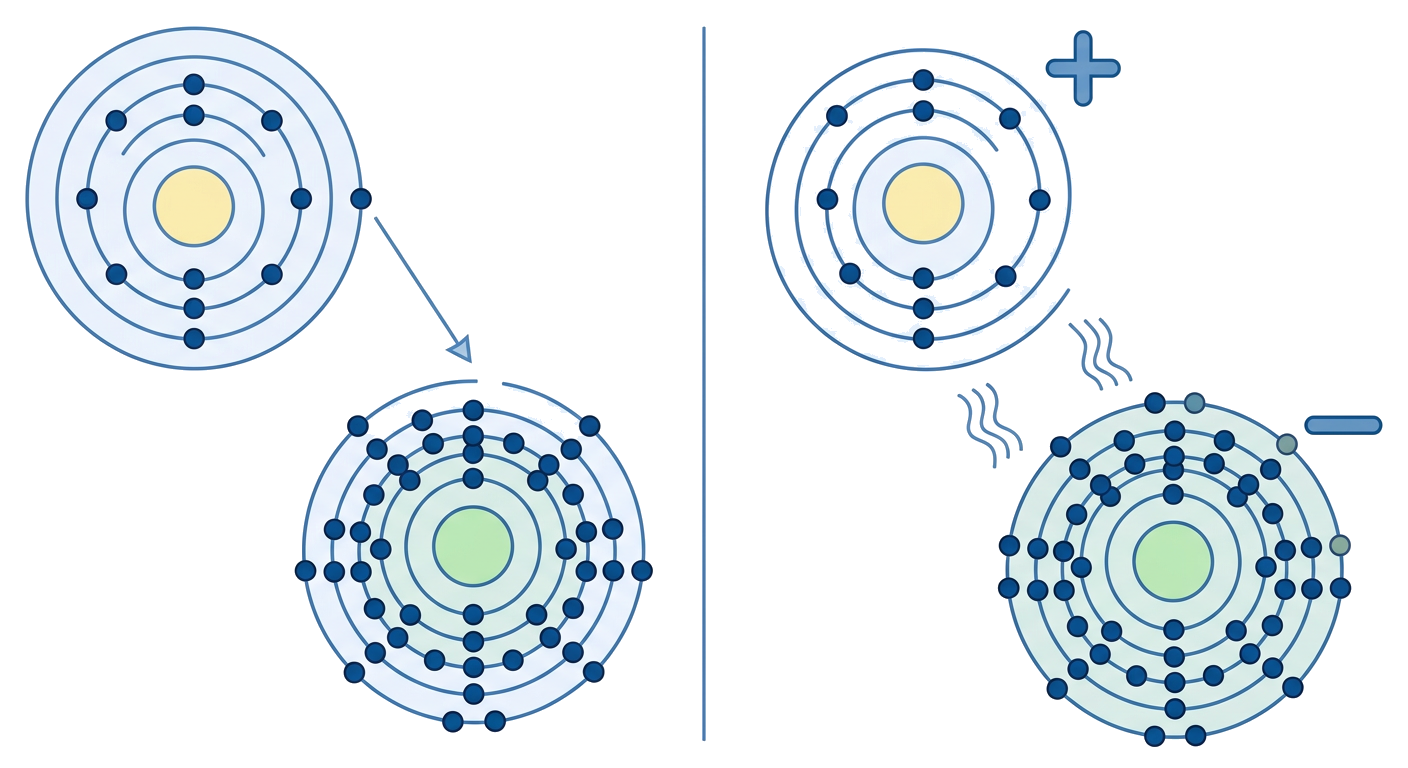
Observe the diagram below illustrating ionic bond formation:
Indicate whether each statement is True or False:
12. Ionic compounds typically have low melting points.
True
False
13. A polyatomic ion is a group of atoms that carries a net electrical charge.
True
False
Write the correct chemical formula for the following ionic compounds:
14. Ammonium phosphate:
15. Iron(II) sulfate:
16. Lead(IV) oxide:
17. Explain why ionic compounds do not conduct electricity in their solid state but do conduct electricity when molten or dissolved in water.