Grade 10 Chemistry: Net Ionic Equations
This worksheet covers the fundamentals of writing and balancing net ionic equations, including identifying spectator ions and precipitates.
Includes
Standards
Grade 10 Chemistry: Net Ionic Equations
Name:
Date:
Score:
Read each question carefully and provide clear, concise answers. For net ionic equations, ensure correct states of matter and balanced charges.
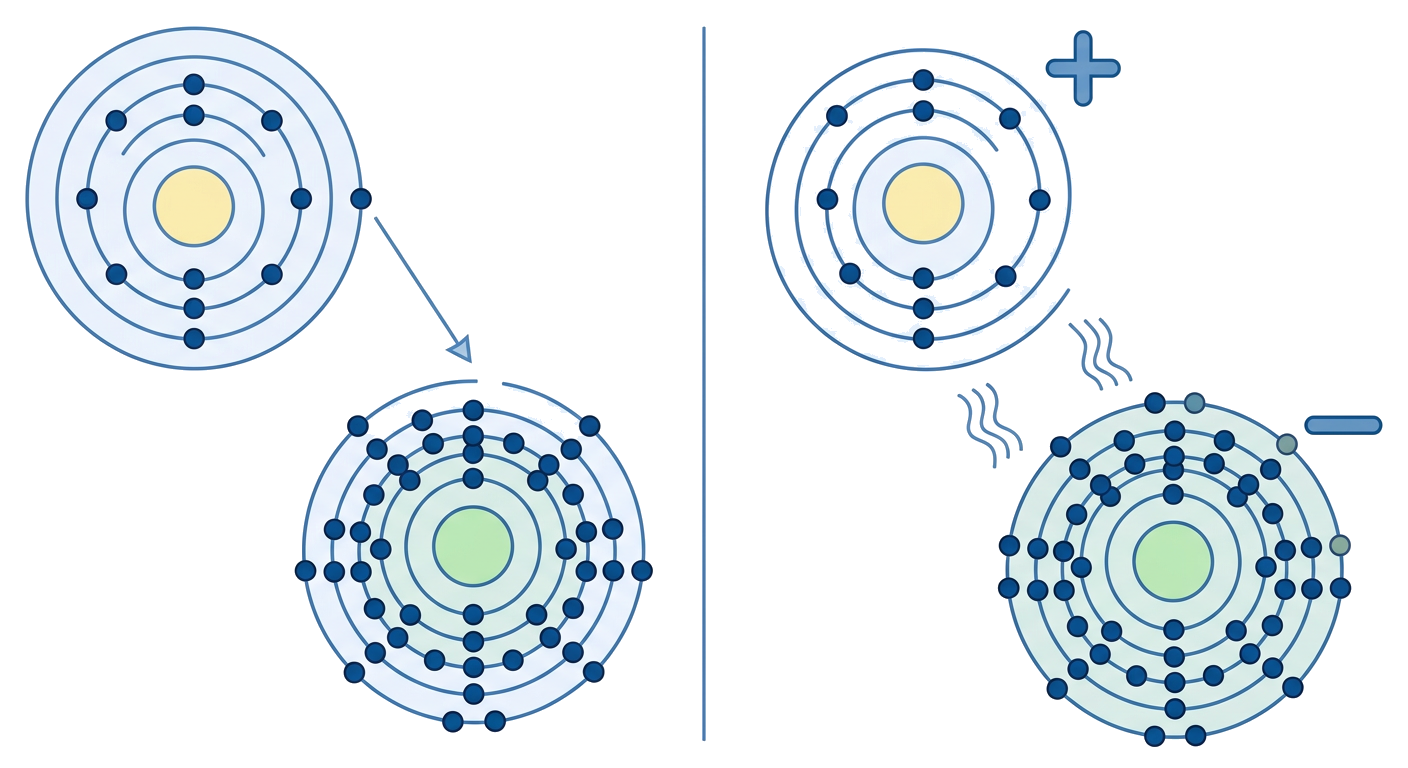
Understanding ionic bonds is crucial for net ionic equations. An ionic bond is formed between a metal and a nonmetal, where electrons are transferred, creating charged ions.
1. Which of the following statements best describes a spectator ion?
An ion that participates in the reaction and forms a precipitate.
An ion that is present in the solution but does not participate in the chemical reaction.
An ion that changes its oxidation state during the reaction.
An ion that is always a cation.
2. When writing a total ionic equation, which of the following compounds should be dissociated into ions?
Insoluble solids
Strong acids and strong bases
Covalent compounds
Water
3. A precipitate is an solid formed in a solution during a chemical reaction.
4. To write a net ionic equation, you must first write the ionic equation and then cancel out the ions.
5. Write the balanced molecular equation, complete ionic equation, and net ionic equation for the reaction between aqueous silver nitrate and aqueous sodium chloride. Clearly identify any spectator ions and the precipitate formed.
Molecular Equation:
Complete Ionic Equation:
Net Ionic Equation:
Spectator Ions:
Precipitate:
6. All ionic compounds are soluble in water.
True
False
7. A net ionic equation only shows the species that are directly involved in the chemical change.
True
False
8. Consider the reaction between aqueous lead(II) nitrate and aqueous potassium iodide. Write the balanced molecular equation, complete ionic equation, and net ionic equation. Identify the spectator ions and the precipitate.