Molecular Polarity Worksheet
Explore the concepts of molecular polarity, electronegativity, and bond types with this Grade 10 chemistry worksheet.
Includes
Standards
Topics
Molecular Polarity Worksheet
Name:
Date:
Score:
Read each question carefully and answer to the best of your ability. Show all your work for calculations.
1. Which of the following best describes a polar molecule?
A molecule with evenly distributed charge.
A molecule with a net dipole moment due to unequal sharing of electrons.
A molecule composed of only nonpolar covalent bonds.
A molecule that dissolves only in nonpolar solvents.
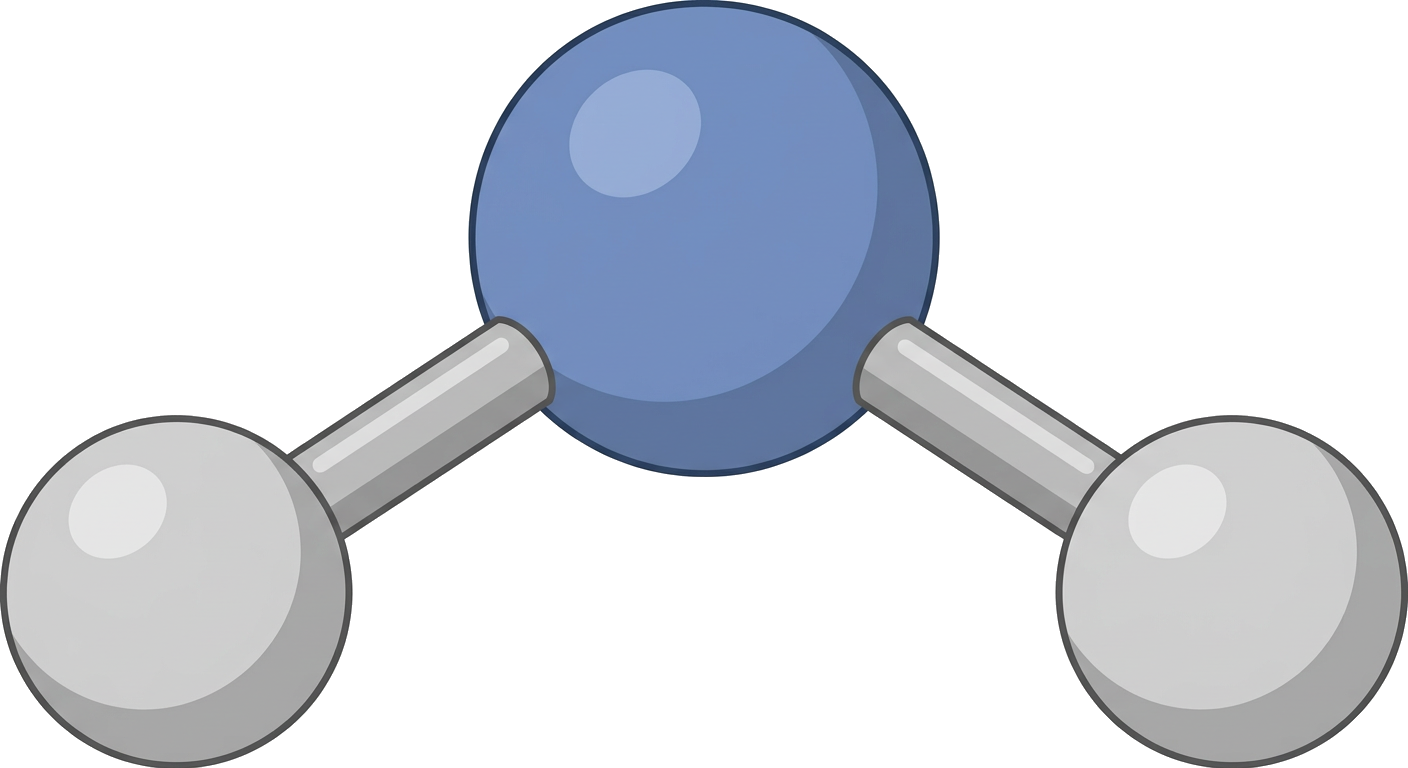
2. The illustration below shows a water molecule. What makes water a polar molecule?
Its linear molecular geometry.
The equal electronegativity of oxygen and hydrogen.
The bent molecular geometry and unequal sharing of electrons.
The presence of only single bonds.
3. Electronegativity is a measure of an atom's ability to attract in a chemical bond.
4. A difference in electronegativity between two bonded atoms leads to a bond.
5. Molecules with symmetrical geometries and nonpolar bonds are typically .
6. All molecules containing polar bonds are polar molecules.
True
False
7. Carbon dioxide (CO2) is a polar molecule because oxygen is more electronegative than carbon.
True
False
8. Explain how molecular geometry influences the overall polarity of a molecule, even if it contains polar bonds. Provide an example.
9. Differentiate between a nonpolar covalent bond and a polar covalent bond.