Writing Chemical Formulas for Ionic Compounds
Practice writing chemical formulas for various ionic compounds, focusing on understanding cation and anion charges.
Includes
Standards
Topics
Writing Chemical Formulas for Ionic Compounds
Name:
Date:
Score:
Read each question carefully and write the correct chemical formula for the given ionic compound. Remember to balance the charges to achieve a neutral compound.
Ionic compounds are formed between a metal and a nonmetal through the transfer of electrons, resulting in the formation of ions. Cations are positively charged ions, and anions are negatively charged ions. The chemical formula for an ionic compound represents the simplest whole-number ratio of ions that results in a neutral compound.
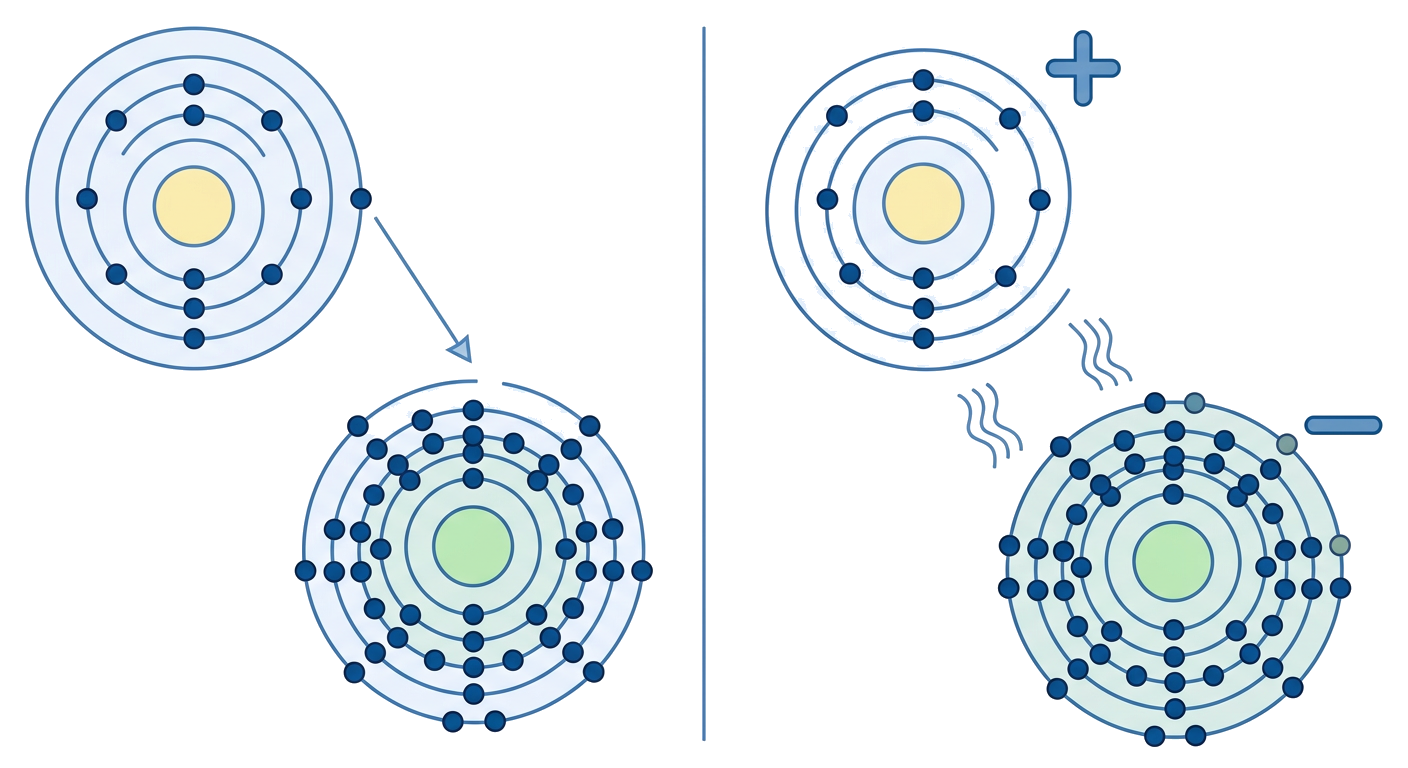
1. An ionic compound is formed between a and a .
2. Cations are charged ions, while anions are charged ions.
3. The overall charge of an ionic compound must always be .
Write the chemical formula for each of the following ionic compounds:
4. Sodium chloride
5. Magnesium oxide
6. Aluminum fluoride
7. Potassium iodide
8. Calcium bromide
Match each cation with its corresponding anion to form a neutral ionic compound. Write the chemical formula in the blank.
9. Fe³⁺
a. O²⁻
10. K⁺
b. Cl⁻
11. Mg²⁺
c. SO₄²⁻
12. NH₄⁺
d. PO₄³⁻
13. What is the correct chemical formula for calcium nitride?
CaN
Ca₂N₃
Ca₃N₂
CaN₂
14. Which of the following is the correct formula for iron(III) sulfate?
FeSO₄
Fe₂(SO₄)₃
Fe₃(SO₄)₂
Fe(SO₄)₃
15. The formula for aluminum oxide is AlO.
True
False
16. In the compound NaCl, the ratio of sodium ions to chloride ions is 1:1.
True
False