Glacier Science Worksheet
Explore the formation, types, and impacts of glaciers with this comprehensive Grade 10 science worksheet.
Includes
Standards
Topics
Glacier Science Worksheet
Name:
Date:
Score:
Read each question carefully and provide your best answer based on your understanding of glaciers and related geological processes.
1. Which of the following best describes the process of glacial abrasion?
The plucking of rock fragments by moving ice.
The grinding and scraping of rock by sediment-laden ice.
The melting and refreezing of ice within cracks in rocks.
The deposition of sediments by glacial meltwater.
2. What is the primary force responsible for glacial movement?
Wind erosion
Tectonic plate movement
Gravity
Thermal expansion
3. A large, perennial accumulation of crystalline ice, snow, rock, sediment, and liquid water that originates on land and moves downslope under the influence of its own weight and gravity is called a .
4. The process by which glaciers acquire and transport rock fragments is known as and .
5. Describe the two main types of glaciers and provide an example of each.
6. Glaciers only exist in polar regions.
True
False
7. The accumulation zone of a glacier is where more ice is gained than lost.
True
False
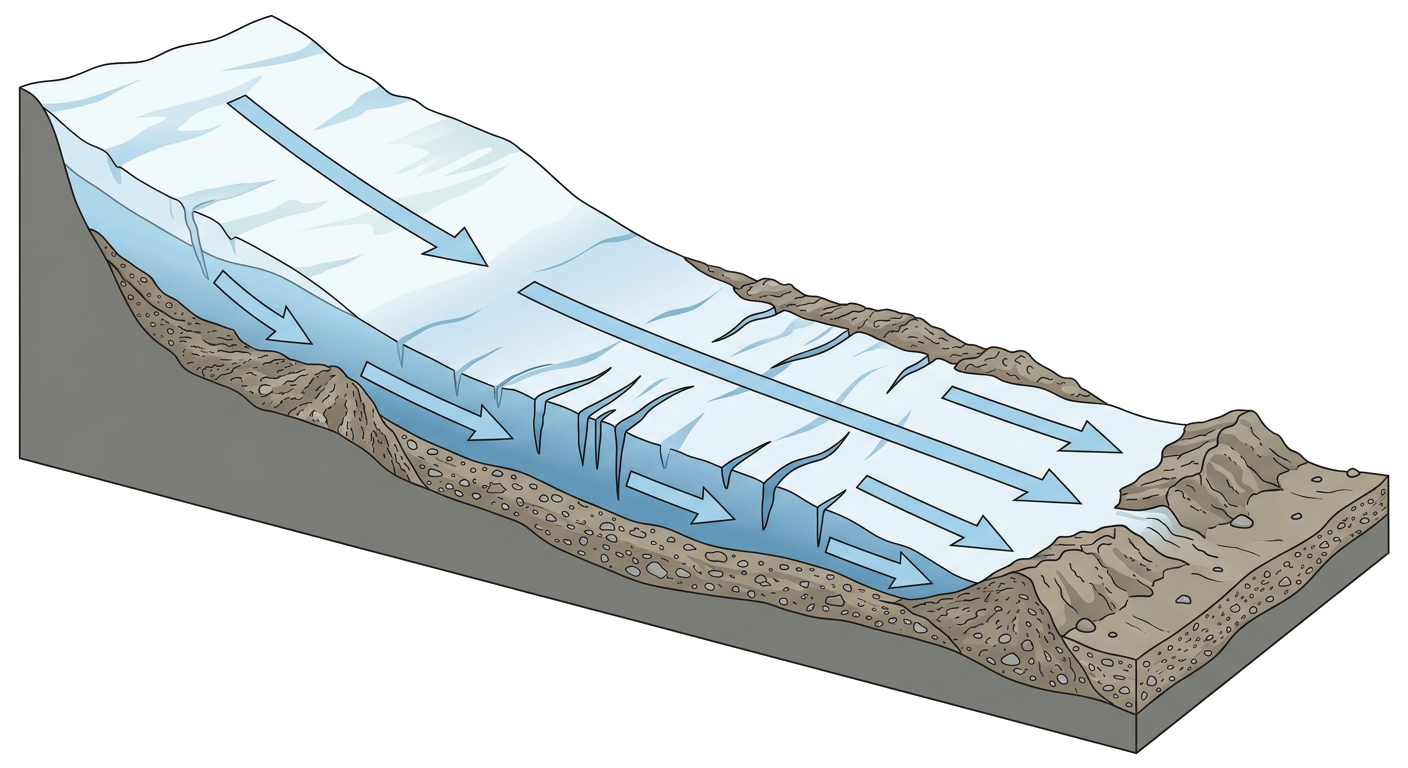
8. Examine the cross-section of a glacier below. Identify and label the following features: accumulation zone, ablation zone, firn line, crevasses, and glacial till.
Match each term on the left with its correct definition on the right.
9. Moraine
a. A sharp, jagged ridge formed by glacial erosion.
10. Cirque
b. A bowl-shaped depression at the head of a glacial valley.
11. Arete
c. An accumulation of unconsolidated glacial debris (till).
12. Discuss the impact of climate change on glaciers worldwide. Include specific consequences of glacial retreat and their potential effects on human populations and ecosystems.
Related Worksheets
Plate Boundaries Worksheet - Grade 10 Science
Explore the different types of plate boundaries, their geological features, and associated phenomena.
Space Exploration Worksheet
Explore the history, technology, and future of space exploration with this comprehensive worksheet for Grade 10 science students.
Continental Drift Worksheet
Explore the theory of continental drift, Pangea, and evidence supporting plate tectonics.
Soil Horizons Exploration
A Grade 10 science worksheet exploring the layers and characteristics of soil horizons.
Nitrogen Cycle Worksheet
A comprehensive worksheet for Grade 10 students to assess their understanding of the nitrogen cycle, including its stages, organisms involved, and environmental impact.
Grade 10 Science: Lab Safety and Procedures
This worksheet covers essential lab safety rules, common laboratory equipment, and fundamental practical skills for Grade 10 science students.
Earth History Exploration
This worksheet explores key concepts in Earth's history, including geological eras, major events, and dating methods for Grade 10 Science students.
Global Wind Patterns Worksheet
Explore the fundamental concepts of global wind patterns, including the Coriolis effect, pressure systems, and major wind belts, through a variety of question types.