Law of Superposition Worksheet
Grade 10 Science worksheet focusing on the Law of Superposition, its principles, and applications in relative dating.
Includes
Standards
Topics
Law of Superposition
Name:
Date:
Score:
Read each question carefully and answer to the best of your knowledge. For multiple choice questions, circle the correct option. For fill-in-the-blank questions, complete the statement with the most appropriate term. For short answer questions, provide a concise and accurate response.
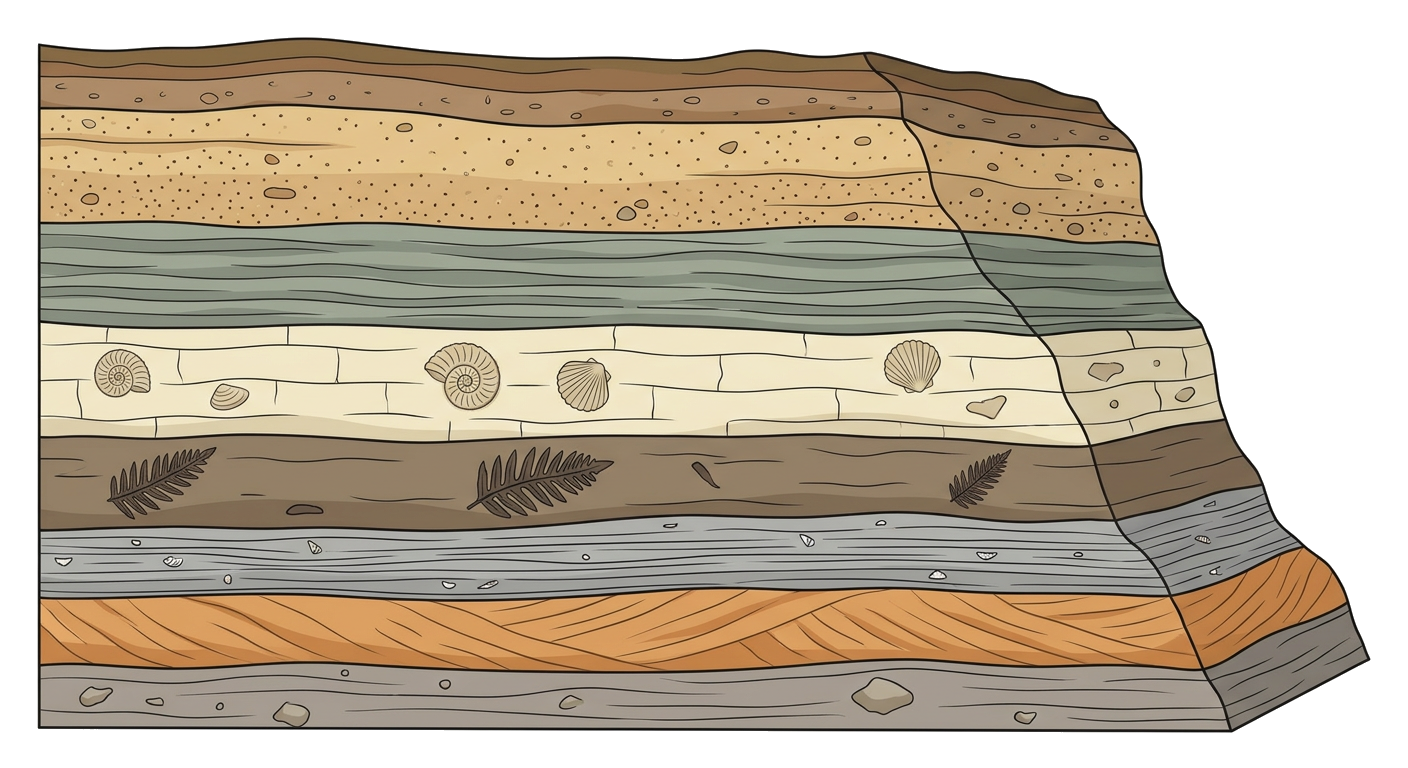
The Law of Superposition is a fundamental principle of stratigraphy, stating that in any undisturbed sequence of rocks deposited in layers, the youngest layer is on top and the oldest layer is on the bottom, each layer being younger than the one beneath it and older than the one above it.
1. Which of the following best describes the Law of Superposition?
Sedimentary layers are always deposited horizontally.
Older rock layers are found below younger rock layers.
Fossils are always found in igneous rocks.
Rocks are constantly being recycled through the rock cycle.
2. The Law of Superposition is primarily used for:
Absolute dating of rocks.
Determining the exact age of fossils.
Relative dating of rock layers and fossils.
Measuring the rate of erosion.
3. The Law of Superposition states that in an undisturbed sequence of sedimentary rocks, the oldest layers are found at the .
4. This principle is crucial for understanding the history of Earth.
5. Fossils found in lower rock layers are generally than those found in upper layers.
6. The Law of Superposition applies to all types of rocks, including igneous and metamorphic.
True
False
7. Unconformities can complicate the direct application of the Law of Superposition.
True
False
8. Examine the diagram below of sedimentary layers. If Layer A is at the bottom and Layer D is at the top, which layer is the oldest and which is the youngest? Explain your reasoning.
9. Briefly describe a scenario where the Law of Superposition might be violated or complicated.
Use the words below to complete the sentences.
10. The principle of states that sediments are generally deposited in horizontal layers.
11. The Law of Superposition is a key principle in which determines the sequential order of events.
12. A break in the geologic record, often due to erosion or non-deposition, is called an .
Related Worksheets
Grade 10 Science: Lab Safety and Procedures
This worksheet covers essential lab safety rules, common laboratory equipment, and fundamental practical skills for Grade 10 science students.
Earth History Exploration
This worksheet explores key concepts in Earth's history, including geological eras, major events, and dating methods for Grade 10 Science students.
Planet Earth Worksheet
Explore the structure, composition, and dynamic processes of Planet Earth with this Grade 10 science worksheet.
Rock Cycle Exploration
Explore the processes and types of rocks involved in the Earth's rock cycle with this comprehensive worksheet.