Locating Earthquakes Worksheet
Grade 10 Science worksheet on understanding seismic waves, seismographs, and the triangulation method for locating earthquake epicenters.
Includes
Standards
Topics
Locating Earthquakes
Name:
Date:
Score:
Read each question carefully and answer to the best of your ability. For multiple-choice questions, select the best option. For short answer questions, provide concise and accurate responses.
1. Which type of seismic wave arrives first at a seismograph station?
S-waves
P-waves
Surface waves
Love waves
2. What is the minimum number of seismograph stations required to locate an earthquake's epicenter?
One
Two
Three
Four
3. The point on the Earth's surface directly above the focus of an earthquake is called the .
4. The difference in arrival times between P-waves and S-waves helps seismologists determine the to the epicenter.
5. Briefly explain how a seismograph works to detect seismic waves.
6. S-waves can travel through both solid and liquid layers of the Earth.
True
False
7. The triangulation method uses data from at least three seismic stations to pinpoint an earthquake's epicenter.
True
False
8. Observe the diagram below, which illustrates different types of seismic waves.
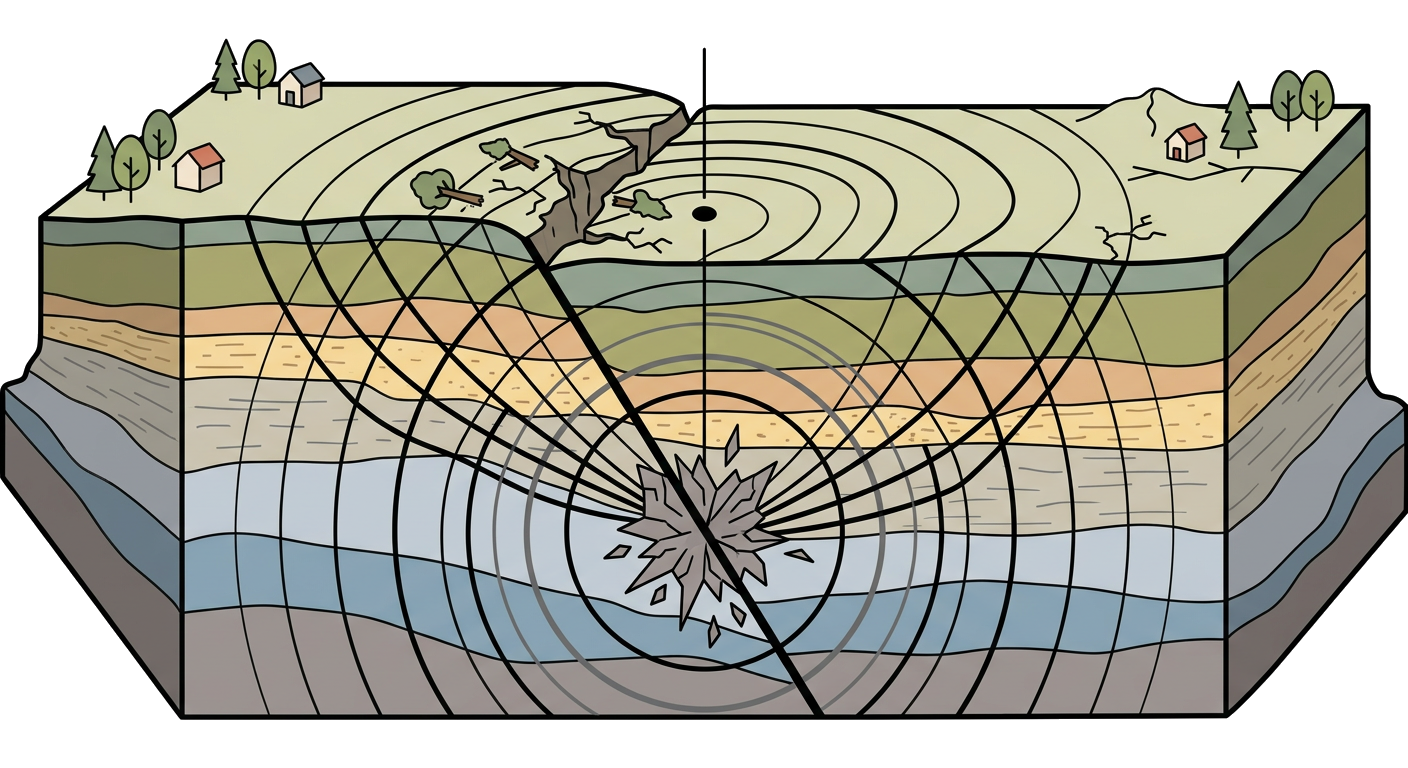
Based on the diagram, describe one key characteristic that differentiates P-waves from S-waves.
Related Worksheets
Grade 10 Science: Lab Safety and Procedures
This worksheet covers essential lab safety rules, common laboratory equipment, and fundamental practical skills for Grade 10 science students.
Earth History Exploration
This worksheet explores key concepts in Earth's history, including geological eras, major events, and dating methods for Grade 10 Science students.
Planet Earth Worksheet
Explore the structure, composition, and dynamic processes of Planet Earth with this Grade 10 science worksheet.
Rock Cycle Exploration
Explore the processes and types of rocks involved in the Earth's rock cycle with this comprehensive worksheet.