Relative Dating in Geology
Explore the principles of relative dating used to determine the chronological order of geological events.
Includes
Standards
Topics
Relative Dating in Geology
Name:
Date:
Score:
Read each question carefully and answer to the best of your ability. Refer to the provided diagrams where applicable.
1. Which principle states that in an undisturbed sequence of sedimentary strata, the oldest layer is at the bottom and the youngest is at the top?
Principle of Cross-Cutting Relationships
Principle of Superposition
Principle of Original Horizontality
Principle of Faunal Succession
2. An igneous intrusion cuts through existing sedimentary layers. According to the Principle of Cross-Cutting Relationships, which is older?
The igneous intrusion
The sedimentary layers
They are the same age
Cannot be determined
3. The Principle of states that sedimentary layers are originally deposited in horizontal or nearly horizontal layers.
4. An unconformity represents a gap in the geologic record, often due to erosion or a period of non- .
5. Observe the image below of sedimentary layers. Based on the Principle of Superposition, identify the oldest and youngest layers.
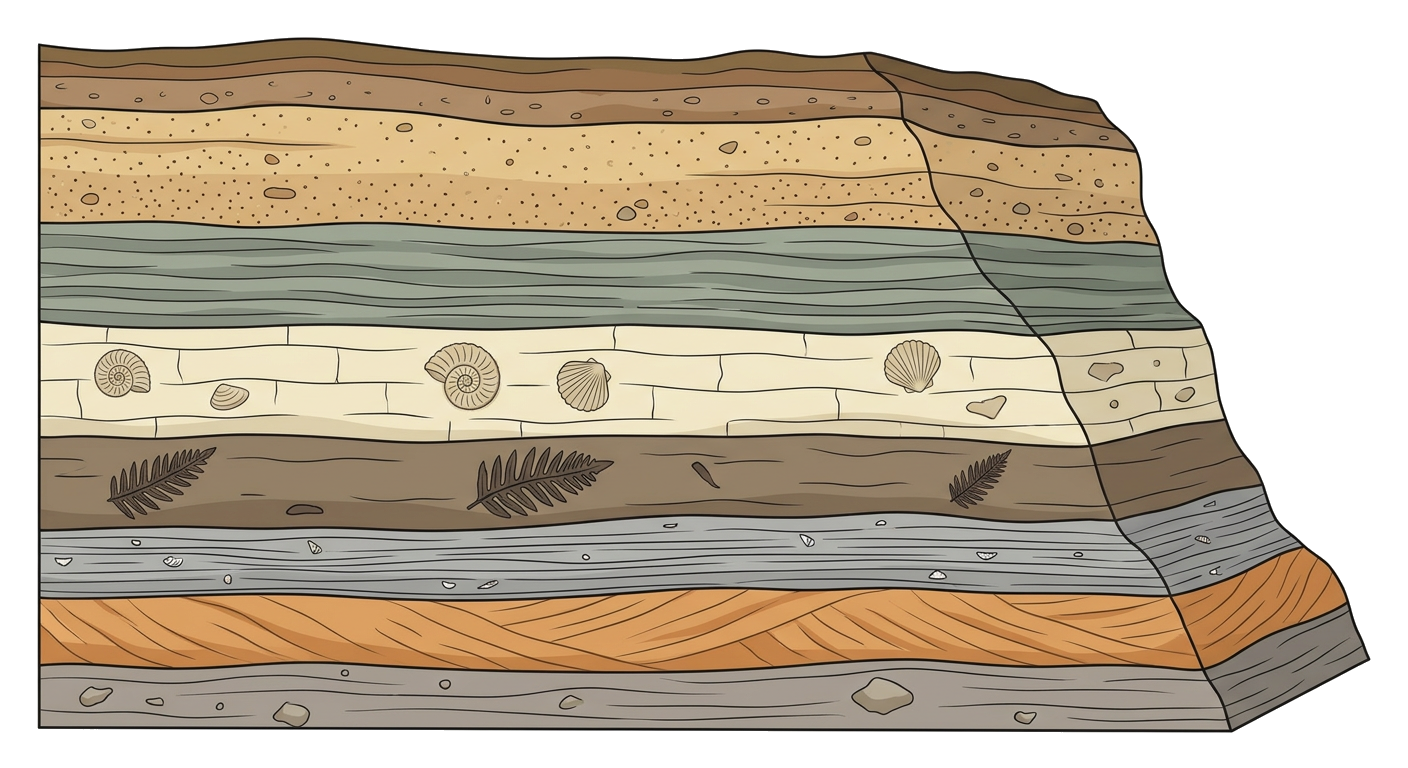
Oldest layer:
Youngest layer:
6. Explain how index fossils are used in relative dating.
7. The Principle of Original Horizontality can be used to infer that tilted sedimentary layers have been disturbed after their deposition.
True
False
8. Relative dating provides a numerical age for geological events.
True
False
Related Worksheets
Plate Boundaries Worksheet - Grade 10 Science
Explore the different types of plate boundaries, their geological features, and associated phenomena.
Space Exploration Worksheet
Explore the history, technology, and future of space exploration with this comprehensive worksheet for Grade 10 science students.
Continental Drift Worksheet
Explore the theory of continental drift, Pangea, and evidence supporting plate tectonics.
Soil Horizons Exploration
A Grade 10 science worksheet exploring the layers and characteristics of soil horizons.
Nitrogen Cycle Worksheet
A comprehensive worksheet for Grade 10 students to assess their understanding of the nitrogen cycle, including its stages, organisms involved, and environmental impact.
Grade 10 Science: Lab Safety and Procedures
This worksheet covers essential lab safety rules, common laboratory equipment, and fundamental practical skills for Grade 10 science students.
Earth History Exploration
This worksheet explores key concepts in Earth's history, including geological eras, major events, and dating methods for Grade 10 Science students.
Global Wind Patterns Worksheet
Explore the fundamental concepts of global wind patterns, including the Coriolis effect, pressure systems, and major wind belts, through a variety of question types.