Analogous Structures Worksheet
Explore analogous structures in biology, understanding convergent evolution and how different species adapt to similar environments.
Includes
Standards
Analogous Structures Worksheet
Name:
Date:
Score:
Read each question carefully and answer to the best of your ability. This worksheet will test your understanding of analogous structures and convergent evolution.
Analogous structures are features in different species that have similar functions but evolved independently, not from a common ancestor. This phenomenon is known as convergent evolution, where organisms adapt to similar environmental pressures in similar ways.
1. Which of the following best defines analogous structures?
Structures with similar ancestry but different functions.
Structures with similar functions but different evolutionary origins.
Structures that are vestigial and have lost their original function.
Structures that are unique to a single species.
2. The wings of a bat and the wings of an insect are considered analogous structures. Why?
They share a common ancestor with wings.
They have different functions but similar structures.
They have similar functions but evolved independently.
They are both examples of homologous structures.
3. The process by which analogous structures evolve is called .
4. Analogous structures are evidence of similar pressures leading to similar adaptations.
5. Analogous structures indicate a close evolutionary relationship between species.
True
False
6. The streamlined body shapes of sharks and dolphins are an example of analogous structures.
True
False
7. Provide two examples of analogous structures found in different animal species and briefly explain why they are considered analogous.
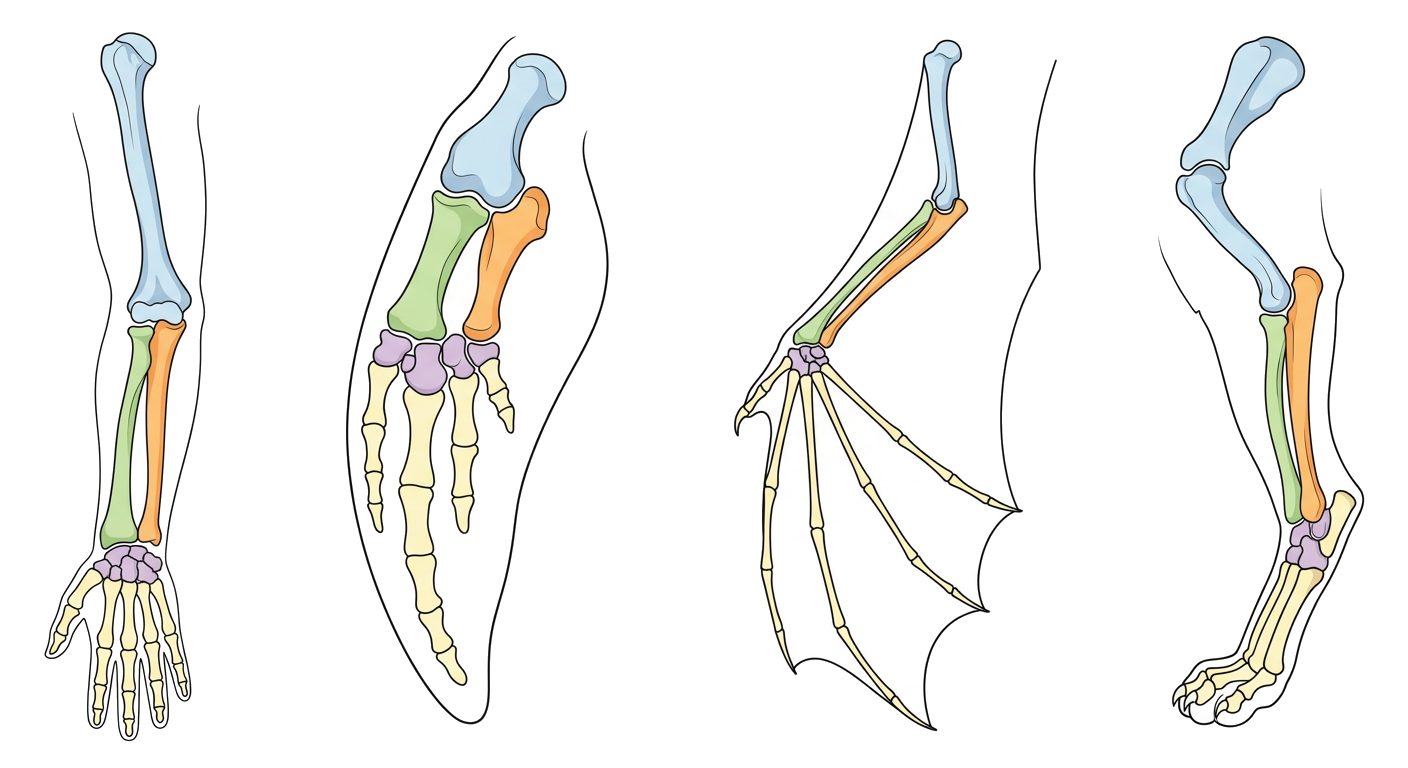
8. Examine the image below, which compares homologous structures. Explain how homologous structures differ from analogous structures in terms of evolutionary origin.
Related Worksheets
Phylogenetic Tree Worksheet
Explore the principles of phylogenetic trees, common ancestry, and evolutionary relationships among organisms.
Blood Sugar Regulation Worksheet
A Grade 10 science worksheet covering the regulation of blood sugar, including the roles of insulin, glucagon, and the pancreas.
Bacterial Transformation Worksheet
This worksheet covers key concepts in bacterial transformation, including the process, mechanisms, and applications.
Cell Environments Worksheet
Explore the principles of cell environments, including osmosis, diffusion, active transport, and their effects on plant and animal cells.
Bone Markings Worksheet
A Grade 10 Science worksheet focusing on the identification and function of various bone markings.
Properties of Carbon Worksheet
Explore the unique properties of carbon, its atomic structure, bonding capabilities, and its importance in organic chemistry and living organisms.
Human Skull Anatomy Worksheet
A Grade 10 science worksheet focusing on the anatomy and functions of the human skull, including its various bones and protective role.
Grade 10 Biology: Heart Structure Worksheet
A comprehensive worksheet for Grade 10 Biology students covering the structure and function of the human heart.