Evidence of Evolution Worksheet
Explore the various lines of evidence that support the theory of evolution, including homologous structures, vestigial structures, embryonic development, and molecular biology.
Includes
Standards
Topics
Evidence of Evolution
Name:
Date:
Score:
Read each question carefully and answer to the best of your ability. Refer to your notes and textbook as needed. Good luck!
1. Which of the following provides evidence for common ancestry based on similar bone structures despite different functions?
Analogous structures
Vestigial structures
Homologous structures
Embryonic structures
2. The presence of gill slits and a tail in early human embryos suggests a common ancestry with which group of organisms?
Insects
Fish
Plants
Bacteria
3. Structures that have lost their original function over time, such as the human appendix or wisdom teeth, are known as .
4. The study of similarities and differences in the anatomy of different species is called .
5. Observe the image below showing homologous structures. Describe how the forelimbs of a human, cat, whale, and bat provide evidence for evolution, even though they have different functions.
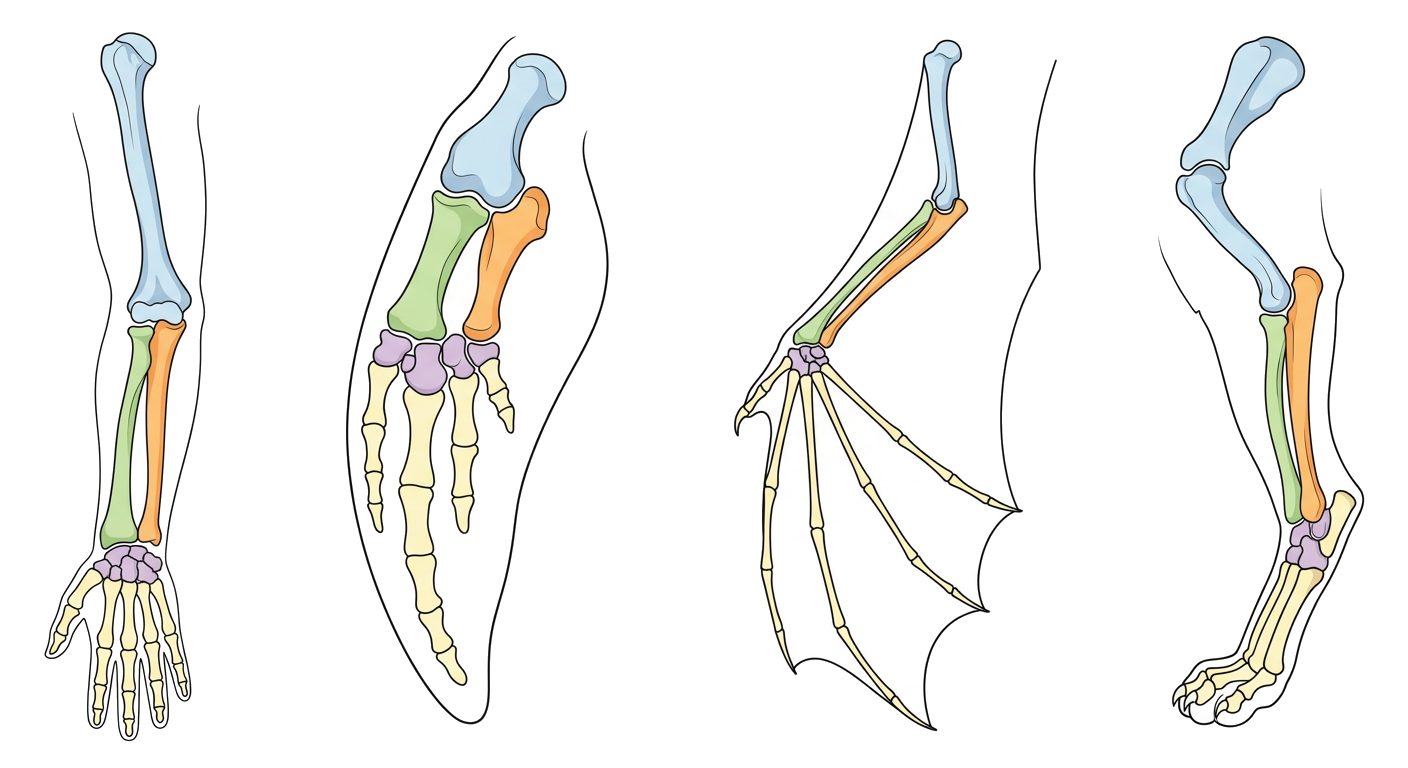
6. DNA sequencing and amino acid comparisons provide molecular evidence for evolutionary relationships.
True
False
7. Analogous structures, like the wings of a bat and a butterfly, indicate a close evolutionary relationship.
True
False
Match the term on the left with its description on the right.
8. Fossil Record
a. The study of early development of organisms.
9. Embryology
b. Preserved remains or traces of organisms from the past.
10. Biogeography
c. Geographic distribution of species.
11. Explain how molecular evidence, such as DNA and protein sequences, provides strong support for the theory of evolution and the concept of common ancestry. Provide at least two specific examples.
Related Worksheets
Phylogenetic Tree Worksheet
Explore the principles of phylogenetic trees, common ancestry, and evolutionary relationships among organisms.
Blood Sugar Regulation Worksheet
A Grade 10 science worksheet covering the regulation of blood sugar, including the roles of insulin, glucagon, and the pancreas.
Bacterial Transformation Worksheet
This worksheet covers key concepts in bacterial transformation, including the process, mechanisms, and applications.
Cell Environments Worksheet
Explore the principles of cell environments, including osmosis, diffusion, active transport, and their effects on plant and animal cells.
Bone Markings Worksheet
A Grade 10 Science worksheet focusing on the identification and function of various bone markings.
Properties of Carbon Worksheet
Explore the unique properties of carbon, its atomic structure, bonding capabilities, and its importance in organic chemistry and living organisms.
Human Skull Anatomy Worksheet
A Grade 10 science worksheet focusing on the anatomy and functions of the human skull, including its various bones and protective role.
Grade 10 Biology: Heart Structure Worksheet
A comprehensive worksheet for Grade 10 Biology students covering the structure and function of the human heart.