Electromagnetic Waves and Interference
This worksheet covers fundamental concepts of electromagnetic waves, their properties, and wave interference at a Grade 10 Physics level.
Includes
Standards
Topics
Electromagnetic Waves and Interference
Name:
Date:
Score:
Read each question carefully and answer to the best of your ability. Show all your work for calculation questions.
1. Which of the following is NOT a characteristic of electromagnetic waves?
They are transverse waves.
They require a medium to travel.
They travel at the speed of light in a vacuum.
They consist of oscillating electric and magnetic fields.
2. Which type of electromagnetic wave has the longest wavelength?
Gamma rays
Ultraviolet light
Radio waves
X-rays
3. The bending of waves as they pass through an opening or around an obstacle is called .
4. When two waves meet and their amplitudes add up to create a larger amplitude, it is called interference.
5. The electromagnetic spectrum ranges from low-frequency radio waves to high-frequency rays.
6. Briefly explain the difference between constructive and destructive interference.
7. What is the relationship between the wavelength and frequency of an electromagnetic wave?
8. Refer to the electromagnetic spectrum diagram below to answer the following questions.
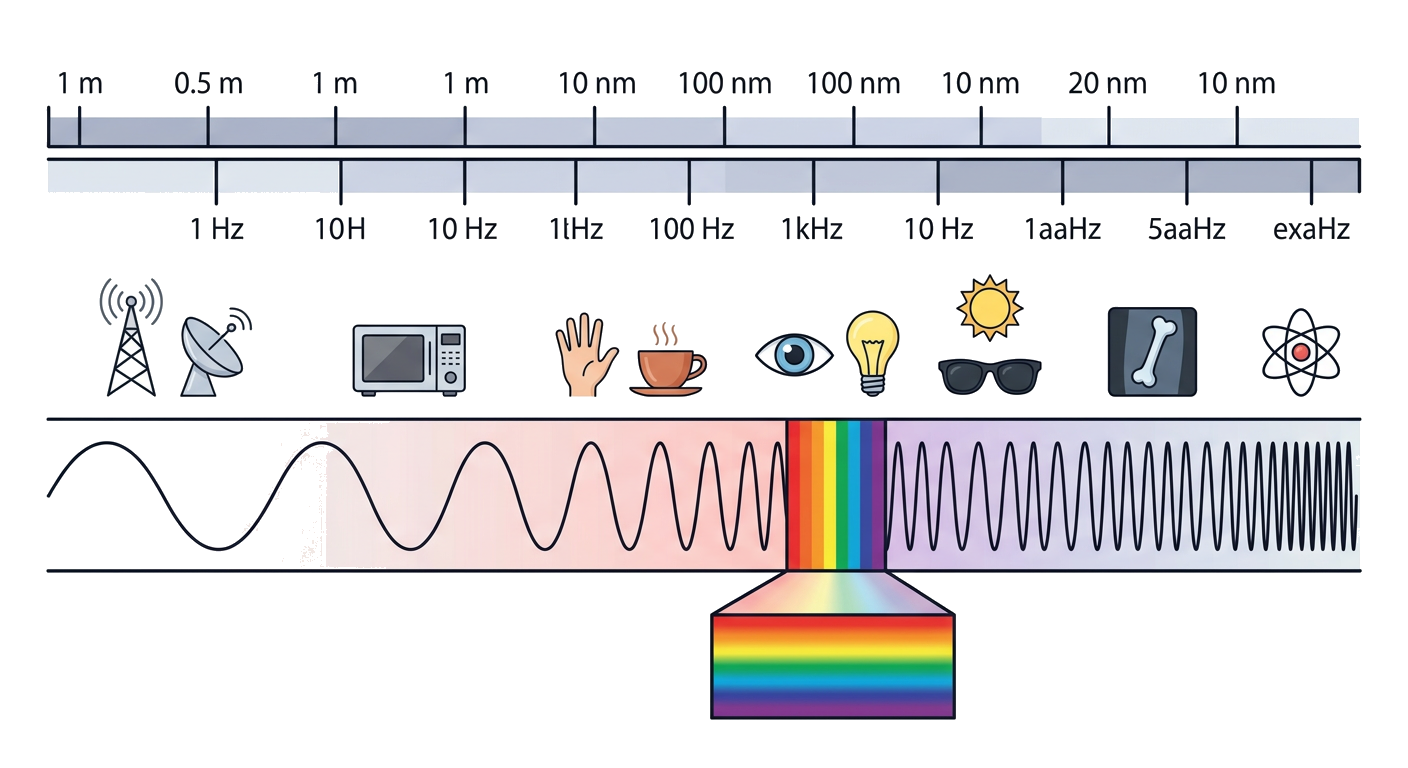
a) Which part of the spectrum has wavelengths shorter than visible light but longer than X-rays?
b) Give one practical application for radio waves.
9. All electromagnetic waves travel at the same speed in a vacuum.
True
False
10. Interference patterns are only observed with light waves, not other electromagnetic waves.
True
False