Torque and Equilibrium Worksheet
Explore the concepts of torque, equilibrium, and levers with this Grade 10 Physics worksheet. Understand how forces create rotational motion and conditions for balance.
Includes
Standards
Topics
Torque and Equilibrium
Name:
Date:
Score:
Read each question carefully and answer to the best of your ability. Show all your work for calculations.
1. Which of the following best defines torque?
The net force acting on an object.
A measure of an object's resistance to rotation.
The rotational equivalent of force, causing angular acceleration.
The amount of work done by a rotating object.
2. For an object to be in rotational equilibrium, what must be true?
The net force acting on it is zero.
The net torque acting on it is zero.
Both the net force and net torque acting on it are zero.
Its angular velocity is constant.
3. Torque is calculated by multiplying the force applied by the arm.
4. The unit of torque in the SI system is .
5. A first-class lever has the fulcrum located the effort and the load.
6. A 50 N force is applied at a distance of 0.8 m from the pivot point of a wrench. Calculate the torque produced.
7. Identify the class of lever shown in the diagram below.
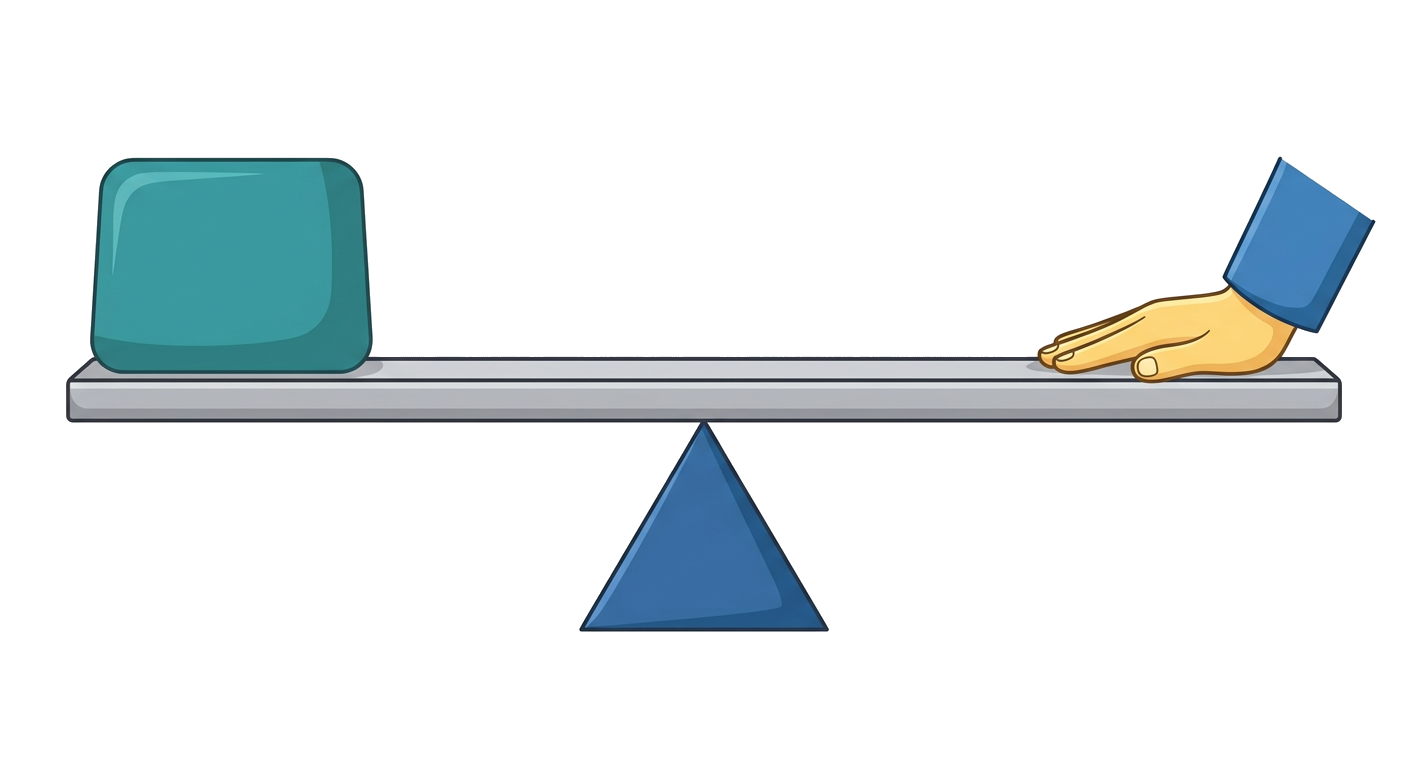
8. Draw a diagram of a second-class lever and label the fulcrum, effort, and load.
9. For an object to be in static equilibrium, it must be both in translational and rotational equilibrium.
True
False
10. Explain how a seesaw demonstrates the principle of rotational equilibrium when two children of different weights are sitting on it.