The Anaconda Plan: A Civil War Strategy
This worksheet explores the Anaconda Plan, a key Union strategy during the American Civil War, focusing on its objectives, components, and effectiveness.
Includes
Standards
Topics
The Anaconda Plan: A Civil War Strategy
Name:
Date:
Score:
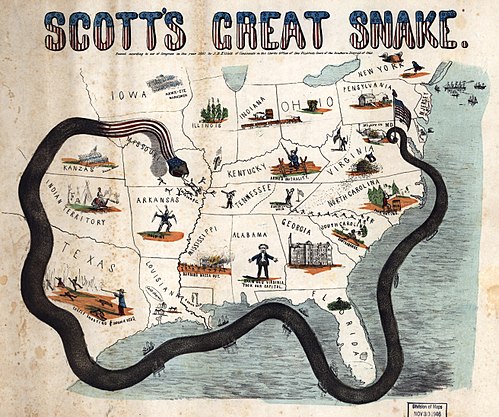
Read each question carefully and answer to the best of your knowledge. Refer to the provided map and your understanding of the Anaconda Plan to complete the tasks.
Observe the map below, which illustrates the Union's Anaconda Plan strategy during the Civil War.
1. Who proposed the Anaconda Plan?
Ulysses S. Grant
Winfield Scott
Robert E. Lee
Abraham Lincoln
2. What was the primary goal of the Anaconda Plan?
To launch a quick, decisive invasion of the Confederate capital.
To blockade Southern ports and control the Mississippi River.
To gain European allies for the Union cause.
To emancipate enslaved people in the Southern states.
3. The Anaconda Plan aimed to the Confederacy by controlling its access to the sea and the Mississippi River.
4. The Union Navy's role in the Anaconda Plan was to establish a along the Confederate coastline.
5. The Anaconda Plan was immediately popular and widely supported by the Northern public and military leaders.
True
False
6. Control of the Mississippi River was crucial to the Anaconda Plan because it would divide the Confederacy and disrupt its supply lines.
True
False
7. Describe the two main components of the Anaconda Plan as envisioned by Winfield Scott.
8. In what ways did the Anaconda Plan contribute to the Union victory, even if it wasn't fully implemented as initially proposed?