Martin Luther King Jr. and the Civil Rights Movement
This worksheet explores the key contributions of Martin Luther King Jr. to the American Civil Rights Movement, focusing on his philosophies, methods, and significant events.
Includes
Topics
Martin Luther King Jr. and the Civil Rights Movement
Name:
Date:
Score:
Read each question carefully and answer to the best of your knowledge. Use complete sentences for short answer questions.
1. Which landmark speech by Martin Luther King Jr. called for racial equality and an end to discrimination?
Address at the March on Washington
Give Us the Ballot
Letter from Birmingham Jail
Beyond Vietnam
2. Martin Luther King Jr.'s philosophy of nonviolent resistance was heavily influenced by the teachings of which global figure?
Nelson Mandela
Mahatma Gandhi
Malcolm X
Frederick Douglass
3. The was a pivotal event in the Civil Rights Movement, where Martin Luther King Jr. delivered his 'I Have a Dream' speech.
4. Martin Luther King Jr. was assassinated in in 1968.
5. Describe the primary goals and methods of the Southern Christian Leadership Conference (SCLC), an organization led by Martin Luther King Jr.
6. The Civil Rights Act of 1964, which outlawed discrimination based on race, color, religion, sex, or national origin, was passed before Martin Luther King Jr.'s assassination.
True
False
Match each term with its description.
7. Montgomery Bus Boycott
a. Advocated for 'Black Power' and self-defense
8. Jim Crow Laws
b. Segregation laws in the American South
9. Malcolm X
c. Protest against segregated public transportation
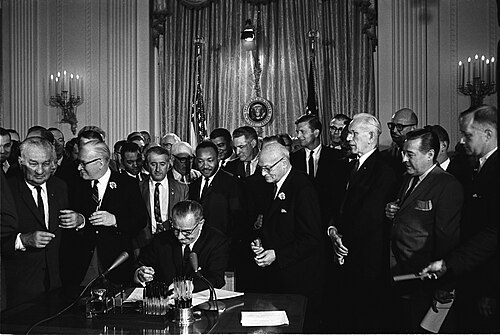
10. The image above shows President Lyndon B. Johnson signing the Civil Rights Act of 1964. Based on your knowledge of the Civil Rights Movement, explain the significance of this act.