The Cell Membrane: Structure and Function
An 11th-grade science worksheet focusing on the structure, components, and functions of the cell membrane, including transport mechanisms.
Includes
Standards
Topics
The Cell Membrane: Structure and Function
Name:
Date:
Score:
Read each question carefully and provide thoughtful answers. Refer to your knowledge of cell biology and the cell membrane. Diagrams may be helpful for some questions.
1. Label the following components of the cell membrane in the diagram below:
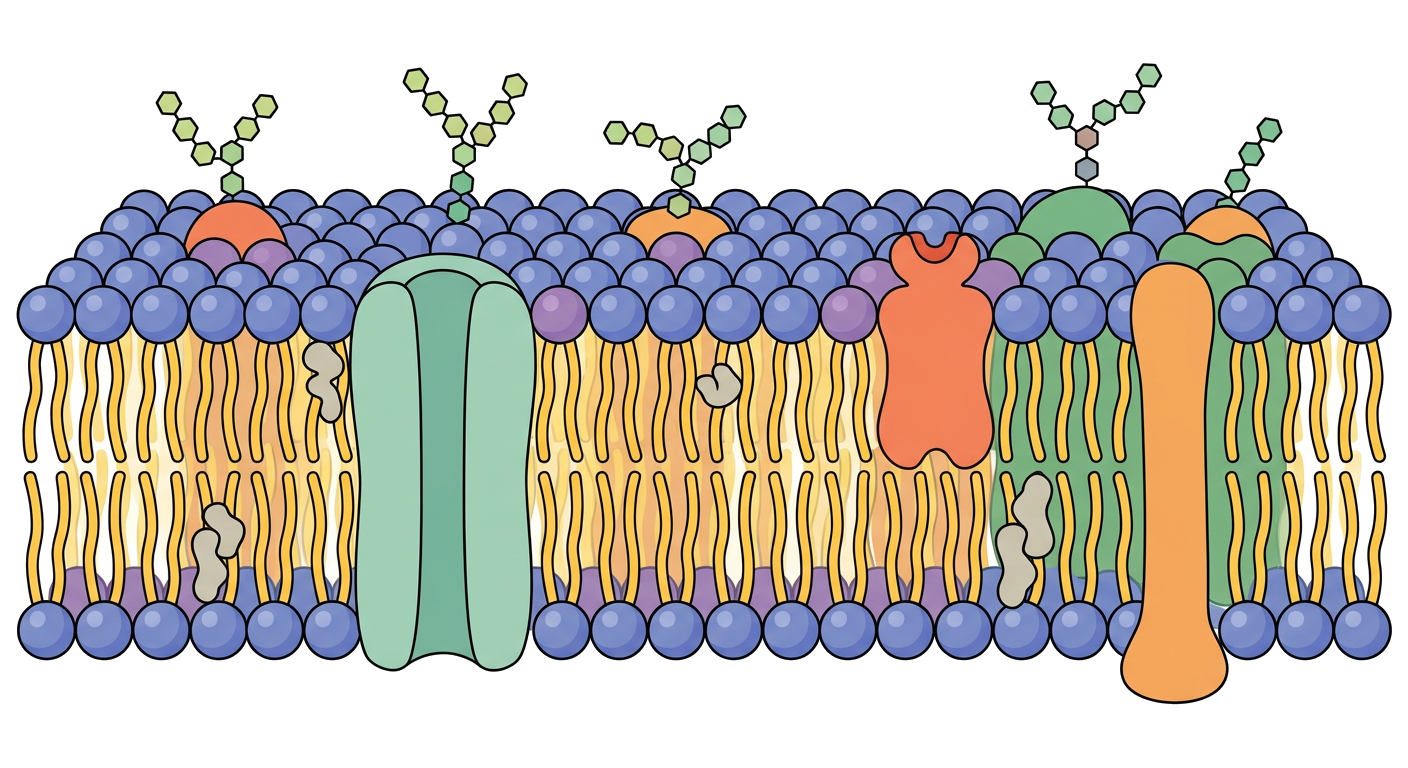
a) Phospholipid bilayer
b) Integral protein
c) Peripheral protein
d) Glycoprotein
e) Glycolipid
f) Cholesterol
2. The cell membrane is described by the model, which suggests that its components are constantly moving.
3. The primary component of the cell membrane is the , which forms a barrier to most water-soluble molecules.
4. are embedded within the lipid bilayer, while are found on the surface of the membrane.
5. In animal cells, helps maintain membrane fluidity across a range of temperatures.
6. Which of the following is NOT a primary function of the cell membrane?
Regulating passage of substances
Providing structural support to the cell
Synthesizing proteins
Cell-to-cell communication
7. Which type of membrane protein is involved in transporting specific substances across the membrane?
Receptor proteins
Enzyme proteins
Transport proteins
Adhesion proteins
8. Diffusion is a form of active transport that requires energy.
True
False
9. Facilitated diffusion requires transport proteins but does not require ATP.
True
False
10. Osmosis is the movement of solutes across a selectively permeable membrane.
True
False
11. Explain the difference between passive transport and active transport across the cell membrane. Provide an example of each.
12. Describe the role of glycoproteins and glycolipids in cell-to-cell recognition.