Balancing Nuclear Reactions Worksheet
A Grade 11 science worksheet focused on balancing nuclear reactions, including alpha decay, beta decay, and nuclear fission.
Includes
Standards
Topics
Balancing Nuclear Reactions
Name:
Date:
Score:
Read each question carefully and provide the best answer. Show all your work for calculations.
Nuclear reactions involve changes in the nucleus of an atom, often resulting in the formation of new elements or isotopes. Unlike chemical reactions, nuclear reactions can release tremendous amounts of energy. Balancing nuclear reactions requires ensuring that both the mass number (superscript) and the atomic number (subscript) are conserved on both sides of the equation.
1. In a balanced nuclear reaction, the total number and the total number must be conserved.
2. Alpha decay involves the emission of an alpha particle, which is a nucleus.
3. Beta decay involves the emission of a beta particle, which is an .
4. Nuclear fission is the process where a heavy nucleus splits into two or more nuclei.
Complete and balance the following alpha decay reactions:
1. ²³⁸₉₂U → ⁴₂He +
2. ²²⁶₈₈Ra → + ²²²₈₆Rn
Complete and balance the following beta decay reactions:
1. ¹⁴₆C → ⁰₋₁e +
2. ¹³¹₅₃I → + ¹³¹₅₄Xe
1. Which of the following particles is emitted during alpha decay?
Proton
Electron
Helium nucleus
Neutron
2. What happens to the atomic number during beta decay?
Decreases by 1
Increases by 1
Remains unchanged
Decreases by 2
1. Consider the nuclear fission of Uranium-235 when struck by a neutron: ¹₀n + ²³⁵₉₂U → ¹⁴¹₅₆Ba + ⁹²₃₆Kr + 3¹₀n + energy. Explain how both the mass number and atomic number are conserved in this reaction.
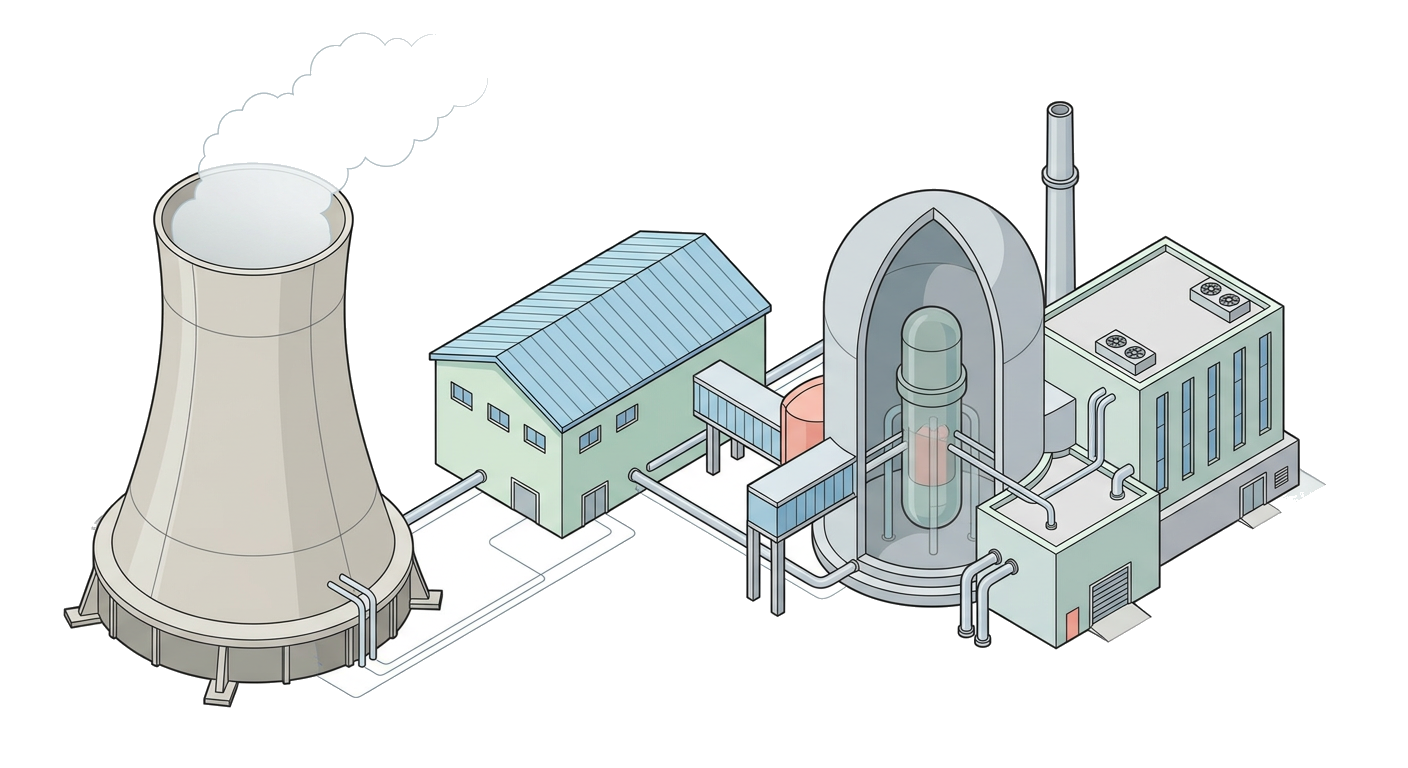
Nuclear power plants utilize controlled nuclear reactions to generate electricity. The image below shows a typical nuclear power plant.
Describe one advantage and one disadvantage of using nuclear reactions for energy production.
Related Worksheets
pH and pOH Calculations Worksheet
A Grade 11 Chemistry worksheet focusing on pH and pOH calculations, including strong acids, bases, and ion concentrations.
Ionic Bonds Worksheet
Explore the fundamentals of ionic bonding, including electron transfer, ion formation, and properties of ionic compounds, suitable for Grade 11 Chemistry students.
Molecular Geometry Worksheet
A Grade 11 Chemistry worksheet focusing on VSEPR theory and molecular shapes, including questions on bond angles and polarity.
Lewis Structure Practice Worksheet
A Grade 11 Chemistry worksheet focusing on drawing and understanding Lewis Structures, including octet rule, formal charge, and resonance.
Molecular Structure Worksheet
A Grade 11 Science worksheet covering key concepts in molecular structure, including VSEPR theory, hybridization, and intermolecular forces.
Calorimetry Principles
This worksheet explores the fundamental principles of calorimetry, including heat transfer, specific heat capacity, and calculations related to calorimetry experiments.
Grade 11 Chemistry: Word Equations
A worksheet for Grade 11 Chemistry students focusing on writing and balancing word equations for chemical reactions.
Types of Chemical Reactions Worksheet
Explore different types of chemical reactions including synthesis, decomposition, single displacement, double displacement, and combustion with this Grade 11 chemistry worksheet.