Calorimetry Principles and Calculations
This worksheet covers fundamental principles of calorimetry, including specific heat capacity, heat transfer, and calculations involving calorimetric experiments.
Includes
Standards
Topics
Calorimetry Principles and Calculations
Name:
Date:
Score:
Read each question carefully and provide clear, concise answers. Show all your work for calculations.
1. Which of the following best describes a calorimeter?
A device used to measure temperature.
A device used to measure heat transfer.
A device used to measure pressure.
A device used to measure volume.
2. What is the specific heat capacity of water?
1.00 J/g°C
4.18 J/g°C
2.00 J/g°C
0.50 J/g°C
3. The principle of calorimetry states that the heat lost by a hot object is equal to the heat by a cold object.
4. The formula for calculating heat transfer is q = m * c * ΔT, where 'q' is heat, 'm' is mass, 'c' is , and 'ΔT' is the change in temperature.
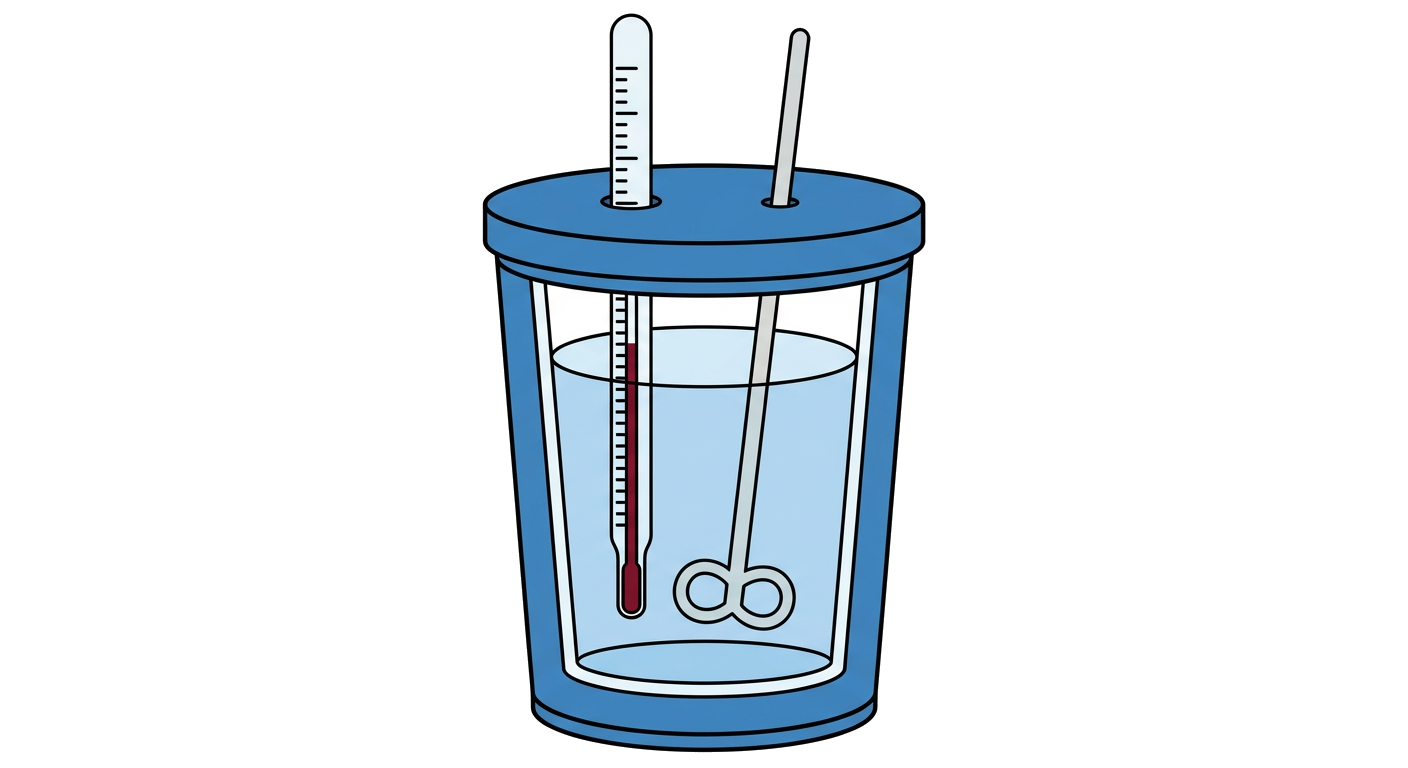
5. Describe the basic function of the calorimeter shown in the diagram above in an experiment to determine the specific heat of a metal.
6. A 50.0 g sample of an unknown metal at 100.0 °C is placed in 75.0 g of water at 20.0 °C in a calorimeter. If the final temperature of the water and metal is 25.0 °C, calculate the specific heat capacity of the metal. (Specific heat of water = 4.18 J/g°C)
7. An exothermic reaction releases heat to its surroundings.
True
False
8. In an ideal calorimeter, there is no heat exchange with the surroundings.
True
False
Use the words below to complete the sentences.
9. A reaction that absorbs heat from its surroundings is called an reaction.
10. In calorimetry, the contents of the calorimeter are considered the , and everything else is the .
Related Worksheets
pH and pOH Calculations Worksheet
A Grade 11 Chemistry worksheet focusing on pH and pOH calculations, including strong acids, bases, and ion concentrations.
Ionic Bonds Worksheet
Explore the fundamentals of ionic bonding, including electron transfer, ion formation, and properties of ionic compounds, suitable for Grade 11 Chemistry students.
Molecular Geometry Worksheet
A Grade 11 Chemistry worksheet focusing on VSEPR theory and molecular shapes, including questions on bond angles and polarity.
Lewis Structure Practice Worksheet
A Grade 11 Chemistry worksheet focusing on drawing and understanding Lewis Structures, including octet rule, formal charge, and resonance.
Molecular Structure Worksheet
A Grade 11 Science worksheet covering key concepts in molecular structure, including VSEPR theory, hybridization, and intermolecular forces.
Calorimetry Principles
This worksheet explores the fundamental principles of calorimetry, including heat transfer, specific heat capacity, and calculations related to calorimetry experiments.
Grade 11 Chemistry: Word Equations
A worksheet for Grade 11 Chemistry students focusing on writing and balancing word equations for chemical reactions.
Types of Chemical Reactions Worksheet
Explore different types of chemical reactions including synthesis, decomposition, single displacement, double displacement, and combustion with this Grade 11 chemistry worksheet.