Chemical Change Fundamentals
Explore the principles of chemical change, including identifying reactions, understanding energy changes, and balancing equations for Grade 11 Chemistry.
Includes
Standards
Topics
Chemical Change Fundamentals
Name:
Date:
Score:
Read each question carefully and provide the best answer. Show all your work for calculations.
1. Which of the following is NOT an indicator of a chemical change?
Formation of a precipitate
Change in state (solid to liquid)
Production of a gas
Significant temperature change
2. What type of reaction absorbs energy from its surroundings?
Exothermic
Endothermic
Combustion
Decomposition
3. In a chemical reaction, the starting materials are called , and the substances formed are called .
4. The law of of mass states that matter cannot be created or destroyed in a chemical reaction.
5. Describe the main difference between a physical change and a chemical change, providing an example for each.
6. Rusting of iron is an example of a physical change.
True
False
7. Balancing a chemical equation ensures that the law of conservation of energy is upheld.
True
False
8. Observe the diagram below showing a type of chemical bond.
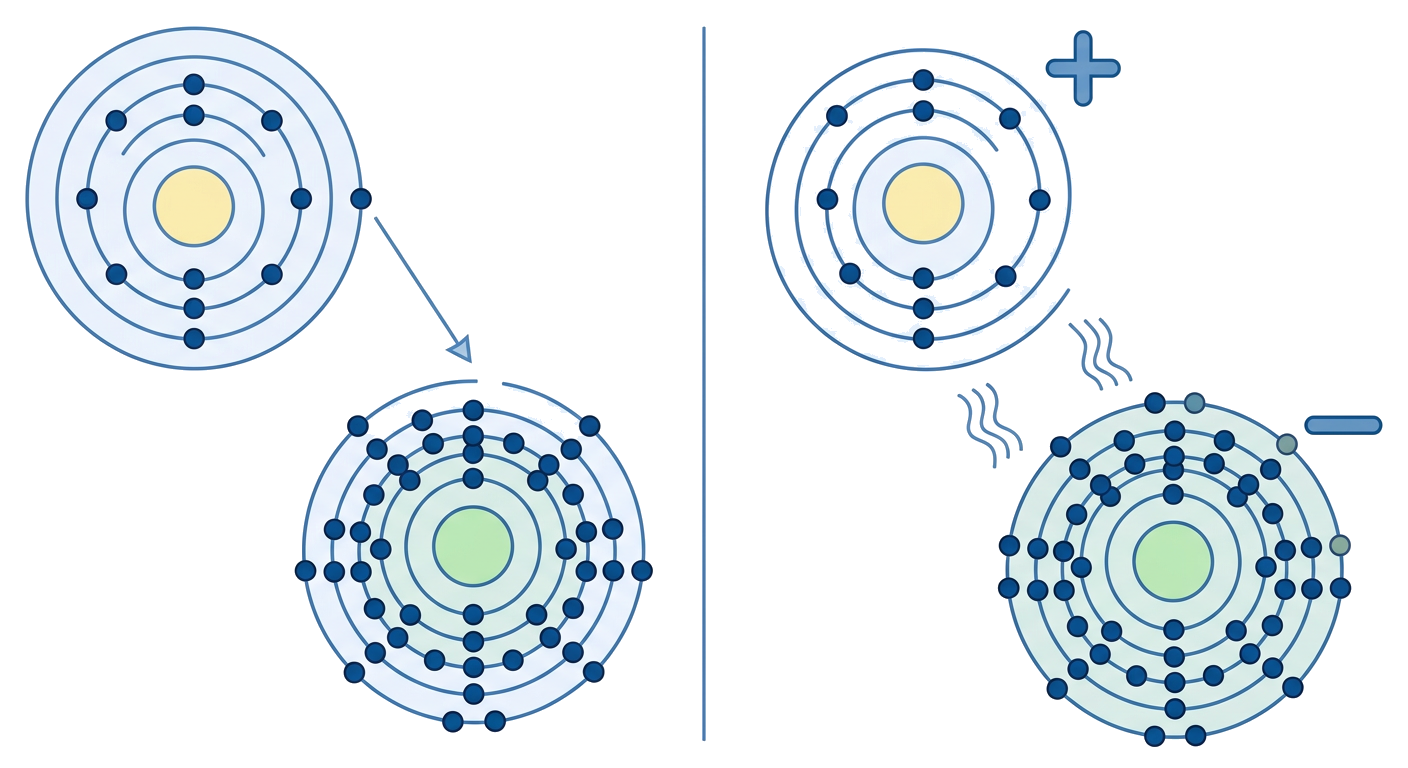
a) Identify the type of chemical bond shown in the diagram.
b) Briefly explain how this type of bond is formed.
Related Worksheets
pH and pOH Calculations Worksheet
A Grade 11 Chemistry worksheet focusing on pH and pOH calculations, including strong acids, bases, and ion concentrations.
Ionic Bonds Worksheet
Explore the fundamentals of ionic bonding, including electron transfer, ion formation, and properties of ionic compounds, suitable for Grade 11 Chemistry students.
Molecular Geometry Worksheet
A Grade 11 Chemistry worksheet focusing on VSEPR theory and molecular shapes, including questions on bond angles and polarity.
Lewis Structure Practice Worksheet
A Grade 11 Chemistry worksheet focusing on drawing and understanding Lewis Structures, including octet rule, formal charge, and resonance.
Molecular Structure Worksheet
A Grade 11 Science worksheet covering key concepts in molecular structure, including VSEPR theory, hybridization, and intermolecular forces.
Calorimetry Principles
This worksheet explores the fundamental principles of calorimetry, including heat transfer, specific heat capacity, and calculations related to calorimetry experiments.
Grade 11 Chemistry: Word Equations
A worksheet for Grade 11 Chemistry students focusing on writing and balancing word equations for chemical reactions.
Types of Chemical Reactions Worksheet
Explore different types of chemical reactions including synthesis, decomposition, single displacement, double displacement, and combustion with this Grade 11 chemistry worksheet.