Flame Test Analysis Worksheet
A Grade 11 Chemistry worksheet on flame tests, identifying metal ions by their characteristic colors, and understanding the underlying atomic principles.
Includes
Standards
Topics
Flame Test Analysis
Name:
Date:
Score:
Read each question carefully and provide concise answers based on your knowledge of flame tests and atomic structure. Ensure all safety precautions are considered.
1. What is the fundamental principle behind a flame test, and how does it allow for the identification of different metal ions?
2. Which of the following safety precautions is most crucial when conducting a flame test in a laboratory setting?
Wearing a lab coat only
Ensuring proper ventilation and wearing safety goggles
Using a very small sample size
Keeping a fire extinguisher nearby at all times
3. The image below shows a Bunsen burner, a common piece of equipment in a chemistry lab. What is its primary function in a flame test?
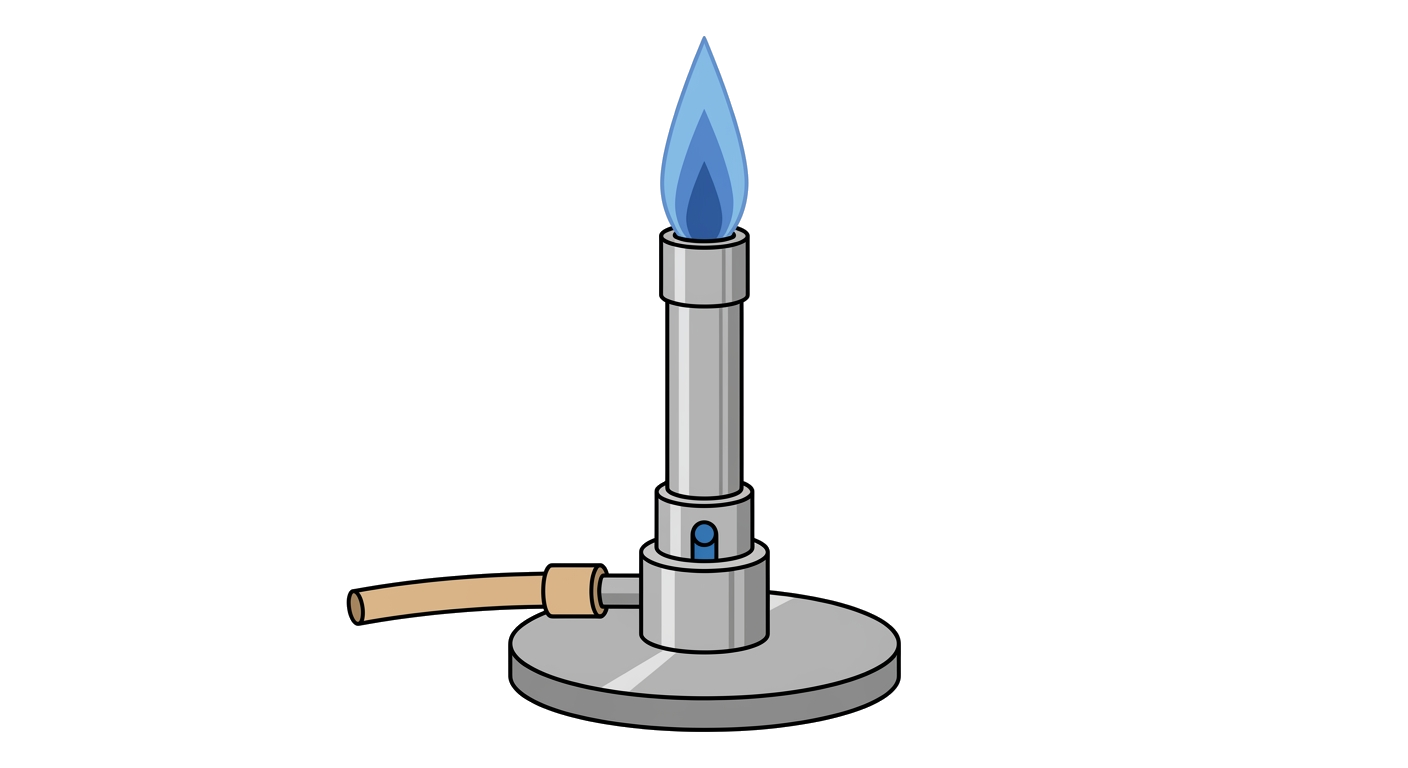
To hold the sample being tested
To provide a hot, non-luminous flame
To measure the temperature of the flame
To filter out impurities from the sample
4. When an electron in a metal atom absorbs energy from the flame, it jumps to a higher energy level, becoming . When it falls back to a lower energy level, it emits light of a specific .
5. True or False: All metal ions produce a characteristic color in a flame test, making it a universally applicable identification method.
True
False
6. Match the metal ion with its characteristic flame test color.
i. Lithium
A. Lilac (purple-red)
ii. Sodium
B. Crimson red
iii. Potassium
C. Orange-red
iv. Calcium
D. Bright yellow
7. Discuss the limitations of the flame test as an analytical technique. What factors can interfere with accurate results, and how can these interferences be minimized?
8. The image provided shows standard laboratory safety goggles. Explain why wearing such goggles is absolutely essential during a flame test.

Related Worksheets
pH and pOH Calculations Worksheet
A Grade 11 Chemistry worksheet focusing on pH and pOH calculations, including strong acids, bases, and ion concentrations.
Ionic Bonds Worksheet
Explore the fundamentals of ionic bonding, including electron transfer, ion formation, and properties of ionic compounds, suitable for Grade 11 Chemistry students.
Molecular Geometry Worksheet
A Grade 11 Chemistry worksheet focusing on VSEPR theory and molecular shapes, including questions on bond angles and polarity.
Lewis Structure Practice Worksheet
A Grade 11 Chemistry worksheet focusing on drawing and understanding Lewis Structures, including octet rule, formal charge, and resonance.
Molecular Structure Worksheet
A Grade 11 Science worksheet covering key concepts in molecular structure, including VSEPR theory, hybridization, and intermolecular forces.
Calorimetry Principles
This worksheet explores the fundamental principles of calorimetry, including heat transfer, specific heat capacity, and calculations related to calorimetry experiments.
Grade 11 Chemistry: Word Equations
A worksheet for Grade 11 Chemistry students focusing on writing and balancing word equations for chemical reactions.
Types of Chemical Reactions Worksheet
Explore different types of chemical reactions including synthesis, decomposition, single displacement, double displacement, and combustion with this Grade 11 chemistry worksheet.