Molality Practice Worksheet
A Grade 11 Chemistry worksheet focusing on calculating molality, understanding its applications, and differentiating it from molarity.
Includes
Standards
Topics
Molality Practice Worksheet
Name:
Date:
Score:
Read each question carefully and show all your work. Use the provided space for calculations and answers. Remember to include appropriate units in your final answers.
1. Molality (m) is defined as the number of moles of per kilogram of .
2. Unlike molarity, molality is independent of because it is based on mass, not volume.
3. The unit for molality is or .
4. Calculate the molality of a solution prepared by dissolving 25.0 g of NaCl (Molar mass = 58.44 g/mol) in 500.0 g of water.
5. A solution contains 15.0 g of sucrose (C₁₂H₂₂O₁₁, Molar mass = 342.3 g/mol) dissolved in 200.0 mL of ethanol. If the density of ethanol is 0.789 g/mL, what is the molality of the solution?
6. Which of the following statements is TRUE regarding molality and molarity?
Molarity changes with temperature, but molality does not.
Both molarity and molality are dependent on the volume of the solution.
Molality is moles of solute per liter of solution.
Molarity is used for colligative properties, while molality is not.
7. Explain why molality is often preferred over molarity in studies involving colligative properties.
8. Adding more solvent to a solution will decrease its molality.
True
False
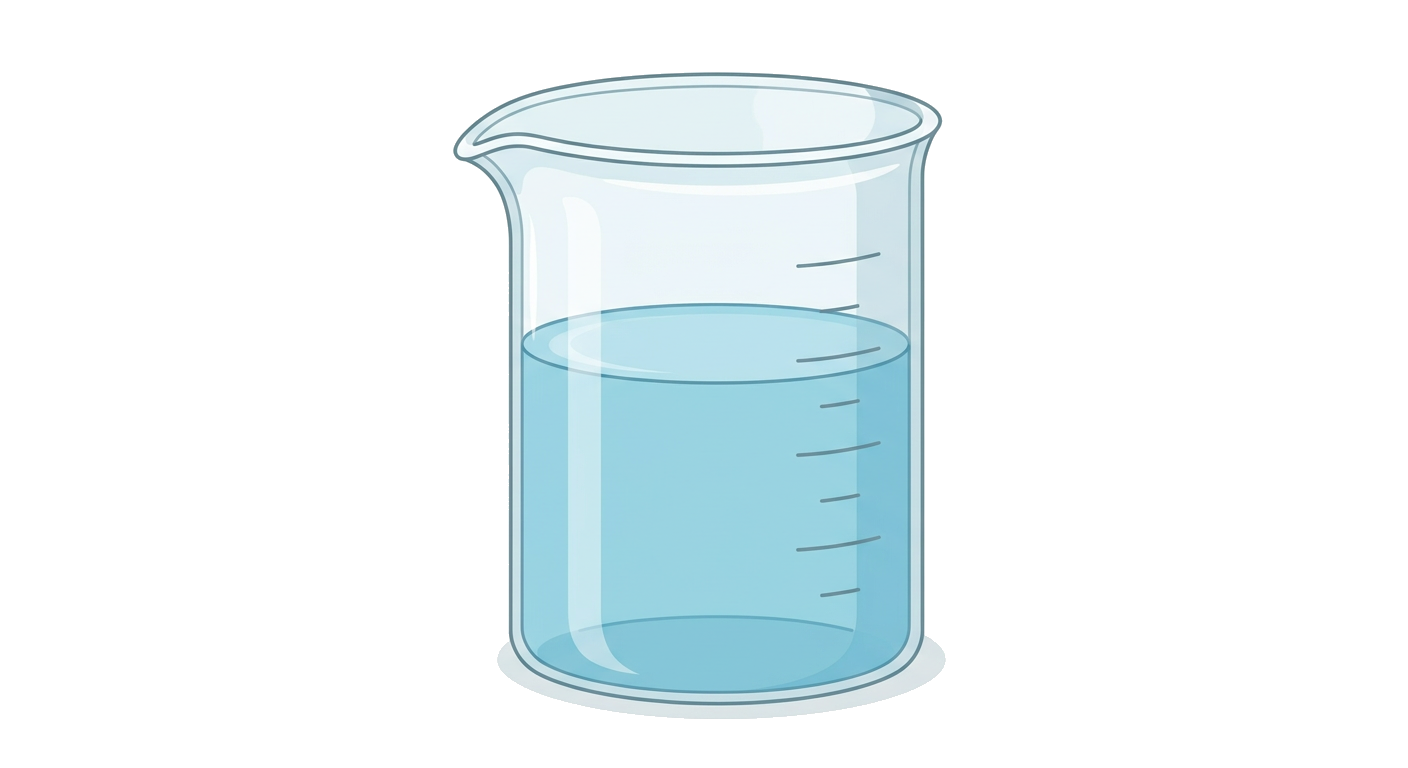
Imagine you are preparing a solution in the beaker shown. If you add 10.0 g of glucose (C₆H₁₂O₆, Molar mass = 180.16 g/mol) to 125 g of water. What is the molality of this glucose solution?
Related Worksheets
pH and pOH Calculations Worksheet
A Grade 11 Chemistry worksheet focusing on pH and pOH calculations, including strong acids, bases, and ion concentrations.
Ionic Bonds Worksheet
Explore the fundamentals of ionic bonding, including electron transfer, ion formation, and properties of ionic compounds, suitable for Grade 11 Chemistry students.
Molecular Geometry Worksheet
A Grade 11 Chemistry worksheet focusing on VSEPR theory and molecular shapes, including questions on bond angles and polarity.
Lewis Structure Practice Worksheet
A Grade 11 Chemistry worksheet focusing on drawing and understanding Lewis Structures, including octet rule, formal charge, and resonance.
Molecular Structure Worksheet
A Grade 11 Science worksheet covering key concepts in molecular structure, including VSEPR theory, hybridization, and intermolecular forces.
Calorimetry Principles
This worksheet explores the fundamental principles of calorimetry, including heat transfer, specific heat capacity, and calculations related to calorimetry experiments.
Grade 11 Chemistry: Word Equations
A worksheet for Grade 11 Chemistry students focusing on writing and balancing word equations for chemical reactions.
Types of Chemical Reactions Worksheet
Explore different types of chemical reactions including synthesis, decomposition, single displacement, double displacement, and combustion with this Grade 11 chemistry worksheet.