Ionic Compound Nomenclature Worksheet
A worksheet for Grade 11 Chemistry students to practice naming and writing formulas for ionic compounds.
Includes
Standards
Topics
Ionic Compound Nomenclature
Name:
Date:
Score:
Read each question carefully and provide the correct name or formula for the given ionic compounds. Remember to consider polyatomic ions and transition metals requiring Roman numerals.
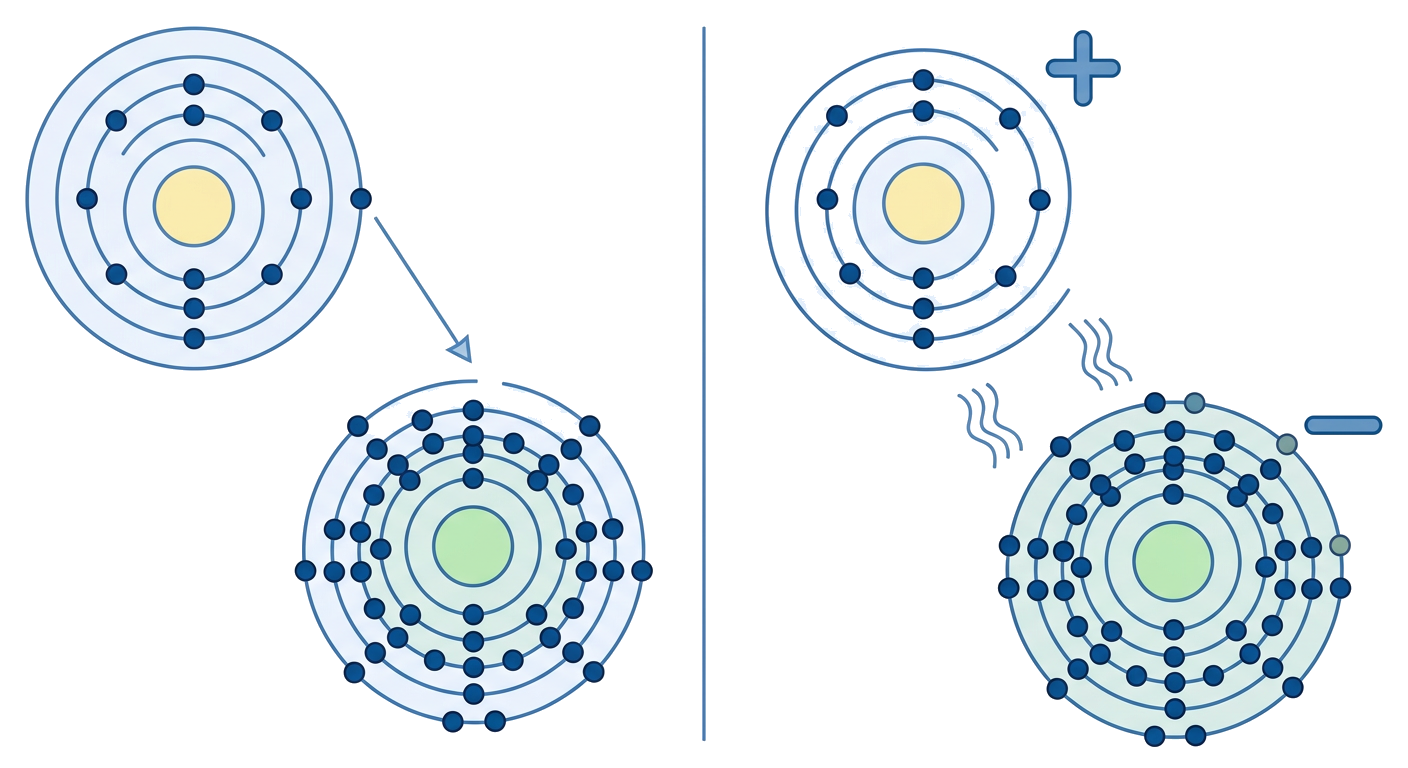
Ionic compounds are formed when electrons are transferred between atoms, creating oppositely charged ions that attract each other. This illustration shows the formation of an ionic bond.
Write the name for each of the following binary ionic compounds:
1. NaCl:
2. KBr:
3. CaCl2:
4. Al2O3:
Write the name for each of the following ionic compounds containing transition metals (remember Roman numerals):
5. FeCl3:
6. CuO:
7. Cr2O3:
Write the chemical formula for each of the following binary ionic compounds:
8. Magnesium iodide:
9. Sodium sulfide:
10. Barium phosphide:
Write the chemical formula for each of the following ionic compounds:
11. Copper(II) nitrate:
12. Ammonium chloride:
13. Iron(III) sulfate:
14. Calcium hydroxide:
15. Which of the following is the correct name for K3PO4?
Potassium phosphite
Tripotassium phosphate
Potassium phosphate
Potassium phosphorus oxide
16. Explain why Roman numerals are used when naming ionic compounds containing transition metals, but not for compounds with alkali metals or alkaline earth metals.
Related Worksheets
pH and pOH Calculations Worksheet
A Grade 11 Chemistry worksheet focusing on pH and pOH calculations, including strong acids, bases, and ion concentrations.
Ionic Bonds Worksheet
Explore the fundamentals of ionic bonding, including electron transfer, ion formation, and properties of ionic compounds, suitable for Grade 11 Chemistry students.
Molecular Geometry Worksheet
A Grade 11 Chemistry worksheet focusing on VSEPR theory and molecular shapes, including questions on bond angles and polarity.
Lewis Structure Practice Worksheet
A Grade 11 Chemistry worksheet focusing on drawing and understanding Lewis Structures, including octet rule, formal charge, and resonance.
Molecular Structure Worksheet
A Grade 11 Science worksheet covering key concepts in molecular structure, including VSEPR theory, hybridization, and intermolecular forces.
Calorimetry Principles
This worksheet explores the fundamental principles of calorimetry, including heat transfer, specific heat capacity, and calculations related to calorimetry experiments.
Grade 11 Chemistry: Word Equations
A worksheet for Grade 11 Chemistry students focusing on writing and balancing word equations for chemical reactions.
Types of Chemical Reactions Worksheet
Explore different types of chemical reactions including synthesis, decomposition, single displacement, double displacement, and combustion with this Grade 11 chemistry worksheet.