Thin Layer Chromatography (TLC) Worksheet
Grade 11 Chemistry worksheet on Thin Layer Chromatography covering principles, applications, and calculations.
Includes
Standards
Topics
Thin Layer Chromatography (TLC) Worksheet
Name:
Date:
Score:
Read each question carefully and provide your answers in the space provided. For multiple-choice questions, circle the correct option. For calculations, show all your work.
Thin Layer Chromatography (TLC) is a widely used analytical technique for separating non-volatile mixtures. It is a quick, inexpensive, and simple method to monitor the progress of reactions, identify compounds present in a given substance, and determine the purity of a substance.
1. Which of the following is the stationary phase in Thin Layer Chromatography?
Solvent
Mobile phase
Adsorbent coated plate
Analyte
2. What is the primary principle behind the separation of compounds in TLC?
Boiling point differences
Differences in solubility and adsorption
Molecular weight differences
Density differences
3. Briefly explain the role of the mobile phase in TLC.
4. List two common applications of Thin Layer Chromatography in a chemistry laboratory.
5. The distance traveled by a compound relative to the solvent front is known as the factor.
6. A TLC plate is typically made of a solid support (like glass, plastic, or aluminum foil) coated with a thin layer of material.
Refer to the diagram below showing a typical Thin Layer Chromatography setup.
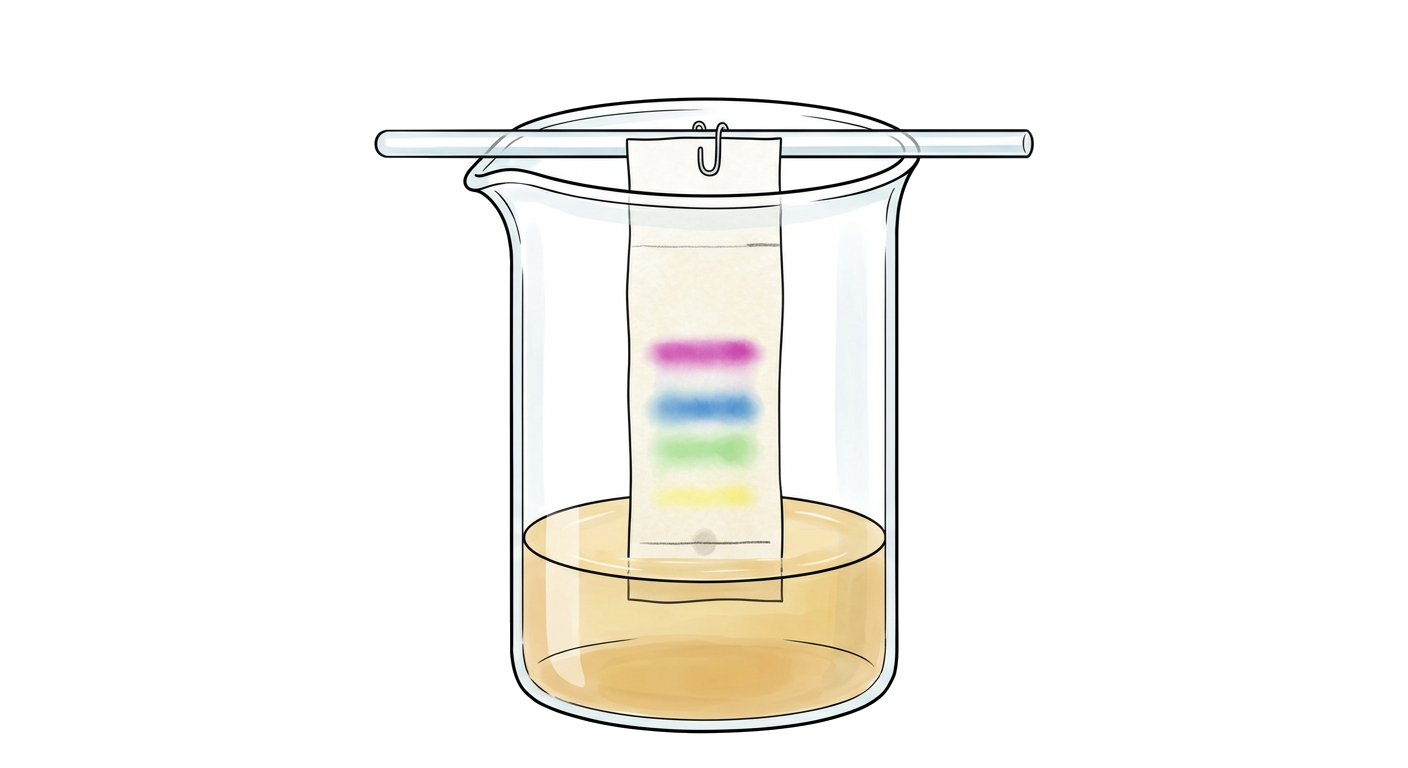
7. In a TLC experiment, compound X traveled 4.5 cm from the origin, and the solvent front traveled 9.0 cm. Calculate the Rf value for compound X. Show your work.
8. A higher Rf value indicates that the compound has a stronger interaction with the stationary phase.
True
False
Related Worksheets
pH and pOH Calculations Worksheet
A Grade 11 Chemistry worksheet focusing on pH and pOH calculations, including strong acids, bases, and ion concentrations.
Ionic Bonds Worksheet
Explore the fundamentals of ionic bonding, including electron transfer, ion formation, and properties of ionic compounds, suitable for Grade 11 Chemistry students.
Molecular Geometry Worksheet
A Grade 11 Chemistry worksheet focusing on VSEPR theory and molecular shapes, including questions on bond angles and polarity.
Lewis Structure Practice Worksheet
A Grade 11 Chemistry worksheet focusing on drawing and understanding Lewis Structures, including octet rule, formal charge, and resonance.
Molecular Structure Worksheet
A Grade 11 Science worksheet covering key concepts in molecular structure, including VSEPR theory, hybridization, and intermolecular forces.
Calorimetry Principles
This worksheet explores the fundamental principles of calorimetry, including heat transfer, specific heat capacity, and calculations related to calorimetry experiments.
Grade 11 Chemistry: Word Equations
A worksheet for Grade 11 Chemistry students focusing on writing and balancing word equations for chemical reactions.
Types of Chemical Reactions Worksheet
Explore different types of chemical reactions including synthesis, decomposition, single displacement, double displacement, and combustion with this Grade 11 chemistry worksheet.