Titration Fundamentals Worksheet
This worksheet covers the fundamental principles and practical aspects of acid-base titrations, including calculations and indicator selection, suitable for Grade 11 Chemistry students.
Includes
Standards
Titration Fundamentals
Name:
Date:
Score:
Read each question carefully and provide your answers in the space provided. Show all your work for calculations.
1. What is the primary purpose of a titration?
To determine the pH of a solution.
To find the concentration of an unknown solution.
To prepare a standard solution.
To measure the volume of a liquid.
2. Which piece of glassware is used to deliver a precise, variable volume of liquid in a titration?
Volumetric flask
Beaker
Burette
Pipette
1. The point at which the indicator changes color during a titration is called the .
2. In an acid-base titration, a reaction occurs between the acid and the base.
3. A solution of known concentration, used to determine the concentration of an unknown solution, is called a solution.
1. Describe the difference between the equivalence point and the endpoint in a titration.
2. Explain why an indicator is necessary for most acid-base titrations.
Observe the image below, depicting a burette, a key piece of equipment in a titration experiment. Then answer the questions that follow.
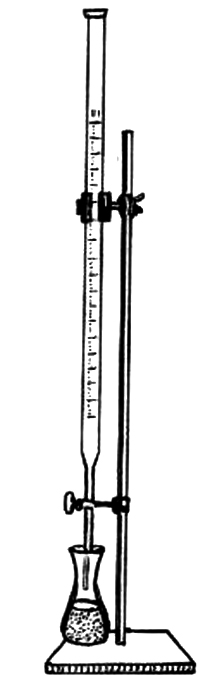
1. What is the primary function of the stopcock on a burette?
2. Why is it important to read the meniscus at eye level when using a burette?
In a titration, 25.0 mL of an unknown concentration of HCl is titrated with 0.150 M NaOH. If 32.5 mL of NaOH is required to reach the equivalence point, what is the concentration of the HCl solution? (Show all steps of your calculation).
Related Worksheets
pH and pOH Calculations Worksheet
A Grade 11 Chemistry worksheet focusing on pH and pOH calculations, including strong acids, bases, and ion concentrations.
Ionic Bonds Worksheet
Explore the fundamentals of ionic bonding, including electron transfer, ion formation, and properties of ionic compounds, suitable for Grade 11 Chemistry students.
Molecular Geometry Worksheet
A Grade 11 Chemistry worksheet focusing on VSEPR theory and molecular shapes, including questions on bond angles and polarity.
Lewis Structure Practice Worksheet
A Grade 11 Chemistry worksheet focusing on drawing and understanding Lewis Structures, including octet rule, formal charge, and resonance.
Molecular Structure Worksheet
A Grade 11 Science worksheet covering key concepts in molecular structure, including VSEPR theory, hybridization, and intermolecular forces.
Calorimetry Principles
This worksheet explores the fundamental principles of calorimetry, including heat transfer, specific heat capacity, and calculations related to calorimetry experiments.
Grade 11 Chemistry: Word Equations
A worksheet for Grade 11 Chemistry students focusing on writing and balancing word equations for chemical reactions.
Types of Chemical Reactions Worksheet
Explore different types of chemical reactions including synthesis, decomposition, single displacement, double displacement, and combustion with this Grade 11 chemistry worksheet.