Writing Formulas for Covalent Compounds
A Grade 11 chemistry worksheet on understanding and writing chemical formulas for covalent compounds, focusing on prefixes and naming conventions.
Includes
Standards
Topics
Writing Formulas for Covalent Compounds
Name:
Date:
Score:
Read each question carefully and provide the best answer. Remember the rules for naming and writing formulas for covalent compounds.
Covalent compounds are formed when two nonmetals share electrons. The chemical formula for a covalent compound indicates the number of atoms of each element present in the molecule. Prefixes are used to denote the number of atoms.
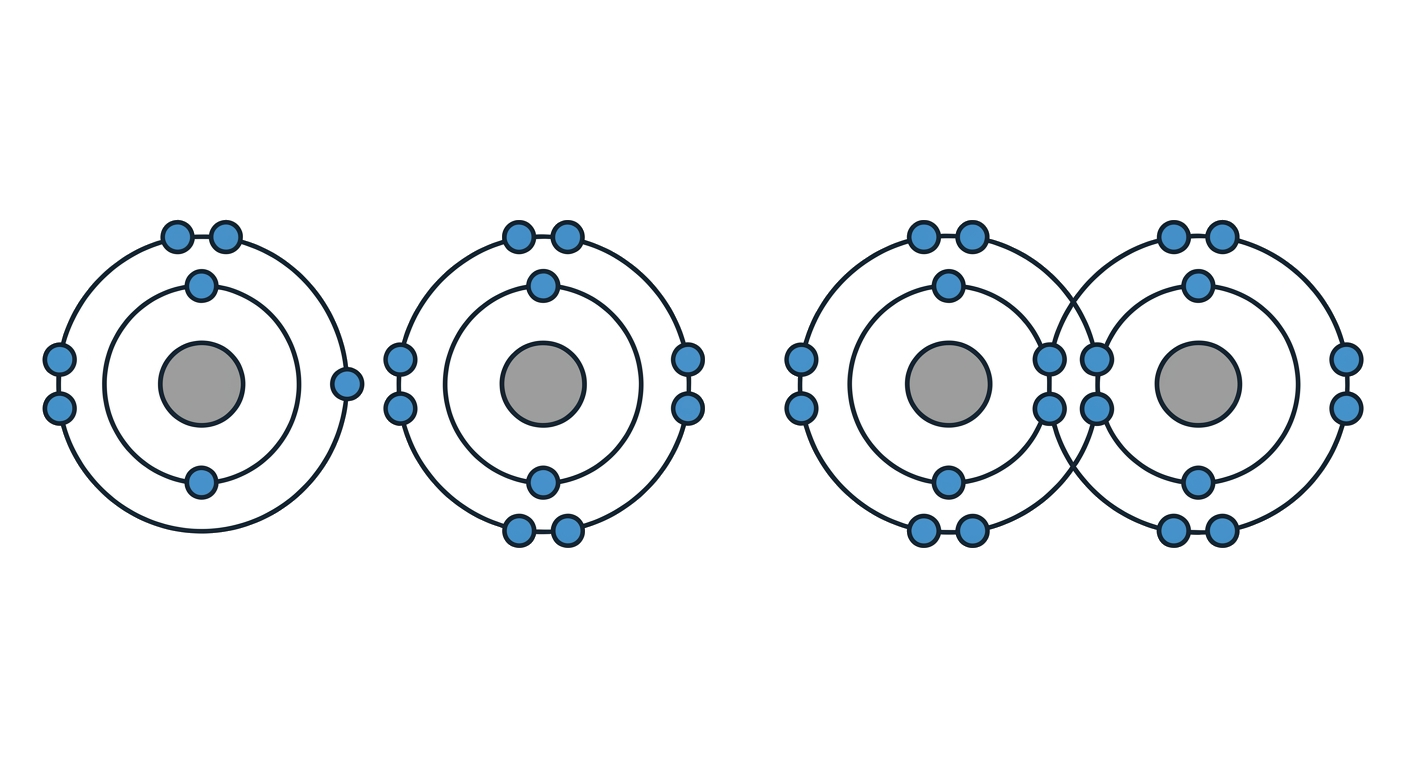
1. Covalent compounds are formed between two atoms.
2. When writing chemical formulas for covalent compounds, numerical prefixes are used to indicate the number of of each element.
3. The prefix for 'two' is .
4. The compound with the formula CO is named carbon .
5. The second element in a binary covalent compound always ends with the suffix .
6. What is the correct chemical formula for dinitrogen pentoxide?
N5O2
N2O5
N2O
NO5
7. What is the name of the compound with the formula PCl3?
Phosphorus chloride
Phosphorus trichloride
Triphosphorus chloride
Monophosphorus trichloride
Write the chemical formula for each of the following covalent compounds:
8. Sulfur dioxide
9. Carbon tetrachloride
10. Dihydrogen monoxide
11. Nitrogen trifluoride
Write the name for each of the following covalent compounds:
12. N2O4
13. SF6
14. SiO2
15. HBr
16. The prefix 'mono' is always used for the first element in a covalent compound if there is only one atom.
True
False
17. The compound N2O is named dinitrogen monoxide.
True
False
Related Worksheets
pH and pOH Calculations Worksheet
A Grade 11 Chemistry worksheet focusing on pH and pOH calculations, including strong acids, bases, and ion concentrations.
Ionic Bonds Worksheet
Explore the fundamentals of ionic bonding, including electron transfer, ion formation, and properties of ionic compounds, suitable for Grade 11 Chemistry students.
Molecular Geometry Worksheet
A Grade 11 Chemistry worksheet focusing on VSEPR theory and molecular shapes, including questions on bond angles and polarity.
Lewis Structure Practice Worksheet
A Grade 11 Chemistry worksheet focusing on drawing and understanding Lewis Structures, including octet rule, formal charge, and resonance.
Molecular Structure Worksheet
A Grade 11 Science worksheet covering key concepts in molecular structure, including VSEPR theory, hybridization, and intermolecular forces.
Calorimetry Principles
This worksheet explores the fundamental principles of calorimetry, including heat transfer, specific heat capacity, and calculations related to calorimetry experiments.
Grade 11 Chemistry: Word Equations
A worksheet for Grade 11 Chemistry students focusing on writing and balancing word equations for chemical reactions.
Types of Chemical Reactions Worksheet
Explore different types of chemical reactions including synthesis, decomposition, single displacement, double displacement, and combustion with this Grade 11 chemistry worksheet.