Daylight Saving Time: Impact and Debate
An 11th-grade science worksheet exploring the history, mechanisms, and societal impacts of Daylight Saving Time.
Includes
Standards
Daylight Saving Time: Impact and Debate
Name:
Date:
Score:
Read each question carefully and provide thoughtful answers based on your understanding of Daylight Saving Time, its scientific basis, and its societal implications.
1. The primary astronomical reason for the varying lengths of daylight throughout the year, which Daylight Saving Time attempts to adjust for, is:
The Earth's elliptical orbit around the sun.
The Earth's daily rotation on its axis.
The tilt of the Earth's axis relative to its orbital plane.
Variations in solar radiation due to sunspot activity.
2. Which of the following is NOT a commonly cited benefit of Daylight Saving Time?
Reduced energy consumption.
Increased agricultural productivity.
Decreased traffic accidents.
Promotion of outdoor leisure activities.
3. The concept of Daylight Saving Time was first proposed by in 1895 to make better use of daylight.
4. When observing Daylight Saving Time, clocks are typically moved by one hour in the spring.
5. All countries around the world observe Daylight Saving Time.
True
False
6. Research consistently shows a significant reduction in crime rates directly attributable to Daylight Saving Time.
True
False
7. Explain how the Earth's axial tilt influences the duration of daylight hours throughout the year, especially in relation to the solstices.
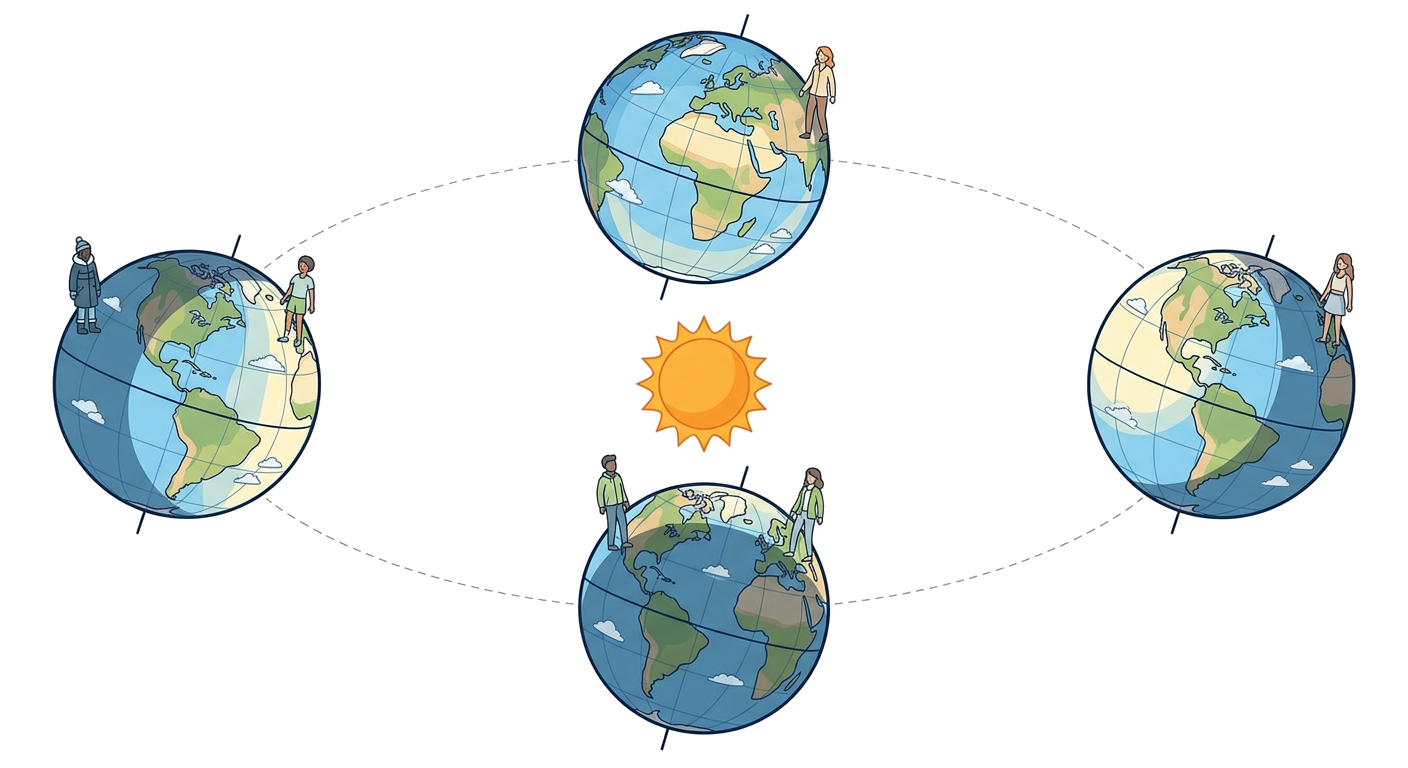
8. Discuss two potential negative health impacts associated with the time changes due to Daylight Saving Time.
9. Argue for or against the continued observance of Daylight Saving Time, presenting at least three distinct arguments based on scientific, economic, or social factors. Support your arguments with evidence or logical reasoning.
Related Worksheets
The Carbon Cycle Worksheet
An 11th-grade science worksheet focusing on the carbon cycle, its processes, reservoirs, and human impact.
Climatograph Analysis Worksheet
Analyze and interpret climatographs to understand regional climate patterns and their impact on ecosystems.
Geological Time Scale Exploration
Explore the history of Earth through the geological time scale, understanding major eons, eras, periods, and significant events.
Rain Shadow Effect Worksheet
Explore the rain shadow effect, a meteorological phenomenon that creates arid conditions on the leeward side of mountain ranges, impacting climate and ecosystems.
Rock Cycle Exploration
Explore the processes and types of rocks involved in the Earth's rock cycle.