Glacier Science Worksheet
An 11th-grade science worksheet covering the formation, types, movement, and impact of glaciers on Earth's landscape.
Includes
Standards
Topics
Glacier Science
Name:
Date:
Score:
Read each question carefully and answer to the best of your ability. Show all your work for calculations.
1. A large, perennial accumulation of crystalline ice, snow, rock, sediment, and liquid water that originates on land and moves downslope under the influence of its own weight and gravity is known as a .
2. The process by which glacial ice breaks off into a body of water, forming icebergs, is called .
3. The zone of a glacier where accumulation exceeds ablation is known as the zone.
4. Long, linear hills of till that are streamlined in the direction of ice flow are called .
5. Which of the following is NOT a type of glacier?
Valley glacier
Ice sheet
Cirque glacier
River glacier
6. What is the primary mechanism by which glaciers erode the landscape?
Wind abrasion
Chemical weathering
Plucking and abrasion
Fluvial erosion
7. Describe the two main processes of glacial movement.
8. Explain how a U-shaped valley is formed by glacial erosion.
9. Glaciers only exist in polar regions.
True
False
10. The accumulation zone of a glacier is where ice melts faster than it accumulates.
True
False
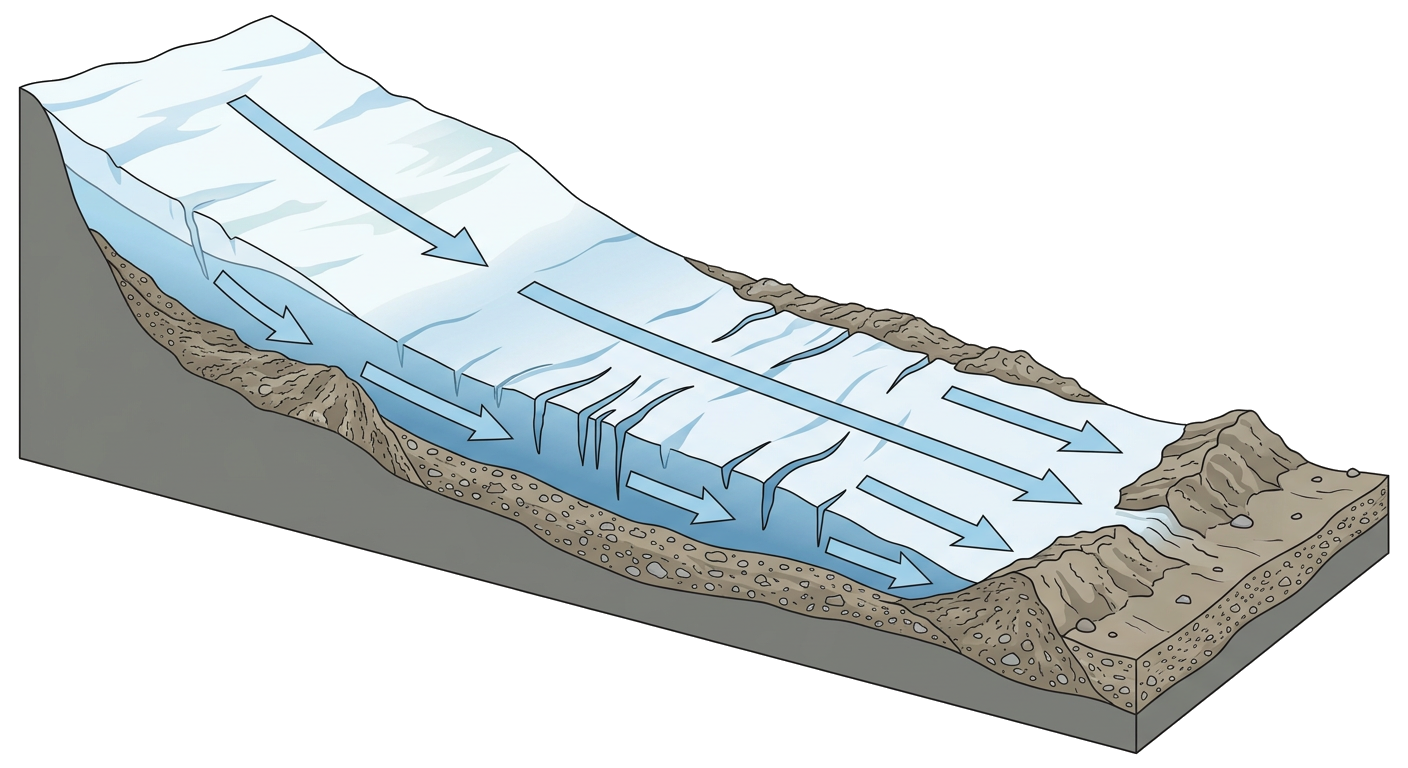
11. Observe the glacier cross-section below. Label the accumulation zone, ablation zone, and equilibrium line.
Match the glacial feature with its description.
12. Moraine
a. Sharp, jagged ridge formed between two cirques.
13. Cirque
b. Bowl-shaped depression at the head of a glacial valley.
14. Arete
c. Ridge of unsorted sediment deposited by a glacier.
15. Fjord
d. Long, narrow, deep inlet of the sea between high, steep-sided cliffs.
16. Discuss the impact of climate change on glaciers globally and explain at least two significant consequences of glacial retreat.
Related Worksheets
The Carbon Cycle Worksheet
An 11th-grade science worksheet focusing on the carbon cycle, its processes, reservoirs, and human impact.
Climatograph Analysis Worksheet
Analyze and interpret climatographs to understand regional climate patterns and their impact on ecosystems.
Geological Time Scale Exploration
Explore the history of Earth through the geological time scale, understanding major eons, eras, periods, and significant events.
Rain Shadow Effect Worksheet
Explore the rain shadow effect, a meteorological phenomenon that creates arid conditions on the leeward side of mountain ranges, impacting climate and ecosystems.
Rock Cycle Exploration
Explore the processes and types of rocks involved in the Earth's rock cycle.