Greenhouse Gases Worksheet
An 11th-grade science worksheet covering the causes, effects, and mitigation of greenhouse gases.
Includes
Standards
Topics
Greenhouse Gases: Causes, Effects, and Solutions
Name:
Date:
Score:
Read each question carefully and answer to the best of your ability. Show all work where applicable.
1. Which of the following is NOT considered a major greenhouse gas?
Carbon Dioxide
Methane
Nitrogen
Nitrous Oxide
2. The primary natural process responsible for the greenhouse effect is:
Absorption of solar radiation by oceans
Reflection of sunlight by clouds
Trapping of infrared radiation by atmospheric gases
Volcanic eruptions releasing heat
3. The increase in global average temperature due to the enhanced greenhouse effect is known as .
4. Deforestation contributes to the increase of carbon dioxide in the atmosphere because trees absorb CO2 through the process of .
5. Briefly explain the difference between the natural greenhouse effect and the enhanced greenhouse effect.
6. Observe the diagram below illustrating the greenhouse effect. Label the components indicated by the arrows.
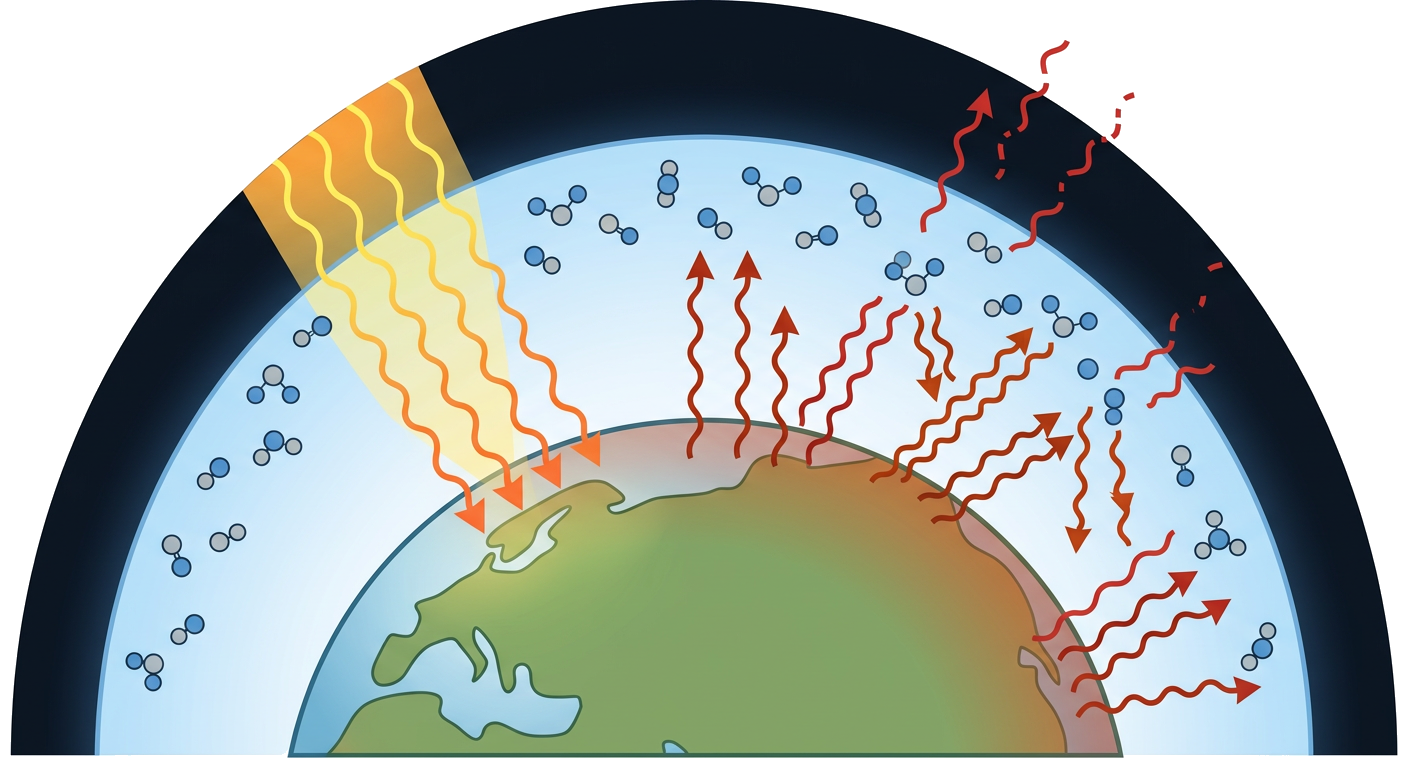
A:
B:
C:
D:
7. Water vapor is the most abundant greenhouse gas in Earth's atmosphere.
True
False
Match each greenhouse gas with its primary source.
8. Carbon Dioxide
a. Livestock farming, landfills
9. Methane
b. Burning of fossil fuels, deforestation
10. Nitrous Oxide
c. Agricultural practices, industrial processes
11. Discuss at least three significant impacts of increased greenhouse gas concentrations on Earth's climate and ecosystems. Propose two potential solutions to mitigate these impacts.
Related Worksheets
Convection in the Earth's Mantle
Explore the process of convection within the Earth's mantle and its role in plate tectonics. This worksheet covers key concepts, definitions, and the impact of mantle convection.
Sedimentary Rocks Worksheet
Explore the formation, characteristics, and classification of sedimentary rocks at a Grade 11 level, covering key processes and rock types.
Ocean Layers Exploration
Explore the distinct characteristics and inhabitants of the various layers of the ocean.
Continental Drift Worksheet
Explore the theory of continental drift, Pangea, and evidence supporting plate tectonics with this Grade 11 science worksheet.
Soil Horizons Exploration
This worksheet explores the different layers of soil, known as soil horizons, their characteristics, and their importance in various ecosystems.
Plate Tectonics Worksheet
An 11th-grade science worksheet covering the fundamentals of plate tectonics, including plate boundaries, geological features, and driving forces.
Plate Boundary Exploration
This worksheet explores the different types of plate boundaries, their geological features, and the processes that occur at each boundary. Suitable for Grade 11 Earth & Space Science.
Mass Extinction Events
Explore the causes, effects, and characteristics of major mass extinction events throughout Earth's history.