Relative Dating of Fossils
This worksheet covers the principles of relative dating, including the Law of Superposition, original horizontality, and cross-cutting relationships, as applied to fossil analysis.
Includes
Standards
Topics
Relative Dating of Fossils Worksheet
Name:
Date:
Score:
Read each question carefully and answer to the best of your ability. Refer to the provided diagrams where applicable.
1. Which principle states that in an undisturbed sequence of sedimentary rocks, the oldest layers are at the bottom and the youngest are at the top?
Principle of Original Horizontality
Law of Superposition
Principle of Cross-Cutting Relationships
Principle of Faunal Succession
2. An igneous intrusion cuts across several layers of sedimentary rock. According to the Principle of Cross-Cutting Relationships, which is older?
The igneous intrusion
The sedimentary rock layers
They are the same age
Cannot be determined
3. The principle of states that sedimentary rock layers are originally deposited in horizontal or nearly horizontal layers.
4. An fossil is a fossil that is useful for dating and correlating the strata in which it is found.
5. Relative dating provides an exact numerical age for geological events.
True
False
6. Unconformities represent gaps in the geological record.
True
False
7. Observe the diagram below showing various rock layers and geological features. Based on the principles of relative dating, identify the youngest geological feature and explain your reasoning.
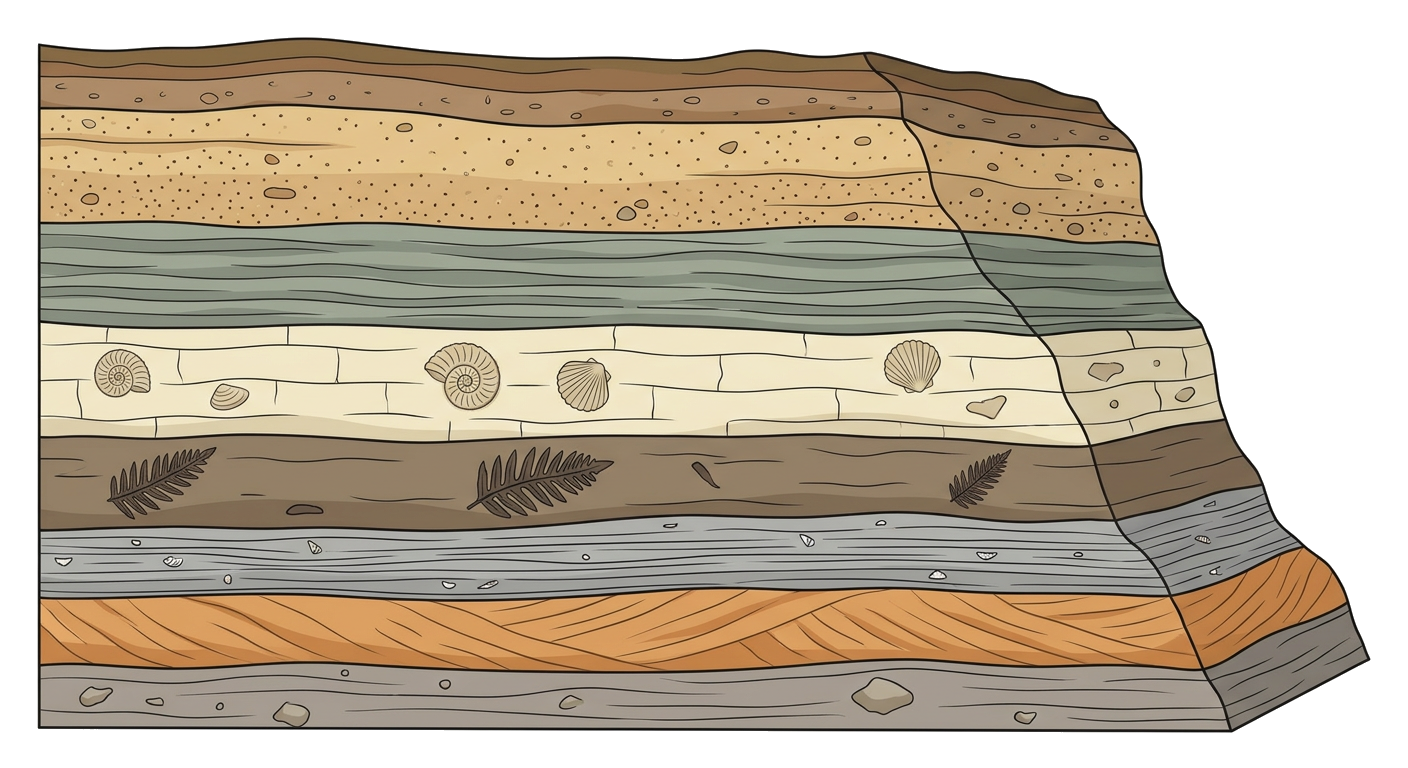
Youngest Feature:
Reasoning:
8. Describe how index fossils are used in relative dating to correlate rock layers across different locations.
Match each geological principle with its definition.
9. Law of Superposition
a. Sedimentary layers are deposited horizontally.
10. Principle of Original Horizontality
b. Faults or intrusions are younger than the rocks they cut.
11. Principle of Cross-Cutting Relationships
c. Oldest layers are at the bottom, youngest at the top.
Related Worksheets
The Carbon Cycle Worksheet
An 11th-grade science worksheet focusing on the carbon cycle, its processes, reservoirs, and human impact.
Climatograph Analysis Worksheet
Analyze and interpret climatographs to understand regional climate patterns and their impact on ecosystems.
Geological Time Scale Exploration
Explore the history of Earth through the geological time scale, understanding major eons, eras, periods, and significant events.
Rain Shadow Effect Worksheet
Explore the rain shadow effect, a meteorological phenomenon that creates arid conditions on the leeward side of mountain ranges, impacting climate and ecosystems.
Rock Cycle Exploration
Explore the processes and types of rocks involved in the Earth's rock cycle.