Spring Potential Energy and Hooke's Law Worksheet
Explore Hooke's Law and calculate spring potential energy with this Grade 11 physics worksheet.
Includes
Standards
Topics
Spring Potential Energy and Hooke's Law
Name:
Date:
Score:
Read each question carefully and provide your answers in the space provided. Show all your work for calculation problems.
1. State Hooke's Law in words and as a mathematical equation. Explain the meaning of each variable in the equation.
2. Which of the following statements is true regarding spring potential energy?
It is directly proportional to the displacement of the spring.
It is inversely proportional to the square of the spring constant.
It is proportional to the square of the displacement of the spring from its equilibrium position.
It is always negative.
3. The constant 'k' in Hooke's Law represents the of the spring.
4. When a spring is compressed or stretched, it stores energy.
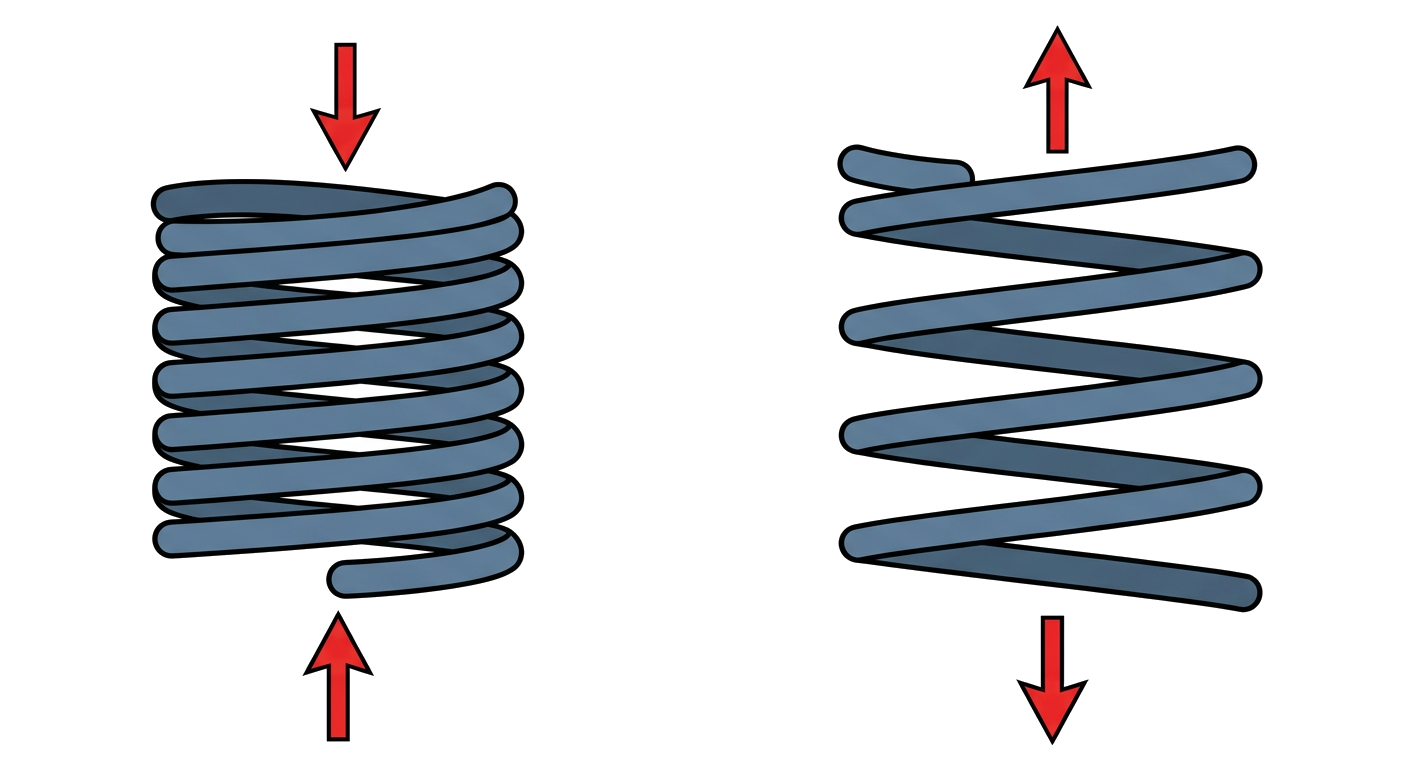
5. A spring has a spring constant of 250 N/m. If it is stretched by 0.15 m from its equilibrium position, calculate the force required to stretch it and the potential energy stored in the spring.
6. Doubling the displacement of a spring will double the spring potential energy stored.
True
False
Related Worksheets
Conservation of Charge Worksheet
An 11th-grade physics worksheet focusing on the principle of conservation of electric charge, including conceptual questions and problem-solving.
Static Electricity Worksheet
Grade 11 Science worksheet covering fundamental concepts of static electricity, charging methods, and applications.
Law of Conservation of Energy Worksheet
Understand and apply the Law of Conservation of Energy with this Grade 11 Physics worksheet, featuring various question types.
Electric Charge, Field, and Potential Worksheet
This worksheet covers fundamental concepts of electric charge, electric fields, and electric potential for Grade 11 Physics students.
Newton's First Law of Motion Worksheet
Explore Newton's First Law of Motion, also known as the Law of Inertia, through various questions and scenarios for Grade 11 science students.